


Benzoyl chloride derivatization with liquid chromatography-mass spectrometry for targeted metabolomics of neurochemicals in biological samples
- PMID: 27083258
- PMCID: PMC4845038
- DOI: 10.1016/j.chroma.2016.04.006
Benzoyl chloride derivatization with liquid chromatography-mass spectrometry for targeted metabolomics of neurochemicals in biological samples
Abstract
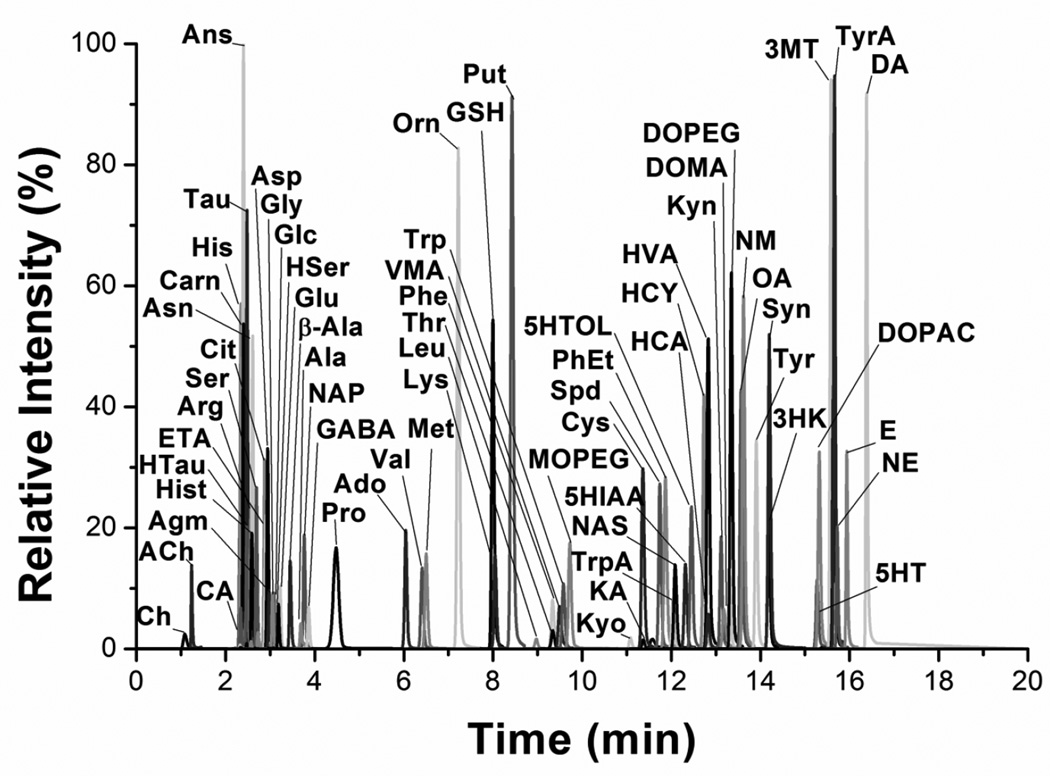
Widely targeted metabolomic assays are useful because they provide quantitative data on large groups of related compounds. We report a high performance liquid chromatography-tandem mass spectrometry (HPLC-MS/MS) method that utilizes benzoyl chloride labeling for 70 neurologically relevant compounds, including catecholamines, indoleamines, amino acids, polyamines, trace amines, antioxidants, energy compounds, and their metabolites. The method includes neurotransmitters and metabolites found in both vertebrates and insects. This method was applied to analyze microdialysate from rats, human cerebrospinal fluid, human serum, fly tissue homogenate, and fly hemolymph, demonstrating its broad versatility for multiple physiological contexts and model systems. Limits of detection for most assayed compounds were below 10nM, relative standard deviations were below 10%, and carryover was less than 5% for 70 compounds separated in 20min, with a total analysis time of 33min. This broadly applicable method provides robust monitoring of multiple analytes, utilizes small sample sizes, and can be applied to diverse matrices. The assay will be of value for evaluating normal physiological changes in metabolism in neurochemical systems. The results demonstrate the utility of benzoyl chloride labeling with HPLC-MS/MS for widely targeted metabolomics assays.
Keywords: Brain; Derivatization; Drosophila; HPLC; Mass spectrometry; Neurochemistry.
Copyright © 2016 Elsevier B.V. All rights reserved.
Figures
References
-
- Knee JM, Rzezniczak TZ, Barsch A, Guo KZ, Merritt TJS. A novel ion pairing LC/MS metabolomics protocol for study of a variety of biologically relevant polar metabolites. Journal of Chromatography B. 2013;936:63–73. - PubMed
-
- Michopoulos F, Whalley N, Theodoridis G, Wilson ID, Dunkley TPJ, Critchlow SE. Targeted profiling of polar intracellular metabolites using ion-pair-high performance liquid chromatography and -ultra high performance liquid chromatography coupled to tandem mass spectrometry: Applications to serum, urine and tissue extracts. Journal of Chromatography A. 2014;1349:60–68. - PubMed
-
- Virgiliou C, Sampsonidis I, Gika HG, Raikos N, Theodoridis GA. Development and validation of a HILIC-MS/MS multitargeted method for metabolomics applications. Electrophoresis. 2015;36:2215–2225. - PubMed
-
- Wei R, Li G, Seymour AB. High-throughput and multiplexed LC/MS/MRM method for targeted metabolomics. Analytical chemistry. 2010;82:5527–5533. - PubMed
-
- Yan Z, Yan R. Increase the accessibility and scale of targeted metabolomics: Construction of a human urinary metabolome-wide multiple reaction monitoring library using directly-coupled reversed-phase and hydrophilic interaction chromatography. Analytica Chimica Acta. 2015;894:65–75. - PubMed
MeSH terms
Substances
Grants and funding
LinkOut - more resources
Full Text Sources
Other Literature Sources
Molecular Biology Databases
