


Young People's Views and Experiences of a Mobile Phone Texting Intervention to Promote Safer Sex Behavior
- PMID: 27083784
- PMCID: PMC4851722
- DOI: 10.2196/mhealth.4302
Young People's Views and Experiences of a Mobile Phone Texting Intervention to Promote Safer Sex Behavior
Abstract
Background: The risk of poor sexual health, including unplanned pregnancy and sexually transmitted infections (STIs), is greatest amongst young people. Innovative and acceptable interventions to improve sexual health are required. Mobile phone text messaging (short message service, SMS) interventions have the potential to reach large numbers of people at relatively low cost, but greater understanding is needed on how these interventions should be developed and how they work.
Objectives: The aim of this paper is to explore young people's views of and experiences with a mobile phone text messaging intervention to promote safer sex behavior.
Methods: We undertook qualitative interviews with young people aged 16 to 24 years as part of a pilot trial of a sexual health intervention delivered by text message in the United Kingdom. Study participants received sexual health promotion text messages based on behavior-change techniques. The message content, tailored by gender and STI status, included support for correct STI treatment and promotion of safer sex behaviors. Young people were eligible if they had received a positive chlamydia test or had more than one partner and at least one episode of unprotected sex in the last year. Telephone interviews were conducted 2 to 3 weeks after initiation of the intervention. A semi-structured topic guide was followed to explore participant experiences and a thematic analysis was conducted.
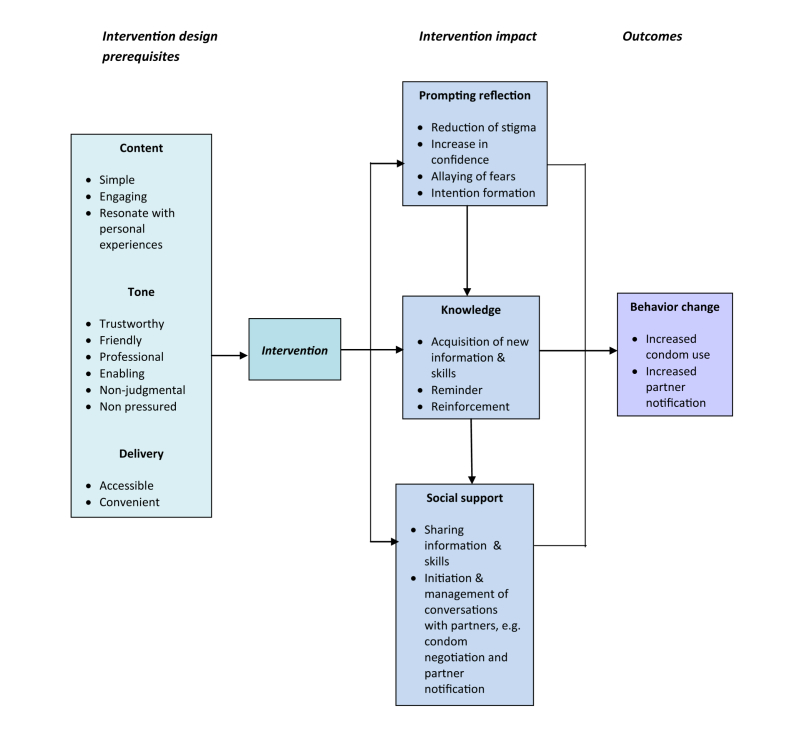
Results: We conducted 16 telephone interviews with participants who had received the text intervention and an additional four interviews with those in the control group (13 women and 7 men). Intervention participants found text messages easy to understand and appearing to come from a friendly and trustworthy source. They considered the frequency and timing of messages to be appropriate, and delivery via mobile phones convenient. Receipt of support by text message allowed recipients to assimilate information at their own pace, and prompted reflection on and sharing of messages with friends, family members, and partners, thus providing opportunities for education and discussion. For some recipients, the messages had increased their knowledge of how to correctly use condoms. Some described how the messages had increased their confidence and reduced stigma, enabling them to disclose infection to a partner and/or to do so sooner and more calmly. Discussing the messages with a partner reportedly enabled some women to negotiate condom use.
Conclusion: From the perspective of the recipients, the tone, frequency, and content of the text messaging-based sexual health intervention was acceptable and appropriate. Their accounts indicated that the intervention increased knowledge, confidence, and safer sex behaviors. A large-scale randomized controlled trial (RCT) is needed to assess effectiveness.
Keywords: behavior change; intervention; qualitative interviews; sexual behavior; sexual health; text messaging; young people.
Conflict of interest statement
Conflicts of Interest: None declared.
Figures
References
-
- Mercer CH, Tanton C, Prah P, Erens B, Sonnenberg P, Clifton S, Macdowall W, Lewis R, Field N, Datta J, Copas AJ, Phelps A, Wellings K, Johnson AM. Changes in sexual attitudes and lifestyles in Britain through the life course and over time: findings from the National Surveys of Sexual Attitudes and Lifestyles (Natsal) Lancet. 2013 Nov 30;382(9907):1781–94. doi: 10.1016/S0140-6736(13)62035-8. http://linkinghub.elsevier.com/retrieve/pii/S0140-6736(13)62035-8 S0140-6736(13)62035-8 - DOI - PMC - PubMed
-
- Wellings K, Jones KG, Mercer CH, Tanton C, Clifton S, Datta J, Copas AJ, Erens B, Gibson LJ, Macdowall W, Sonnenberg P, Phelps A, Johnson AM. The prevalence of unplanned pregnancy and associated factors in Britain: findings from the third National Survey of Sexual Attitudes and Lifestyles (Natsal-3) Lancet. 2013 Nov 30;382(9907):1807–16. doi: 10.1016/S0140-6736(13)62071-1. http://linkinghub.elsevier.com/retrieve/pii/S0140-6736(13)62071-1 S0140-6736(13)62071-1 - DOI - PMC - PubMed
-
- Sonnenberg P, Clifton S, Beddows S, Field N, Soldan K, Tanton C, Mercer CH, da Silva FC, Alexander S, Copas AJ, Phelps A, Erens B, Prah P, Macdowall W, Wellings K, Ison CA, Johnson AM. Prevalence, risk factors, and uptake of interventions for sexually transmitted infections in Britain: findings from the National Surveys of Sexual Attitudes and Lifestyles (Natsal) Lancet. 2013 Nov 30;382(9907):1795–806. doi: 10.1016/S0140-6736(13)61947-9. http://linkinghub.elsevier.com/retrieve/pii/S0140-6736(13)61947-9 S0140-6736(13)61947-9 - DOI - PMC - PubMed
-
- Shepherd J, Kavanagh J, Picot J, Cooper K, Harden A, Barnett-Page E, Jones J, Clegg A, Hartwell D, Frampton GK, Price A. The effectiveness and cost-effectiveness of behavioural interventions for the prevention of sexually transmitted infections in young people aged 13-19: a systematic review and economic evaluation. Health Technol Assess. 2010 Feb;14(7):1–206, iii. doi: 10.3310/hta14070. http://www.journalslibrary.nihr.ac.uk/hta/volume-14/issue-7 - DOI - PubMed
Grants and funding
LinkOut - more resources
Full Text Sources
Other Literature Sources
