Review
. 2016 Apr 15;30(8):881-91.
doi: 10.1101/gad.277863.116.

CTCF: making the right connections

Affiliations
Review

CTCF: making the right connections

Rodolfo Ghirlando et al. Genes Dev. .

Abstract

The role of the zinc finger protein CTCF in organizing the genome within the nucleus is now well established. Widely separated sites on DNA, occupied by both CTCF and the cohesin complex, make physical contacts that create large loop domains. Additional contacts between loci within those domains, often also mediated by CTCF, tend to be favored over contacts between loci in different domains. A large number of studies during the past 2 years have addressed the questions: How are these loops generated? What are the effects of disrupting them? Are there rules governing large-scale genome organization? It now appears that the strongest and evolutionarily most conserved of these CTCF interactions have specific rules for the orientation of the paired CTCF sites, implying the existence of a nonequilibrium mechanism of generation. Recent experiments that invert, delete, or inactivate one of a mating CTCF pair result in major changes in patterns of organization and gene expression in the surrounding regions. What remain to be determined are the detailed molecular mechanisms for re-establishing loop domains and maintaining them after replication and mitosis. As recently published data show, some mechanisms may involve interactions with noncoding RNAs as well as protein cofactors. Many CTCF sites are also involved in other functions such as modulation of RNA splicing and specific regulation of gene expression, and the relationship between these activities and loop formation is another unanswered question that should keep investigators occupied for some time.

Keywords: chromatin; insulators; topologically associated domains.


Figures

Figure 1.
Figure 1.
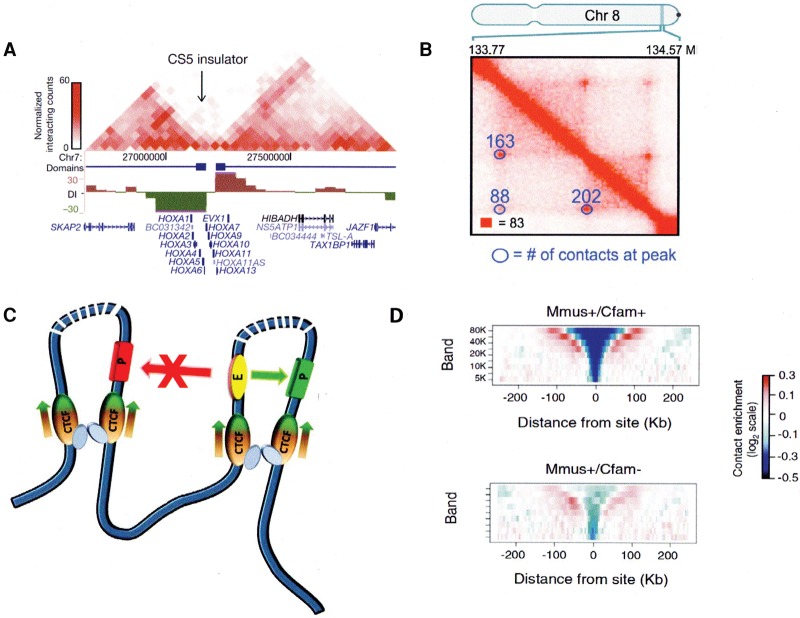
CTCF roles in domain organization within the nucleus. (A) TADs in the human HOXA locus, with a CTCF insulator site between them. (Adapted by permission from Macmillan Publishers Ltd. from Dixon et al. 2012.) (B) High-resolution Hi-C analysis of a small region of human chromosome 8 in GM12878 cells. Contact peaks are circled. (Adapted from Rao et al. 2014 with permission from Elsevier.) (C) Loop domains bordered by CTCF sites typically associated with cohesin. Interactions between enhancers and promoters within the same loop are favored; those between loops are blocked. At loops bordered by the strongest and most conserved CTCF sites, CTCF is oriented as shown, with the N terminus of each protein facing into the loop (see also Fig. 5, below). (D) Contact insulation analysis showing reduced frequency of contacts across CTCF boundary sites conserved between mice and dogs, compared with nonconserved sites. (Adapted from Vietri Rudan et al. 2015 with permission from Elsevier.)
Figure 2.
Figure 2.
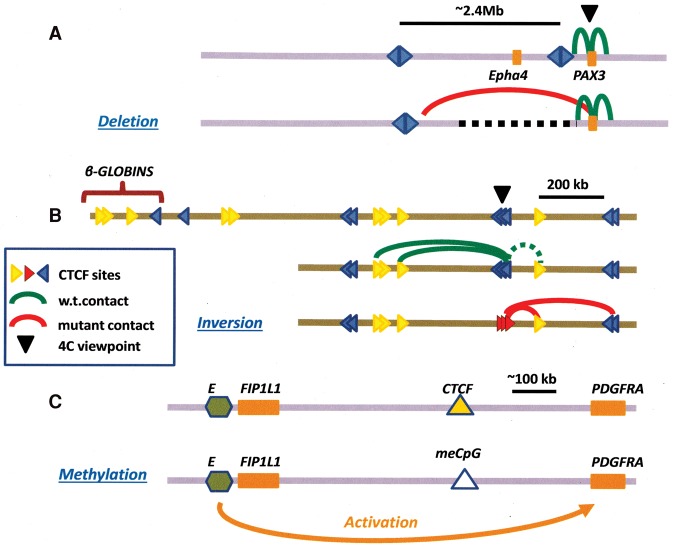
Effects of altering CTCF-binding sites on domain structure and gene expression. (A) Effect on 4C contacts of deleting DNA containing an insulator boundary near the mouse PAX3 gene, showing novel interactions with regions further upstream (Lupianez et al. 2015). Disruption of a TAD boundary had been shown earlier to cause ectopic chromosomal contacts and long-range transcriptional misregulation in the mouse Xist locus (Nora et al. 2012; see also Dowen et al. 2014). (B) Effect of inverting CTCF-binding sites on the pattern of 4C contacts near the mouse β-globin locus. The dotted green interaction line calls attention to the nonconvergent orientation of the CTCF sites marked by the blue triangles and the yellow one immediately downstream. After inversion, contacts between the red (inverted) sites and the yellow site actually strengthened despite the fact that the sites are not facing toward each other on the loop (Guo et al. 2015; see also de Wit et al. 2015) (C) Effect of methylation of a CTCF site on boundary activity. In certain human gliomas, the product of the mutated isocitrate dehydrogenase (IDH) gene interferes with DNA demethylation at a critical CTCF-binding site, resulting in loss of CTCF binding and insulation and inappropriate activation of the PDGFRA gene, a glioma oncogene, by a distal enhancer (green hexagon) (Flavahan et al. 2016).
Figure 3.
Figure 3.
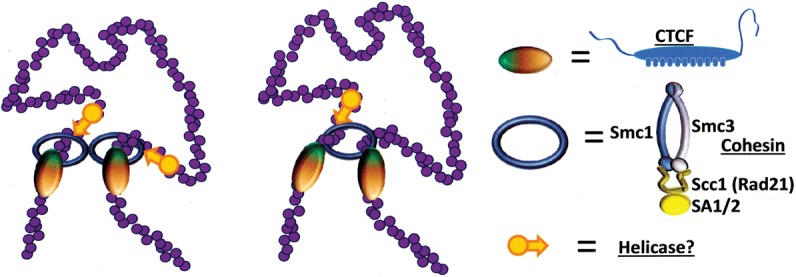
Proposed mechanisms (Sanborn et al. 2015) for generating loop domains terminated by convergently oriented CTCF sites (see Fig. 5, below). Cohesin bound to chromatin extrudes a loop and continues until it reaches a properly oriented CTCF site on each arm of the loop. It then stops searching; CTCF either comigrates with cohesin or is prebound, but cohesin is deposited only when CTCFs are properly oriented. Two possible configurations of cohesin are shown, corresponding to proposed models of cohesin interaction with chromatin (Nasmyth 2011). This process would require an energy source, suggested here to be an as yet unspecified helicase, shown as orange arrows.
Figure 4.
Figure 4.
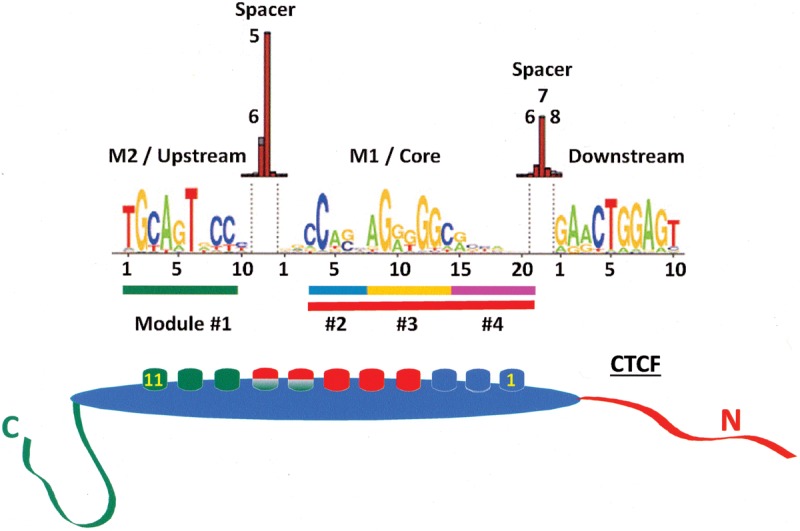
CTCF-binding motifs showing the M1/core that specifically engages fingers 4–8 and the M2/upstream sequence that engages fingers 7–11, with overlapping binding of the middle fingers to M1 and M2 (Nakahashi et al. 2013). Fingers not engaged in sequence-specific contacts may nonetheless contribute to overall binding stability through nonspecific interactions. Note that the sequence as shown binds CTCF with the N terminus facing downstream (Renda et al. 2007; Nakahashi et al. 2013). The DNA-binding modules described by Rhee and Pugh (2011) based on a ChIP-exo study are highlighted as colored bars at the bottom of the motif.
Figure 5.
Figure 5.
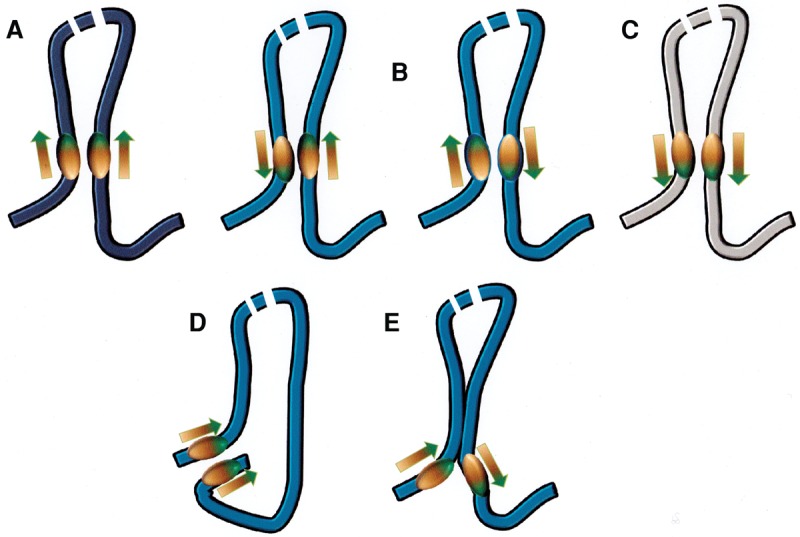
Orientation of CTCF-binding sites at the base of loops (Rao et al. 2014; Guo et al. 2015; Vietri Rudan et al. 2015). (A) The observed preferred convergent orientation for strong, conserved sites. (B) Two equivalent tandem orientations that occur with reduced frequency (see the text). (C) The divergent orientation, which appears to be disfavored. (D) “Coil” arrangement proposed (Tang et al. 2015) to explain how tandemly oriented sites might interact, assuming that where CTCF/cohesins contact each other, they have to align in parallel. (E) Although TADs are large and the energetic costs of deforming chromatin within a domain should be small, there could be cases in which other strong interactions near the base of a loop constrain conformations and make interactions between CTCF sites either less or more energetically favored.

References

    1. Agirre E, Bellora N, Allo M, Pages A, Bertucci P, Kornblihtt AR, Eyras E. 2015. A chromatin code for alternative splicing involving a putative association between CTCF and HP1α proteins. BMC Biol 13: 31. - PMC - PubMed
    1. Alipour E, Marko JF. 2012. Self-organization of domain structures by DNA-loop-extruding enzymes. Nucleic Acids Res 40: 11202–11212. - PMC - PubMed
    1. Arib G, Cleard F, Maeda RK, Karch F. 2015. Following the intracellular localization of the iab-8ncRNA of the bithorax complex using the MS2-MCP-GFP system. Mech Dev 138(Pt 2): 133–140. - PubMed
    1. Arnold R, Burcin M, Kaiser B, Muller M, Renkawitz R. 1996. DNA bending by the silencer protein NeP1 is modulated by TR and RXR. Nucleic Acids Res 24: 2640–2647. - PMC - PubMed
    1. Bell AC, Felsenfeld G. 2000. Methylation of a CTCF-dependent boundary controls imprinted expression of the Igf2 gene. Nature 405: 482–485. - PubMed

Publication types