Review
. 2016 Jun 13;82(13):3698-3710.
doi: 10.1128/AEM.01055-16. Print 2016 Jul 1.

Symbiotic Nitrogen Fixation and the Challenges to Its Extension to Nonlegumes

Affiliations
Review

Symbiotic Nitrogen Fixation and the Challenges to Its Extension to Nonlegumes

Florence Mus et al. Appl Environ Microbiol. .

Abstract

Access to fixed or available forms of nitrogen limits the productivity of crop plants and thus food production. Nitrogenous fertilizer production currently represents a significant expense for the efficient growth of various crops in the developed world. There are significant potential gains to be had from reducing dependence on nitrogenous fertilizers in agriculture in the developed world and in developing countries, and there is significant interest in research on biological nitrogen fixation and prospects for increasing its importance in an agricultural setting. Biological nitrogen fixation is the conversion of atmospheric N2 to NH3, a form that can be used by plants. However, the process is restricted to bacteria and archaea and does not occur in eukaryotes. Symbiotic nitrogen fixation is part of a mutualistic relationship in which plants provide a niche and fixed carbon to bacteria in exchange for fixed nitrogen. This process is restricted mainly to legumes in agricultural systems, and there is considerable interest in exploring whether similar symbioses can be developed in nonlegumes, which produce the bulk of human food. We are at a juncture at which the fundamental understanding of biological nitrogen fixation has matured to a level that we can think about engineering symbiotic relationships using synthetic biology approaches. This minireview highlights the fundamental advances in our understanding of biological nitrogen fixation in the context of a blueprint for expanding symbiotic nitrogen fixation to a greater diversity of crop plants through synthetic biology.


Figures

FIG 1
FIG 1
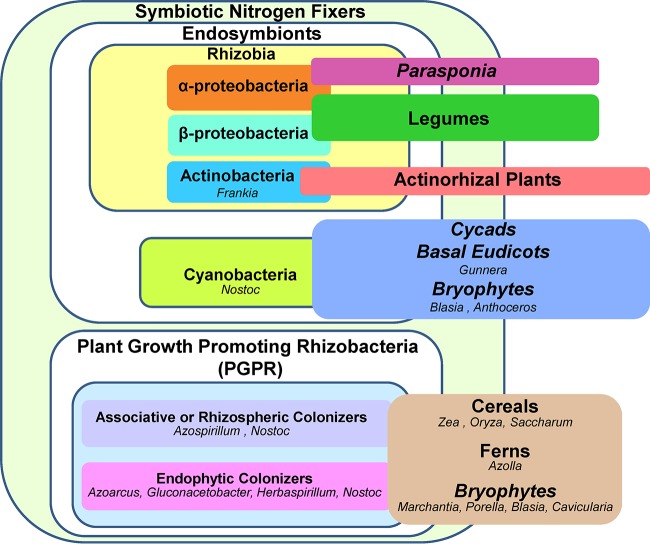
Schematic representation of the different associations between diazotrophs and plant hosts. Diazotrophs are divided in two main groups: root-nodule bacteria and plant growth-promoting rhizobacteria (PGPR). Root-nodule bacteria include rhizobia and Frankia. Rhizobia (alpha- and betaproteobacteria) enter into a symbiotic association with legumes and Frankia with actinorhizal plants. Alphaproteobacteria can also nodulate Parasponia species. Some plants develop endosymbiotic interactions with nitrogen-fixing cyanobacteria (Nostoc). PGPRs include proteobacteria (alpha-, beta-, and gammaproteobacteria), actinobacteria, bacilli, and cyanobacteria. Many PGPRs develop associative or endophytic associations with cereals. Some cyanobacteria found within plant tissues are classified as endophytes.
FIG 2
FIG 2
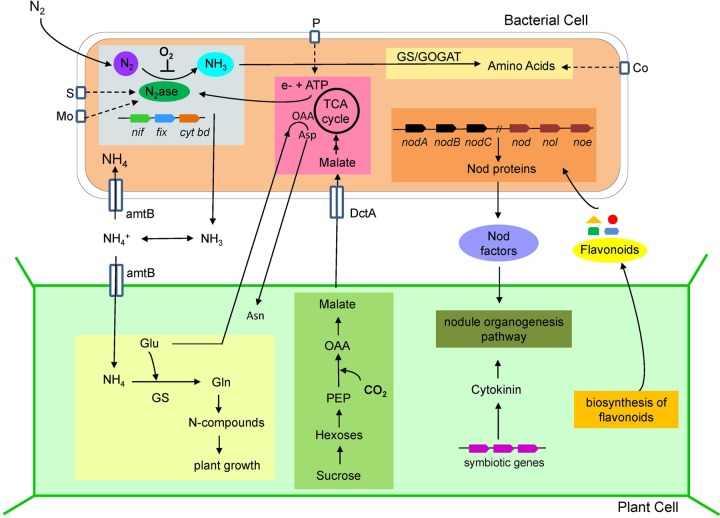
Schematic representation of partnership between a diazotrophic bacterial cell and a nodulating plant cell during symbiotic nitrogen fixation. Rhizobia induce the formation of nodules on legumes using either Nod factor-dependent or Nod factor-independent processes. In the Nod factor-dependent strategy, plants release signals, such as flavonoids, that are perceived by compatible bacteria in the rhizosphere. This activates the nodulation (nod) genes of rhizobia, which in turn synthesize and release bacterial signals, mainly lipochitooligosaccharides (LCOs) (Nod factors), which trigger early events in the nodulation process. Synthesis of the Nod factors backbone is controlled by the canonical nodABC genes, which are present in all rhizobia, but a combination of other nodulation genes (nod, nol, or noe) encode the addition of various decorations to the core structure. In the Nod factor-independent process, bacteria enter in the plant via cracks in the epidermis. Accumulation of cytokinin synthesized by the bacteria in these infection zones might trigger nodule organogenesis. In the mature nodule, bacteria progressively experience lower oxygen concentrations and differentiate into bacteroids, fixing diffused nitrogen gas using their nitrogenase enzyme complex. NH3 produced by nitrogenase from the bacteria (nif, fix, and cytochrome bd) can be incorporated into amino acids via the glutamine synthetase-glutamate synthase (GS-GOGAT) pathway. NH3 can also diffuse through the bacterial membrane and be transported to the plant cytoplasm via ammonia transporters (e.g., AmtB), where it is assimilated into nitrogen compounds (amino acids, proteins, and alkaloids) in exchange for food molecules, e.g., glucose, amino acids, and other saccharides. The plant provides amino acids to the bacterial cell and in return the bacterial cell cycles amino acids back to the plant for asparagine synthesis. Other nutrients have to be made available for the microbe, including phosphorus, sulfur, molybdenum, and cobalt. Asn, asparagine; Asp, aspartate; αKG, alpha ketoglutarate; AmtB, ammonia transporter; Co, cobalt; cyt bd, cytochrome bd; DctA, dicarboxylate transporter; Glu, glutamate; Gln, glutamine; GOGAT, glutamate synthase; GS, glutamine synthetase; HCO3, bicarbonate; Mo, molybdenum; NH3, ammonia; N2ase, nitrogenase; Nod factors, nodulation factors; NFR, Nod factor receptor; OAA, oxaloacetate; P, phosphorus; S, sulfur.
FIG 3
FIG 3
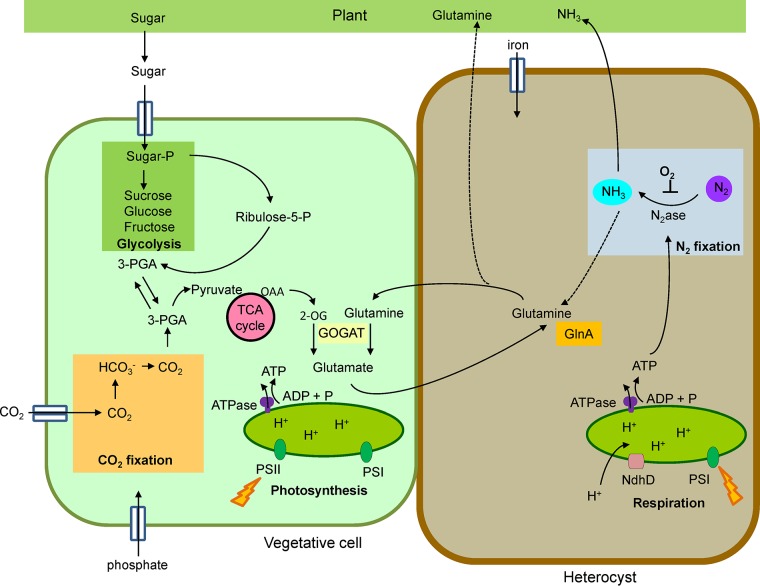
Schematic illustration of important metabolic pathways in associations of nitrogen-fixing cyanobacteria and host plant. The cell on the left represents a vegetative cell, while the cell on the right represents a nitrogen-fixing heterocyst. Important metabolic pathways in associations of nitrogen-fixing cyanobacteria and host plant are glycolysis, carbon fixation, photosynthesis, respiration, and nitrogen fixation. The nitrogen fixed in the heterocyst is incorporated via the GS-GOGAT pathway and used for the synthesis of amino acids, although during symbiosis, most nitrogen is exported to the plant as NH3. In exchange, sugars are provided by the host plant. GOGAT, glutamate synthase; GlnA, glutamine synthetase; HCO3, bicarbonate; NH3, ammonia; N2ase, nitrogenase; OAA, oxaloacetate; 3-PGA, polyglycolic acid; PGAL, phosphoglyceraldehyde.
FIG 4
FIG 4
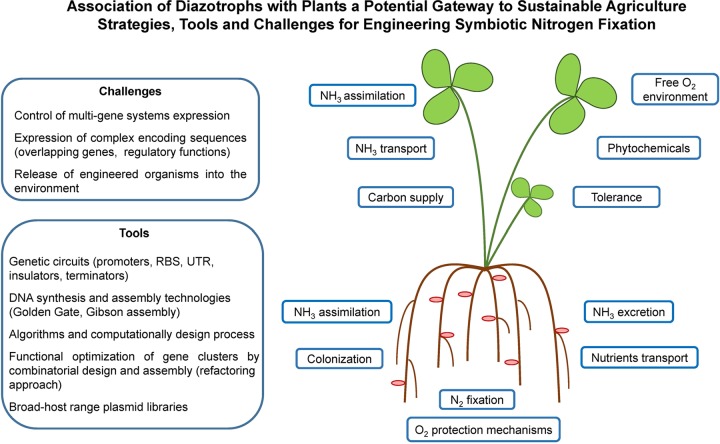
Association of diazotrophs with plants as a potential gateway to sustainable agriculture: strategies, tools, and challenges for engineering symbiotic nitrogen fixation. The availability of nitrogen is one of the principal elements limiting growth and development of crops. Nature solved the nitrogen limitation problem via the evolution of biological nitrogen fixation in diazotrophic bacteria, which reduce atmospheric nitrogen to ammonia (NH3) that is subsequently assimilated into biological molecules. Some plants, including most legumes and a few nonlegumes, have evolved the ability to form intimate nitrogen-fixing symbioses with diazotrophs, whereby large populations of diazotrophs are accommodated within living plant cells that provide nutrients to the bacteria in exchange for ammonia produced by nitrogenase. The plant host also protects oxygen-labile nitrogenase from inactivation by reducing free-oxygen. Several factors must be taken into account to engineer a synthetic nitrogen-fixing symbiosis: (i) optimization of the colonization process, (ii) engineering of synthetic nif clusters optimized for nitrogen fixation by microsymbionts, (iii) engineering of respiratory protection and O2-binding proteins to allow aerobic nitrogen fixation by microsymbionts, (iv) conditional suppression of ammonium assimilation by microsymbionts to ensure nitrogen delivery to plants, (v) ensured effective uptake of ammonium by plant cells, and (vi) optimization of carbon supply from root cells to endosymbiotic bacteria. One of the major limiting factors in engineering symbiotic nitrogen fixation is the challenge to control the expression of multigene systems and complex coding sequences. However, tools have been developed to modularize and control gene expression with precision (promoters, RBS, untranslated region [UTR], insulators, terminators, and broad-host-range plasmids). Nascent computer-aided design algorithms give engineers the ability to create and debug large multigene systems and build synthetic regulation. Intricate designs of large multigene systems are now realizable due to the rise of DNA synthesis and DNA assembly techniques. The use of engineered organisms also raises concerns about the release of genetically modified organisms and their DNA into the environment. Genome-scale engineering approaches can be applied to build safety controls to prevent the survival of genetically modified organisms in the environment and DNA release.

References

    1. Boyd ES, Peters JW. 2013. New insights into the evolutionary history of biological nitrogen fixation. Front Microbiol 4:201. doi:10.3389/fmicb.2013.00201. - DOI - PMC - PubMed
    1. Hardoim PR, van Overbeek LS, Berg G, Pirttilä AM, Compant S, Campisano A, Döring M, Sessitsch A. 2015. The hidden world within plants: ecological and evolutionary considerations for defining functioning of microbial endophytes. Microbiol Mol Biol Rev 79:293–320. doi:10.1128/MMBR.00050-14. - DOI - PMC - PubMed
    1. Santi C, Bogusz D, Franche C. 2013. Biological nitrogen fixation in non-legume plants. Ann Bot 111:743–767. doi:10.1093/aob/mct048. - DOI - PMC - PubMed
    1. Compant S, Clément C, Sessitsch A. 2010. Plant growth-promoting bacteria in the rhizo- and endosphere of plants: their role, colonization, mechanisms involved and prospects for utilization. Soil Biol Biochem 42:669–678. doi:10.1016/j.soilbio.2009.11.024. - DOI
    1. Schmid M, Hartmann A. 2007. Molecular phylogeny and ecology of root associated diazotrophic α- and β-proteobacteria, p 21–40. In Elmerich C, Newton W (ed), Associative and endophytic nitrogen-fixing bacteria and cyanobacterial associations. Springer; -Verlag New York, Inc., New York, NY.

Publication types