


Screening for Prostate Cancer Starting at Age 50-54 Years. A Population-based Cohort Study
- PMID: 27084245
- PMCID: PMC5061609
- DOI: 10.1016/j.eururo.2016.03.026
Screening for Prostate Cancer Starting at Age 50-54 Years. A Population-based Cohort Study
Abstract
Background: Current prostate cancer screening guidelines conflict with respect to the age at which to initiate screening.
Objective: To evaluate the effect of prostate-specific antigen (PSA) screening versus zero screening, starting at age 50-54 yr, on prostate cancer mortality.
Design, setting, and participants: This is a population-based cohort study comparing 3479 men aged 50 yr through 54 yr randomized to PSA-screening in the Göteborg population-based prostate cancer screening trial, initiated in 1995, versus 4060 unscreened men aged 51-55 yr providing cryopreserved blood in the population-based Malmö Preventive Project in the pre-PSA era, during 1982-1985.
Outcome measurements and statistical analysis: Cumulative incidence and incidence rate ratios of prostate cancer diagnosis, metastasis, and prostate cancer death.
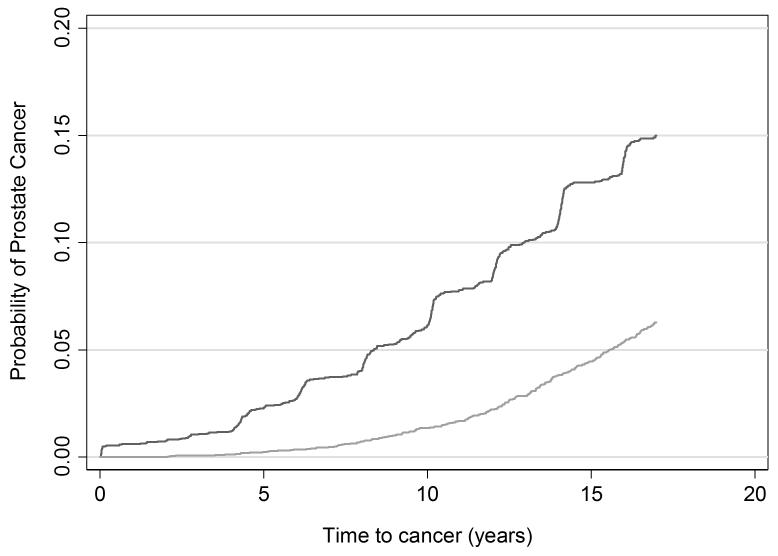
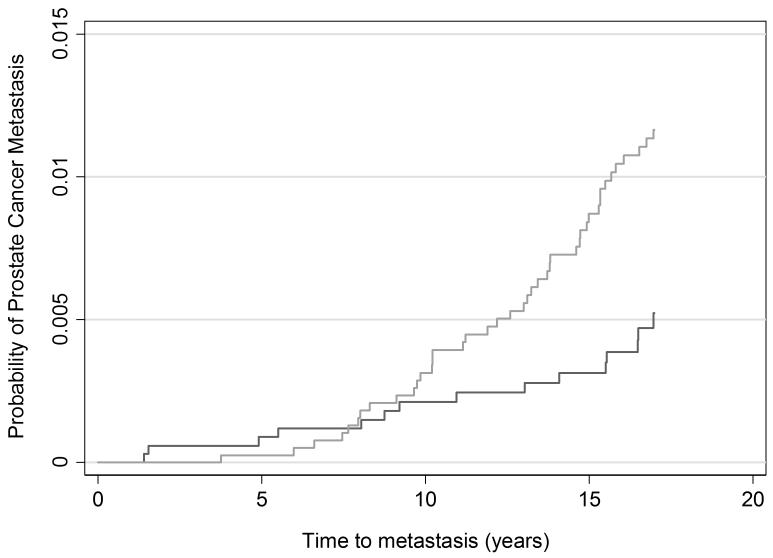
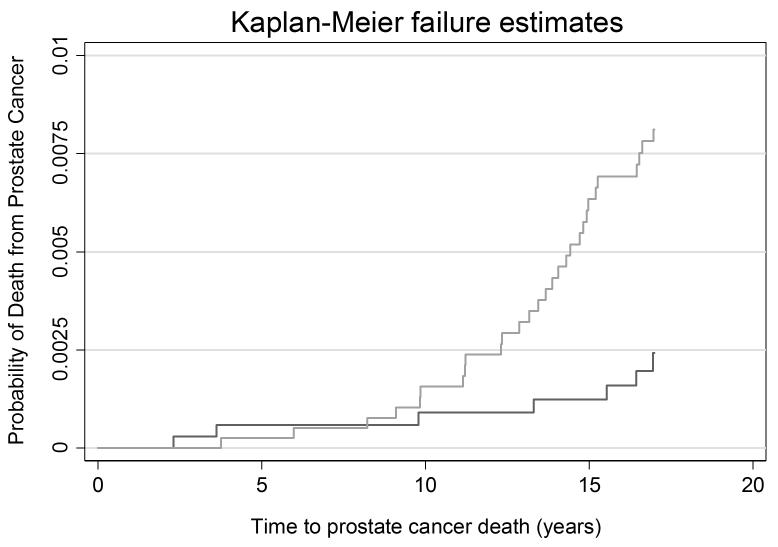
Results and limitations: At 17 yr, regular PSA-screening in Göteborg of men in their early 50s carried a more than two-fold higher risk of prostate cancer diagnosis compared with the unscreened men in Malmö (incidence rate ratio [IRR] 2.56, 95% confidence interval [CI] 2.18, 3.02), but resulted in a substantial decrease in the risk of metastases (IRR 0.43, 95% CI 0.22, 0.79) and prostate cancer death (IRR 0.29, 95% CI 0.11, 0.67). There were 57 fewer prostate cancer deaths per 10000 men (95% CI 22, 92) in the screened group. At 17 yr, the number needed to invite to PSA-screening and the number needed to diagnose to prevent one prostate cancer death was 176 and 16, respectively. The study is limited by lack of treatment information and the comparison of the two different birth cohorts.
Conclusions: PSA screening for prostate cancer can decrease prostate cancer mortality among men aged 50-54 yr, with the number needed to invite and number needed to detect to prevent one prostate cancer death comparable to those previously reported from the European Randomized Study of Screening for Prostate Cancer for men aged 55-69 yr, at a similar follow-up. Guideline groups could consider whether guidelines for PSA screening should recommend starting no later than at ages 50-54 yr.
Patient summary: Guideline recommendations about the age to start prostate-specific antigen screening could be discussed.
Keywords: Prostate cancer; Prostate-specific antigen; Screening.
Copyright © 2016. Published by Elsevier B.V.
Figures
Comment in
-
A Matched Cohort Analysis of Prostate Cancer Screening in Younger Men in Sweden.Eur Urol. 2017 Jan;71(1):53-54. doi: 10.1016/j.eururo.2016.04.006. Epub 2016 Apr 16. Eur Urol. 2017. PMID: 27090976 No abstract available.
References
-
- Moyer VA, U.S. Preventive Services Task Force Screening for prostate cancer: U.S. Preventive Services Task Force recommendation statement. Ann Intern Med. 2012;157:120–34. - PubMed
-
- Heidenreich A, Abrahamsson PA, Artibani W, et al. Early detection of prostate cancer: European Association of Urology recommendation. Eur Urol. 2013;64:347–54. - PubMed
-
- [Date accessed 2015-10-09];National Comprehensive Cancer Network prostate cancer screening guidelines. 2014 Available at: http://www.nccn.org/professionals/physician_gls/pdf/prostate_detection.pdf.
Publication types
MeSH terms
Substances
Grants and funding
LinkOut - more resources
Full Text Sources
Other Literature Sources
Medical
Research Materials
Miscellaneous
