


Results From the Imaging and Radiation Oncology Core Houston's Anthropomorphic Phantoms Used for Proton Therapy Clinical Trial Credentialing
- PMID: 27084644
- PMCID: PMC4834872
- DOI: 10.1016/j.ijrobp.2016.01.061
Results From the Imaging and Radiation Oncology Core Houston's Anthropomorphic Phantoms Used for Proton Therapy Clinical Trial Credentialing
Abstract
Purpose: The purpose of this study was to summarize the findings of anthropomorphic proton phantom irradiations analyzed by the Imaging and Radiation Oncology Core Houston QA Center (IROC Houston).
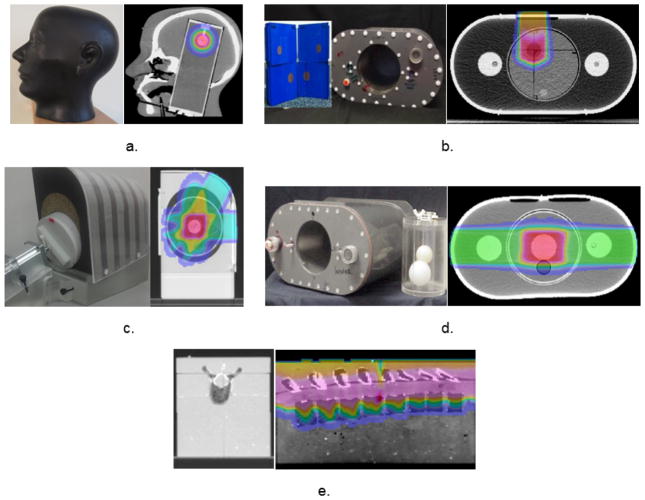
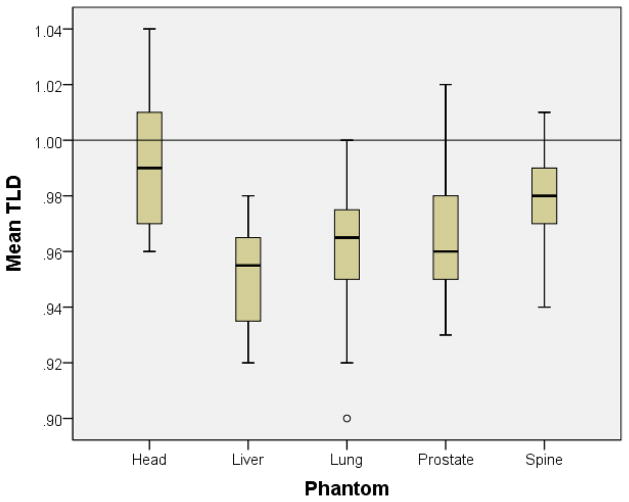
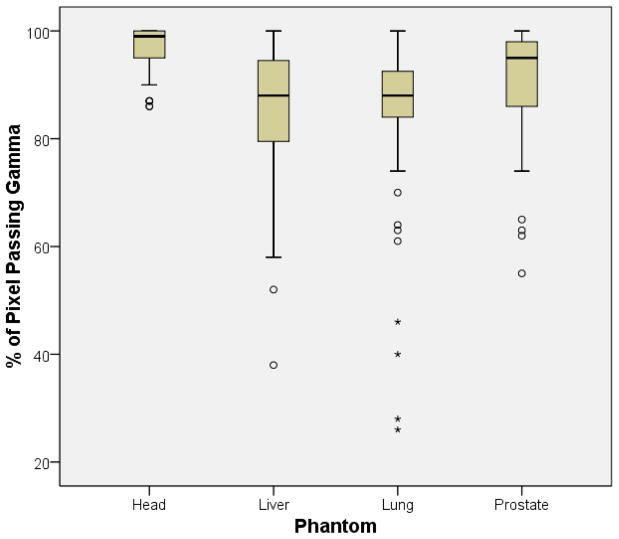
Methods and materials: A total of 103 phantoms were irradiated by proton therapy centers participating in clinical trials. The anthropomorphic phantoms simulated heterogeneous anatomy of a head, liver, lung, prostate, and spine. Treatment plans included those for scattered, uniform scanning, and pencil beam scanning beam delivery modalities using 5 different treatment planning systems. For every phantom irradiation, point doses and planar doses were measured using thermoluminescent dosimeters (TLD) and film, respectively. Differences between measured and planned doses were studied as a function of phantom, beam delivery modality, motion, repeat attempt, treatment planning system, and date of irradiation.
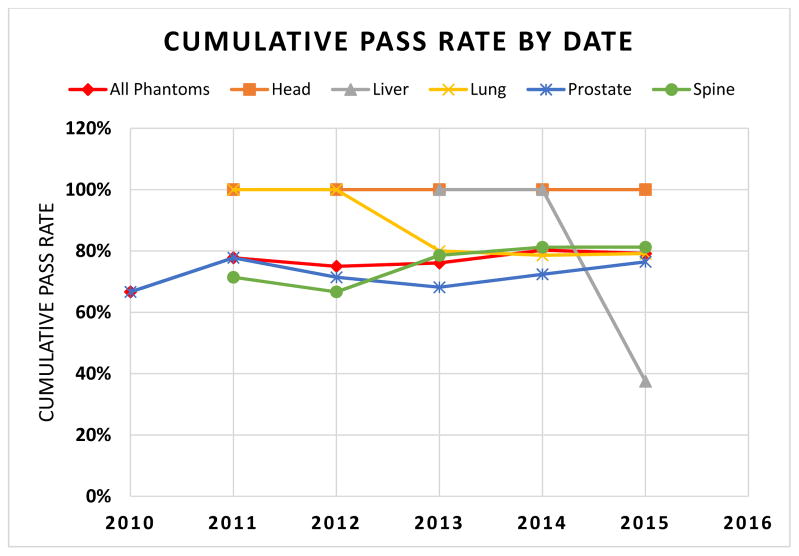
Results: The phantom pass rate (overall, 79%) was high for simple phantoms and lower for phantoms that introduced higher levels of difficulty, such as motion, multiple targets, or increased heterogeneity. All treatment planning systems overestimated dose to the target, compared to TLD measurements. Errors in range calculation resulted in several failed phantoms. There was no correlation between treatment planning system and pass rate. The pass rates for each individual phantom are not improving over time, but when individual institutions received feedback about failed phantom irradiations, pass rates did improve.
Conclusions: The proton phantom pass rates are not as high as desired and emphasize potential deficiencies in proton therapy planning and/or delivery. There are many areas for improvement with the proton phantom irradiations, such as treatment planning system dose agreement, range calculations, accounting for motion, and irradiation of multiple targets.
Published by Elsevier Inc.
Conflict of interest statement
Conflict of interest: None
Figures
References
-
- Bush DA, Slater JD, Garberoglio C, et al. Partial breast irradiation delivered with proton beam: results of a phase II trial. Clin Breast Cancer. 2011;11:241–245. - PubMed
-
- Mendenhall NP, Li Z, Hoppe BS, et al. Early outcomes from three prospective trials of image-guided proton therapy for prostate cancer. Int J Radiat Oncol Biol Phys. 2012;82:213–221. - PubMed
-
- Institute NC; Center IHQ, editor. Guidelines for the Use of Proton Radiation Therapy in NCI-Sponsored Cooperative Group Clinical Trials. 2012 irochouston.mdanderson.org.
-
- Ibbott GS, Molineu A, Followill DS. Independent evaluations of IMRT through the use of an anthropomorphic phantom. Technol Cancer Res Treat. 2006;5:481–487. - PubMed
Publication types
MeSH terms
Grants and funding
LinkOut - more resources
Full Text Sources
Other Literature Sources
Medical
