


Clinical Outcomes and Patterns of Disease Recurrence After Intensity Modulated Proton Therapy for Oropharyngeal Squamous Carcinoma
- PMID: 27084653
- PMCID: PMC5474303
- DOI: 10.1016/j.ijrobp.2016.02.021
Clinical Outcomes and Patterns of Disease Recurrence After Intensity Modulated Proton Therapy for Oropharyngeal Squamous Carcinoma
Abstract
Purpose: A single-institution prospective study was conducted to assess disease control and toxicity of proton therapy for patients with head and neck cancer.
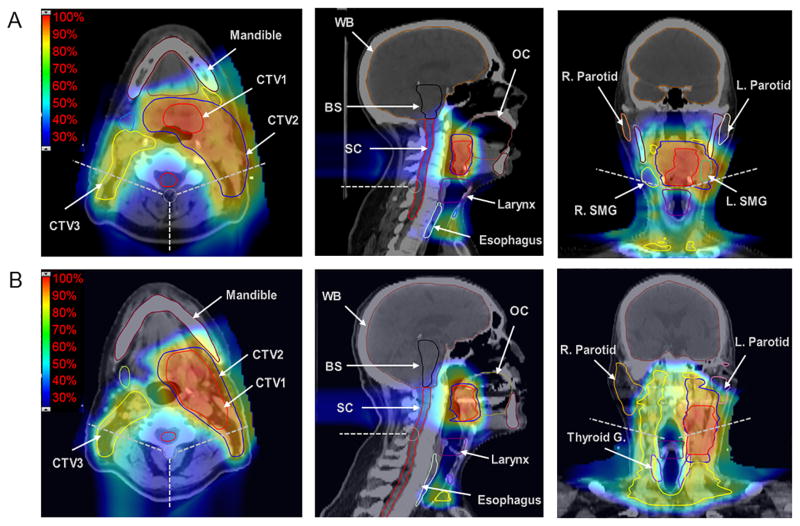
Methods and materials: Disease control, toxicity, functional outcomes, and patterns of failure for the initial cohort of patients with oropharyngeal squamous carcinoma (OPC) treated with intensity modulated proton therapy (IMPT) were prospectively collected in 2 registry studies at a single institution. Locoregional failures were analyzed by using deformable image registration.
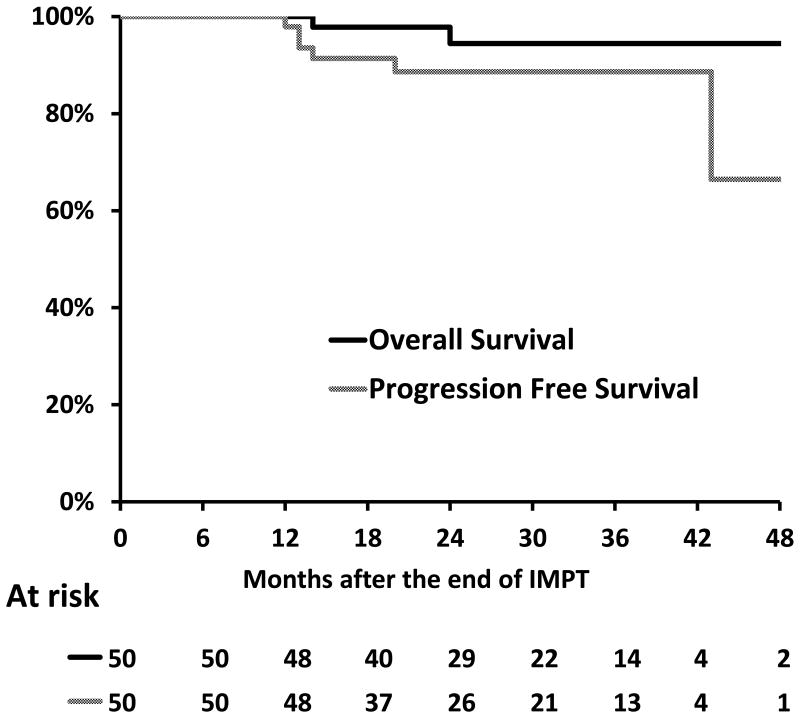
Results: Fifty patients with OPC treated from March 3, 2011, to July 2014 formed the cohort. Eighty-four percent were male, 50% had never smoked, 98% had stage III/IV disease, 64% received concurrent therapy, and 35% received induction chemotherapy. Forty-four of 45 tumors (98%) tested for p16 were positive. All patients received IMPT (multifield optimization to n=46; single-field optimization to n=4). No Common Terminology Criteria for Adverse Events grade 4 or 5 toxicities were observed. The most common grade 3 toxicities were acute mucositis in 58% of patients and late dysphagia in 12%. Eleven patients had a gastrostomy (feeding) tube placed during therapy, but none had a feeding tube at last follow-up. At a median follow-up time of 29 months, 5 patients had disease recurrence: local in 1, local and regional in 1, regional in 2, and distant in 1. The 2-year actuarial overall and progression-free survival rates were 94.5% and 88.6%.
Conclusions: The oncologic, toxicity, and functional outcomes after IMPT for OPC are encouraging and provide the basis for ongoing and future clinical studies.
Trial registration: ClinicalTrials.gov NCT01893307.
Copyright © 2016 Elsevier Inc. All rights reserved.
Conflict of interest statement
Figures
References
-
- Kandula S, Zhu X, Garden AS, et al. Spot-scanning beam proton therapy vs intensity-modulated radiation therapy for ipsilateral head and neck malignancies: A treatment planning comparison. Med Dosim. 2013;38:390–394. - PubMed
Publication types
MeSH terms
Associated data
Grants and funding
LinkOut - more resources
Full Text Sources
Other Literature Sources
Medical
