


Improving Outcomes for Esophageal Cancer using Proton Beam Therapy
- PMID: 27084662
- PMCID: PMC10862360
- DOI: 10.1016/j.ijrobp.2015.11.043
Improving Outcomes for Esophageal Cancer using Proton Beam Therapy
Abstract
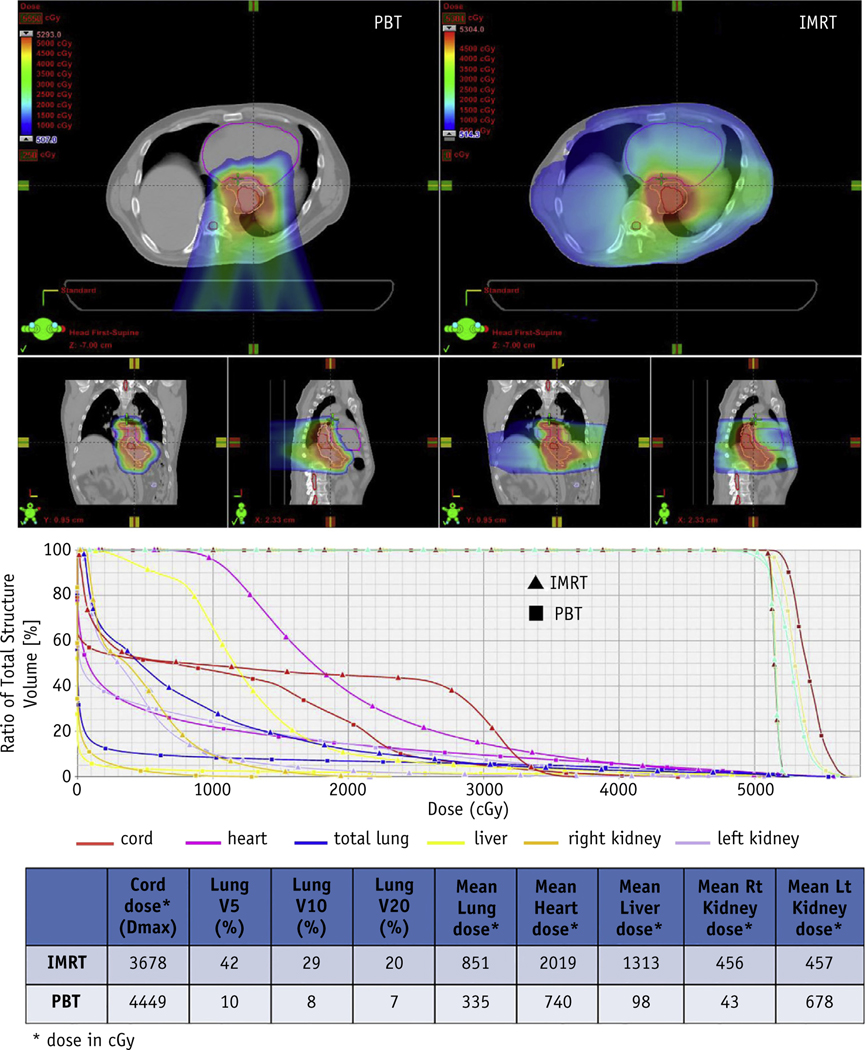
Radiation therapy (RT) plays an essential role in the management of esophageal cancer. Because the esophagus is a centrally located thoracic structure there is a need to balance the delivery of appropriately high dose to the target while minimizing dose to nearby critical structures. Radiation dose received by these critical structures, especially the heart and lungs, may lead to clinically significant toxicities, including pneumonitis, pericarditis, and myocardial infarction. Although technological advancements in photon RT delivery like intensity modulated RT have decreased the risk of such toxicities, a growing body of evidence indicates that further risk reductions are achieved with proton beam therapy (PBT). Herein we review the published dosimetric and clinical PBT literature for esophageal cancer, including motion management considerations, the potential for reirradiation, radiation dose escalation, and ongoing esophageal PBT clinical trials. We also consider the potential cost-effectiveness of PBT relative to photon RT.
Copyright © 2016 Elsevier Inc. All rights reserved.
Conflict of interest statement
Conflict of interest: none.
Figures
References
-
- Torre LA, Bray F, Siegel RL, et al. Global cancer statistics, 2012. CA Cancer J Clin 2015;65:87–108. - PubMed
-
- Siegel RL, Miller KD, Jemal A. Cancer statistics, 2015. CA Cancer J Clin 2015;65:5–29. - PubMed
-
- Shapiro J, van Lanschot JJ, Hulshof MC, et al. Neoadjuvant chemoradiotherapy plus surgery versus surgery alone for oesophageal or junctional cancer (CROSS): Long-term results of a randomised controlled trial. Lancet Oncol 2015;16:1090–1098. - PubMed
-
- Herskovic A, Martz K, al-Sarraf M, et al. Combined chemotherapy and radiotherapy compared with radiotherapy alone in patients with cancer of the esophagus. N Engl J Med 1992;326:1593–1598. - PubMed
Publication types
MeSH terms
Grants and funding
LinkOut - more resources
Full Text Sources
Other Literature Sources
Medical
