


Nicotine withdrawal alters neural responses to psychosocial stress
- PMID: 27087432
- PMCID: PMC4907902
- DOI: 10.1007/s00213-016-4299-5
Nicotine withdrawal alters neural responses to psychosocial stress
Abstract
Introduction: Psychosocial stress is considered to be an important mechanism underlying smoking behavior and relapse. Thus, understanding the effects of acute nicotine withdrawal on responses to stress is important to intervene to prevent stress-induced relapse. The current study investigated the neural correlates of psychosocial stress during acute nicotine withdrawal in chronic smokers.
Methods: Thirty-nine treatment-seeking smokers were randomized to one of two conditions (abstinent 24 h (n = 21) or smoking as usual (n = 18)). They were then exposed to the Montreal Imaging Stress Task (MIST), a psychosocial stress task consisting of difficult mental arithmetic problems while receiving negative performance feedback while undergoing functional magnetic resonance imaging (fMRI).
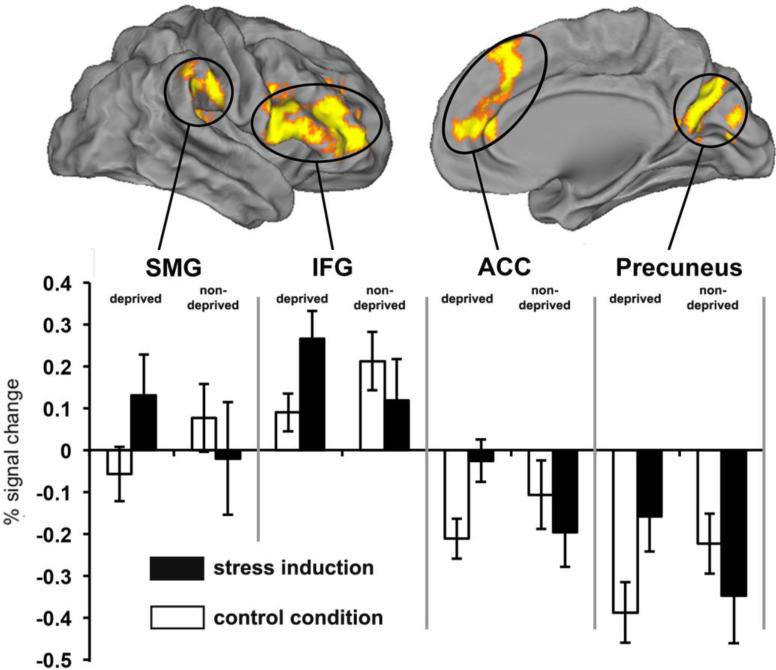
Results: Subjective measures of stress increased following the MIST, compared to baseline. Whole brain between-group analysis identified significant activation clusters in four regions for the stress induction minus control contrast: inferior frontal gyrus (IFG), anterior/para cingulate cortex (ACC), precuneus, and supramarginal gyrus (SMG). In all regions, the deprived group showed significantly greater activation compared to the non-deprived group. No significant correlations were found between subjective stress and BOLD signal activation (ps > 0.07).
Conclusions: This study provides new evidence that brain regions previously shown to be predictive of relapse, such as the precuneus and IFG, display heightened neural responses to stress during nicotine deprivation. These data identify the brain regions that may be associated with withdrawal-related stress responses. Increased stress-related activation during nicotine withdrawal may identify those most vulnerable to relapse and represent a target for novel pharmacological intervention.
Keywords: Imaging; Nicotine; Smoking; Stress; Withdrawal; fMRI.
Figures
References
-
- al'Absi M. Hypothalamic-pituitary-adrenocortical responses to psychological stress and risk for smoking relapse. Int J Psychophysiol. 2006;59:218–27. - PubMed
-
- al'Absi M, Amunrud T, Wittmers LE. Psychophysiological effects of nicotine abstinence and behavioral challenges in habitual smokers. Pharmacology, biochemistry, and behavior. 2002;72:707–16. - PubMed
-
- al'Absi M, Hatsukami D, Davis G. Attenuated adrenocorticotropic responses to psychological stress are associated with early smoking relapse. Psychopharmacology. 2005;181:107–17. - PubMed
-
- al'Absi M, Wittmers LE, Erickson J, Hatsukami D, Crouse B. Attenuated adrenocortical and blood pressure responses to psychological stress in ad libitum and abstinent smokers. Pharmacology Biochemistry and Behavior. 2003;74:401–410. - PubMed
Publication types
MeSH terms
Substances
Grants and funding
LinkOut - more resources
Full Text Sources
Other Literature Sources
Medical
