. 2016 Apr 21;165(3):730-41.
doi: 10.1016/j.cell.2016.03.041. Epub 2016 Apr 14.

Pooled ChIP-Seq Links Variation in Transcription Factor Binding to Complex Disease Risk

Affiliations

Pooled ChIP-Seq Links Variation in Transcription Factor Binding to Complex Disease Risk

Ashley K Tehranchi et al. Cell. .

Abstract

Cis-regulatory elements such as transcription factor (TF) binding sites can be identified genome-wide, but it remains far more challenging to pinpoint genetic variants affecting TF binding. Here, we introduce a pooling-based approach to mapping quantitative trait loci (QTLs) for molecular-level traits. Applying this to five TFs and a histone modification, we mapped thousands of cis-acting QTLs, with over 25-fold lower cost compared to standard QTL mapping. We found that single genetic variants frequently affect binding of multiple TFs, and CTCF can recruit all five TFs to its binding sites. These QTLs often affect local chromatin and transcription but can also influence long-range chromosomal contacts, demonstrating a role for natural genetic variation in chromosomal architecture. Thousands of these QTLs have been implicated in genome-wide association studies, providing candidate molecular mechanisms for many disease risk loci and suggesting that TF binding variation may underlie a large fraction of human phenotypic variation.


Figures

Figure 1
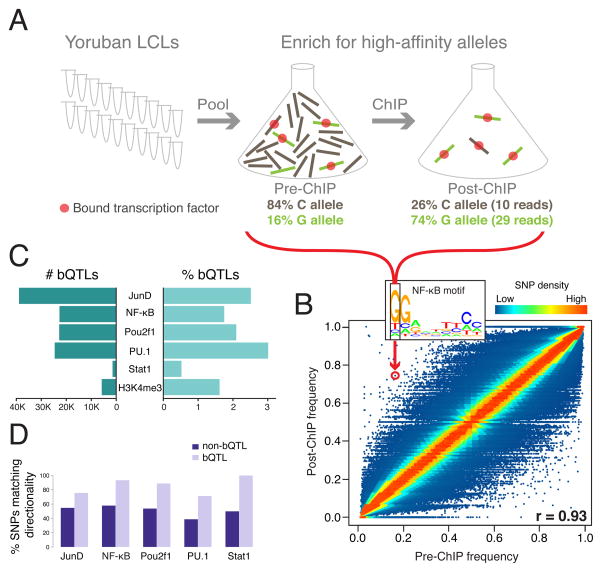
Figure 1. Outline and results of pooled ChIP-seq
A. Performing ChIP in a pool of individuals selects only the DNA molecules bound by a TF (or with a particular histone modification), thus enriching for high-affinity alleles. In this example, the G allele has a low pre-ChIP frequency but a high post-ChIP frequency, due to its higher affinity. The allele frequencies and read counts are for the SNP highlighted in panel B. B. For NF-κB, plotting pre-ChIP vs. post-ChIP allele frequencies shows that the vast majority of allele frequencies change very little, as expected. One SNP (rs10263017) significantly off the diagonal is highlighted. This SNP occurs in the boxed position of an NF-κB binding site motif, where the G allele has higher predicted affinity, consistent with the allele frequency shift. C. The number of independent bQTLs (after removing those in LD) (left), and the percent of all bound SNPs called as bQTLs (right). D. Directionality agreement between predicted effects of SNPs in TF binding motifs, and their observed associations. SNPs that are bound but have no allele frequency shift (p > 0.5) show ~50% agreement, as expected by chance; bQTL (p < 0.005) agreement is significantly higher. H3K4me3 has no motif, so is not included. All comparisons are significant at Fisher’s exact test p < 0.005 except for Stat1, due to its small number of bQTLs. See also Figure S1 and Table S1.
Figure 2
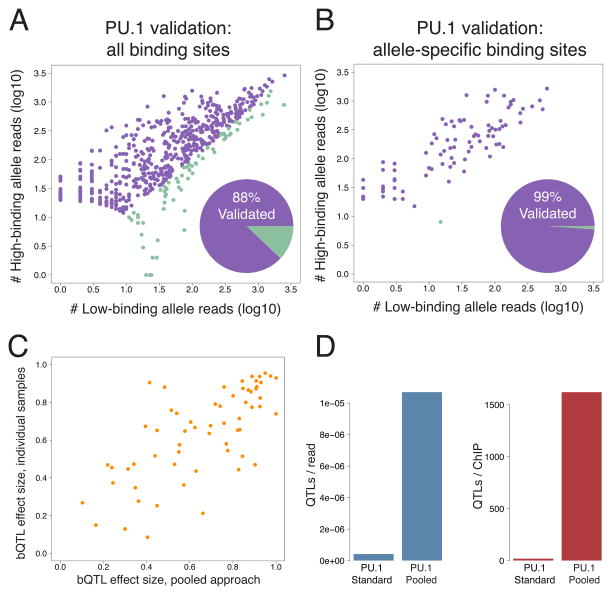
Figure 2. Comparing pooled bQTLs with ChIP-seq in individual samples
A. Examining allele-specific binding of PU.1 (measured in individual heterozygous samples) at 592 PU.1 bQTLs (Waszak et al., 2015), we found 88% directionality agreement. B. Comparing our PU.1 bQTLs to allele-specific binding at 89 SNPs previously reported as PU.1 bQTLs (Waszak et al., 2015), we found 99% directionality agreement. C. Effect sizes of our bQTLs compared to the strength of allelic bias summed across individual heterozygous samples. D. Number of PU.1 bQTLs per sequence read and per ChIP, at equivalent significance cutoffs for each data set. See also Figure S2.
Figure 3
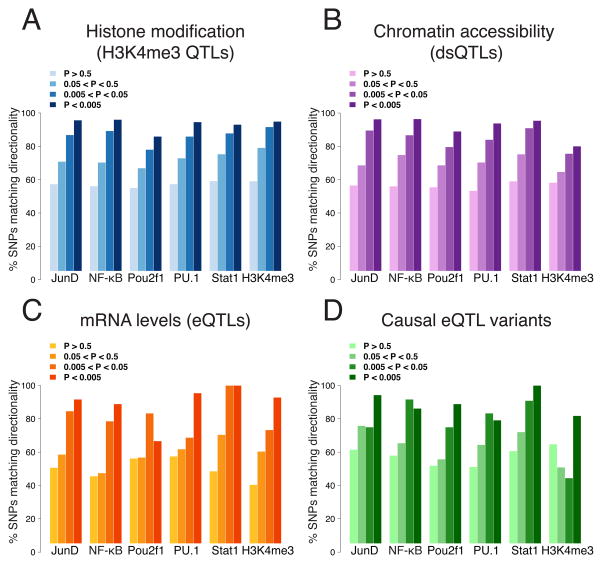
Figure 3. Comparisons with other molecular-level QTLs
For each type of previously published QTL, we calculated the degree of allelic concordance with our bQTLs. A. H3K4me3 QTLs (Grubert et al., 2015). B. dsQTLs (Degner et al., 2012). C. eQTLs (Lappalainen et al., 2013). D. Causal SNPs underlying eQTLs (R. Tewhey and P. Sabeti, pers. comm.). See also Figure S3.
Figure 4
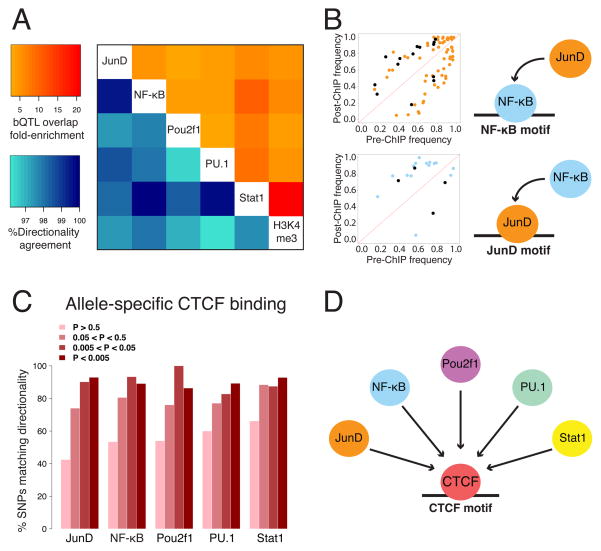
Figure 4. Causal relationships between TFs
A. For every pairwise combination of bQTLs, we calculated the enrichment of their overlaps (upper right, relative to bound SNPs that are not bQTLs), and the degree of allelic concordance among the overlaps (lower left). B. We tested whether SNPs in the binding motifs for one TF were predictive of binding of another TF. Scatter plots show allele frequencies before and after ChIP (as in Figure 1B), with those SNPs whose effect is in the direction predicted by the motif’s PWM colored to match the ChIP-ed TF, and those not matching colored black. C. Allelic bias of CTCF binding at heterozygous sites (Ding et al., 2014) generally agrees in direction with our bQTLs. See also Figure S4. D. Our model for CTCF as a major pioneer factor.
Figure 5
Figure 5. Long-range effects of bQTLs
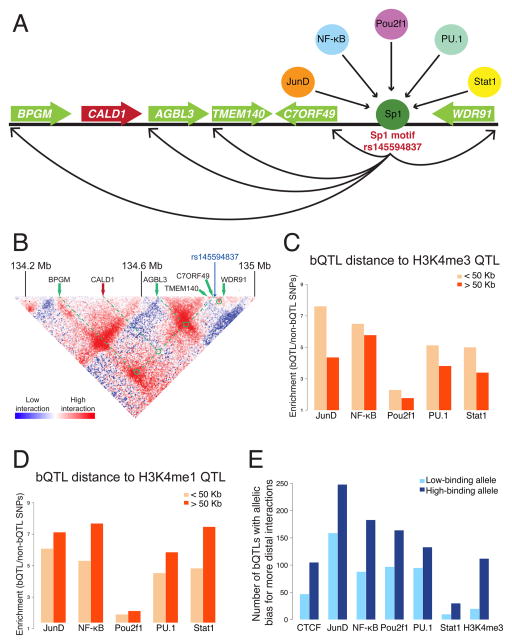
A. An example of a bQTL for all five TFs that affects the expression of five genes, including one (BPGM) 525 kb away. B. The pattern of chromosomal contacts around the bQTL shown above indicates high levels of interactions with the promoter regions of the distal genes that it affects. No enrichment is observed with CALD1, a gene within this region not affected by the bQTL. Color bar indicates the ratio of observed/expected contact, given the distance between loci (even though the deletion is not enriched more than expected for contacts with the two closest genes, C7ORF49 and TMEM140, there is still a high level of contact with these and other proximal loci). Hi-C data were normalized with the “balanced” method (Rao et al., 2014, see also Figure S5). C. Enrichment of bQTLs for local and distal hQTLs affecting H3K4me3 show a consistent bias for local effects. D. Enrichment of bQTLs for local and distal hQTLs affecting H3K4me1 show a consistent bias for distal effects. E. bQTLs affect the extent of long-range contacts. For each factor, the number of bQTLs where the higher-bound allele has more distal (>30 kb) interactions is plotted in dark blue, and the number where the lower-bound allele has more is plotted in light blue. The difference is significant in every case.
Figure 6
Figure 6. Effects of bQTLs on disease risk
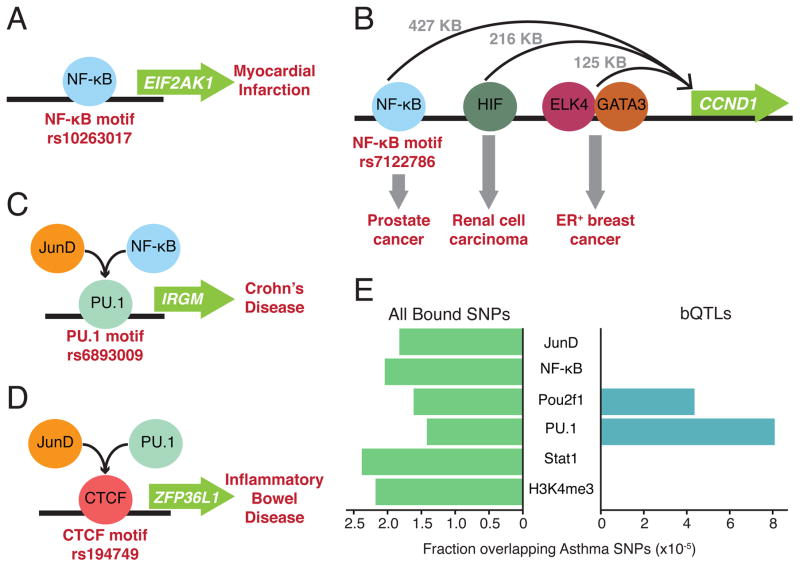
Each example involves a SNP in a TF binding motif that is also a bQTL, and is associated with disease risk. A. bQTL for NF-κB (highlighted in Figure 1B) in an NF-κB binding motif that is also an eQTL for EIF2AK1 and associated with myocardial infarction. B. bQTL for NF-κB in an NF-κB binding motif that is also an eQTL for CCND1 and is associated with prostate cancer. See also Figure S5. C. bQTL for PU.1, NF-κB, and JunD in a PU.1 binding motif that is also associated with Crohn’s disease. D. bQTL for JunD and PU.1 in a CTCF binding motif that is also associated with inflammatory bowel disease. E. Comparing enrichments for asthma-associated SNPs: all bound SNPs (left), and bQTLs (right). See also Figure S6 and Table S2.

Comment in

References

    1. Aittomäki S, Yang J, Scott EW, Simon MC, Silvennoinen O. Molecular basis of Stat1 and PU.1 cooperation in cytokine-induced Fcgamma receptor I promoter activation. Int Immunol. 2004;16:265–74. - PubMed
    1. Amin Al Olama A, Dadaev T, Hazelett DJ, Li Q, Leongamornlert D, et al. Multiple novel prostate cancer susceptibility signals identified by fine-mapping of known risk loci among Europeans. Hum Mol Genet. 2015 Advance online. - PMC - PubMed
    1. Ansel J, Bottin H, Rodriguez-Beltran C, Damon C, Nagarajan M, Fehrmann S, Francois J, Yvert G. Cell-to-cell stochastic variation in gene expression is a complex genetic trait. PLoS Genet. 2008;4:e1000049. - PMC - PubMed
    1. Banovich NE, et al. Methylation QTLs are associated with coordinated changes in transcription factor binding, histone modifications, and gene expression levels. PLoS Genet. 2014;10:e1004663. - PMC - PubMed
    1. Bonhoure N, et al. Quantifying ChIP-seq data, a spiking method providing an internal reference for sample-to-sample normalization. Genome Res. 2014;24:1157–68. - PMC - PubMed

Publication types

MeSH terms

Substances