


Microperimetric Assessment after Epiretinal Membrane Surgery: 4-Year Follow-Up
- PMID: 27088008
- PMCID: PMC4819098
- DOI: 10.1155/2016/7030791
Microperimetric Assessment after Epiretinal Membrane Surgery: 4-Year Follow-Up
Abstract
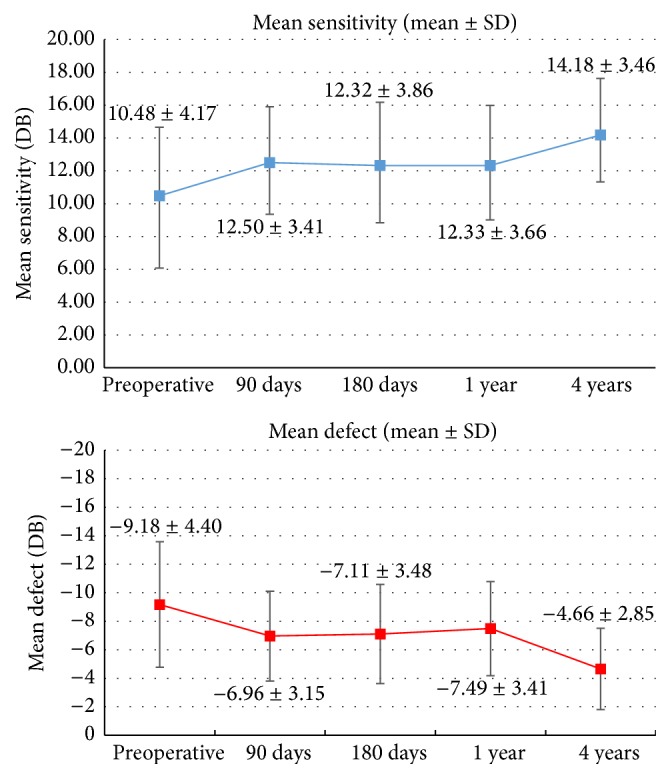
Purpose. To investigate retinal function using microperimetry in patients affected by idiopathic epiretinal membrane (iERM) and cataract who underwent combined surgery: 4-year follow-up. Design. Prospective, interventional case series. Methods. 30 eyes of 30 consecutive patients with iERM and age-related cataract underwent 25-gauge vitrectomy and cataract surgery. At baseline, 90 and 180 days, and 1 and 4 years, we examined retinal mean sensitivity (MS), retinal mean defect (MD), fixation stability, and frequency of microscotomas using MP1 microperimetry. Best-corrected visual acuity (BCVA) and central retinal thickness (CRT) using a spectral domain optical coherence tomography (SD-OCT) were also performed. Results. All patients completed 1-year follow-up, while 23 patients reached last follow-up. Baseline MS and MD (10.48 ± 4.17 and -9.18 ± 4.40 dB) significantly changed at one year (12.33 ± 3.66 and -7.49 ± 3.31 dB, p < 0.01), at four years (14.18 ± 3.46 and -4.66 ± 2.85, p < 0.01), and between one and four years (p < 0.01) after surgery. Compared to baseline, CRT and BCVA significantly changed at one year and remained stable at four years. No variations were observed in fixation stability and frequency of microscotomas compared to baseline. Conclusions. Long-term follow-up using microperimetry seems useful to evaluate patients after iERM surgery: retinal sensitivity changes even when BCVA and CRT remain stable.
Figures
References
-
- Rizzo S., Genovesi-Ebert F., Murri S., et al. 25-Gauge, sutureless vitrectomy and standard 20-gauge pars plana vitrectomy in idiopathic epiretinal membrane surgery: a comparative pilot study. Graefe's Archive for Clinical and Experimental Ophthalmology. 2006;244(4):472–479. doi: 10.1007/s00417-005-0173-6. - DOI - PubMed
LinkOut - more resources
Full Text Sources
Other Literature Sources
Research Materials
Miscellaneous
