


Scale-dependent effects of nonnative plant invasion on host-seeking tick abundance
- PMID: 27088044
- PMCID: PMC4827432
- DOI: 10.1002/ecs2.1317
Scale-dependent effects of nonnative plant invasion on host-seeking tick abundance
Abstract
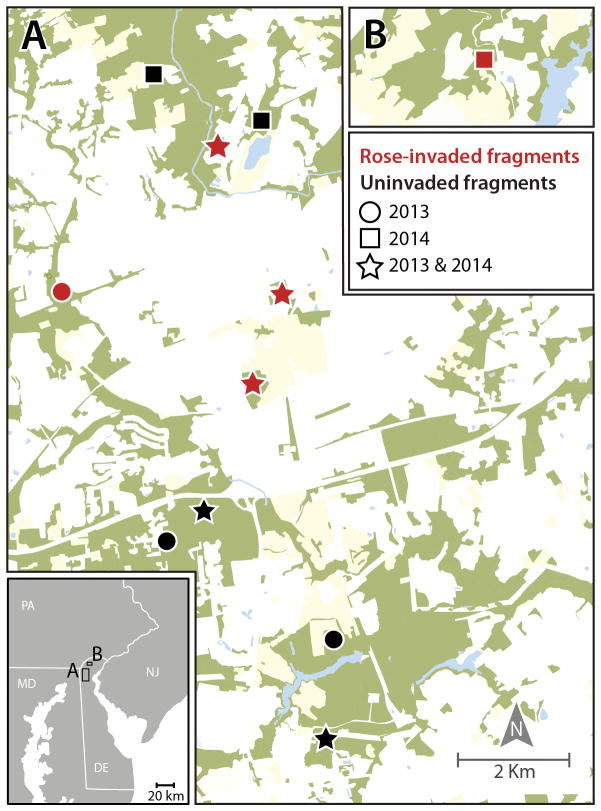
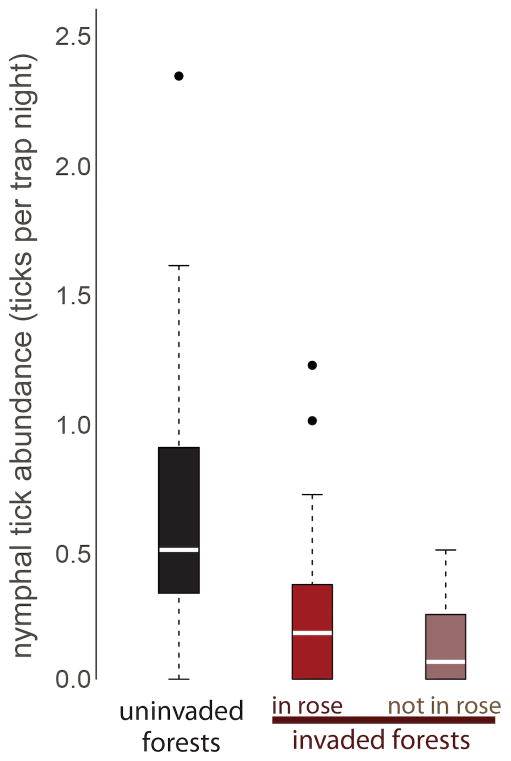
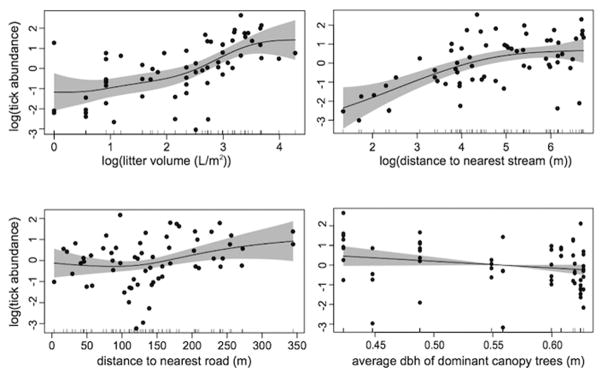
Nonnative, invasive shrubs can affect human disease risk through direct and indirect effects on vector populations. Multiflora rose (Rosa multiflora) is a common invader within eastern deciduous forests where tick-borne disease (e.g. Lyme disease) rates are high. We tested whether R. multiflora invasion affects blacklegged tick (Ixodes scapularis) abundance, and at what scale. We sampled host-seeking ticks at two spatial scales: fine-scale, within R. multiflora-invaded forest fragments; and patch scale, among R. multiflora-invaded and R. multiflora-free forest fragments. At a fine scale, we trapped 2.3 times more ticks under R. multiflora compared to paired traps 25 m away from R. multiflora. At the patch scale, we trapped 3.2 times as many ticks in R. multiflora-free forests compared to R. multiflora-invaded forests. Thus, ticks are concentrated beneath R. multiflora within invaded forests, but uninvaded forests support significantly more ticks. Among all covariates tested, leaf litter volume was the best predictor of tick abundance; at the patch scale, R. multiflora-invaded forests had less leaf litter than uninvaded forests. We suggest that leaf litter availability at the patch-scale plays a greater role in constraining tick abundance than the fine-scale, positive effect of invasive shrubs.
Keywords: Ixodes scapularis; Rosa multiflora; forest fragmentation; invasive species; nonnative plant; scale.
Figures
References
-
- Ashton IW, Hyatt LA, Howe KM, Gurevitch J, Lerdau MT. Invasive species accelerate decomposition and litter nitrogen loss in a mixed deciduous forest. Ecological Applications. 2005;15:1263–1272.
-
- Bacon R, Kugeler K, Mead P. Surveillance for Lyme disease--United States, 1992–2006. Centers for Disease Control and Prevention; USA: 2008. http://www.cdc.gov/MMWR/PREVIEW/MMWRHTML/ss5710a1.htm. - PubMed
-
- Beauséjour R, I, Handa T, Lechowicz MJ, Gilbert B, Vellend M. Historical anthropogenic disturbances influence patterns of non-native earthworm and plant invasions in a temperate primary forest. Biological Invasions. 2015;17:1267–1281.
-
- Belote RT, Jones RH. Tree leaf litter composition and nonnative earthworms influence plant invasion in experimental forest floor mesocosms. Biological Invasions. 2009;11:1045–1052.
Grants and funding
LinkOut - more resources
Full Text Sources
Other Literature Sources