


Taxonomies of Timing: Where Does the Cerebellum Fit In?
- PMID: 27088121
- PMCID: PMC4831717
- DOI: 10.1016/j.cobeha.2016.02.034
Taxonomies of Timing: Where Does the Cerebellum Fit In?
Abstract
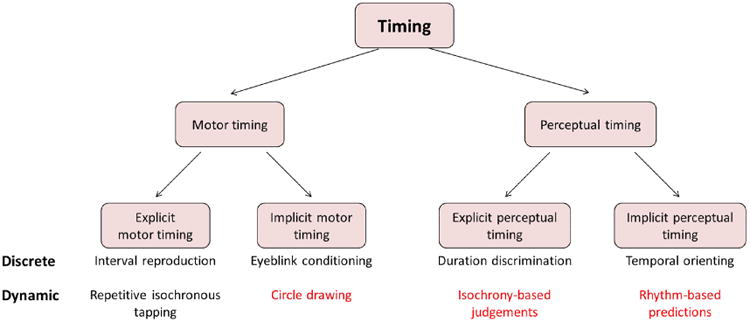
Recent models of interval timing have emphasized local, modality-specific processes or a core network centered on a cortico-thalamic-striatal circuit, leaving the role of the cerebellum unclear. We examine this issue, using current taxonomies of timing as a guide to review the association of the cerebellum in motor and perceptual tasks in which timing information is explicit or implicit. Evidence from neuropsychological, neurophysiological, and neuroimaging studies indicates that the involvement of the cerebellum in timing is not restricted to any subdomain of this taxonomy. However, an emerging pattern is that tasks in which timing is done in cyclic continuous contexts do not rely on the cerebellum. In such scenarios, timing may be an emergent property of system dynamics, and especially oscillatory entrainment. The cerebellum may be necessary to time discrete intervals in the absence of continuous cyclic dynamics.
Figures
References
-
- Kant I. Critique of pure reason. Cambridge: Cambridge University Press; 1781/1999.
-
- Treisman M. Temporal discrimination and the indifference interval: Implications for a model of the “internal clock”. Psychological Monographs. 1963;77:1–31. - PubMed
-
- Gibbon J, Church RM, Meck WH. Scalar timing in memory. Ann NY Acad Sci. 1984;423:52–77. - PubMed
-
- Keele SW, Pokorny RA, Corcos DM, Ivry RB. Do perception and motor production share common timing mechanisms: a correctional analysis. Acta Psychol (Amst) 1985;60(2–3):173–191. - PubMed
-
- Ivry RB, Hazeltine RE. The perception and production of temporal intervals across a range of durations: evidence for a common timing mechanism. J Exp Psycho Hum Percept Perform. 1995;21:1–12. - PubMed
Grants and funding
LinkOut - more resources
Full Text Sources
Other Literature Sources