


Health Insurance Trends in United States Living Kidney Donors (2004 to 2015)
- PMID: 27088263
- PMCID: PMC5069113
- DOI: 10.1111/ajt.13827
Health Insurance Trends in United States Living Kidney Donors (2004 to 2015)
Abstract
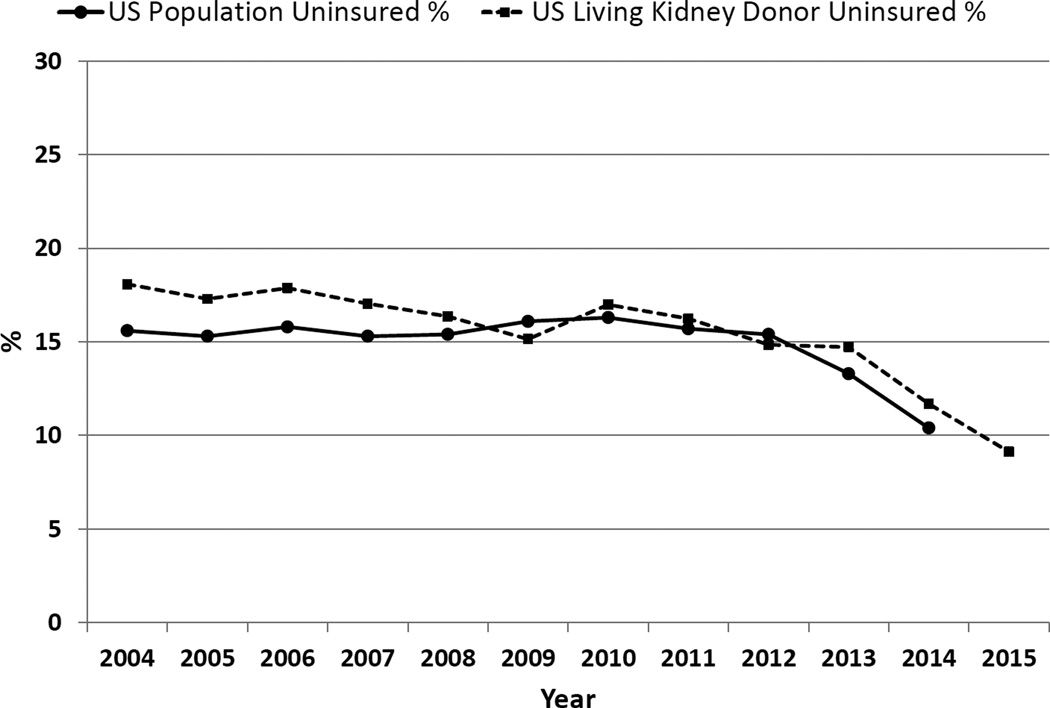
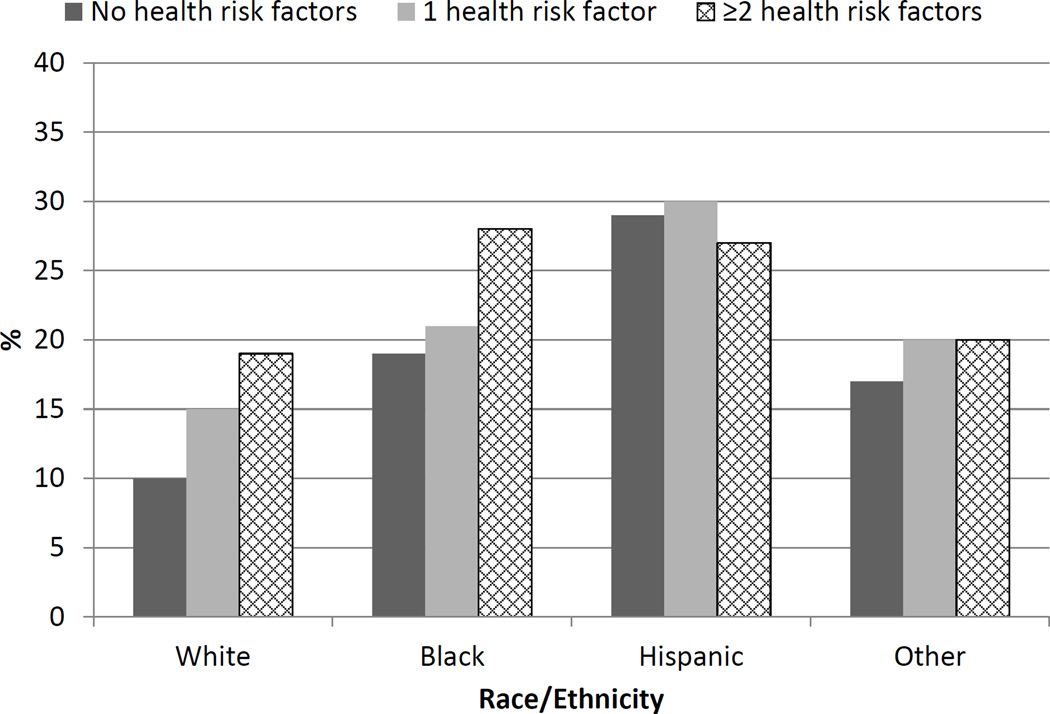
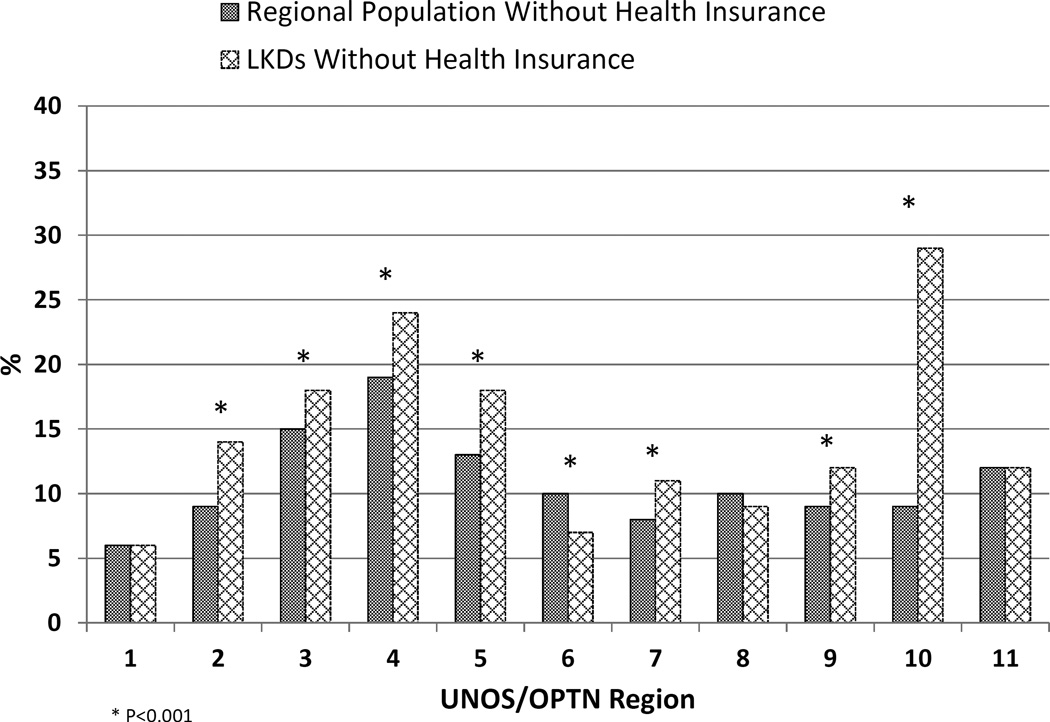
Some transplant programs consider the lack of health insurance as a contraindication to living kidney donation. Still, prior studies have shown that many adults are uninsured at time of donation. We extend the study of donor health insurance status over a longer time period and examine associations between insurance status and relevant sociodemographic and health characteristics. We queried the United Network for Organ Sharing/Organ Procurement and Transplantation Network registry for all living kidney donors (LKDs) between July 2004 and July 2015. Of the 53 724 LKDs with known health insurance status, 8306 (16%) were uninsured at the time of donation. Younger (18 to 34 years old), male, minority, unemployed, less educated, unmarried LKDs and those who were smokers and normotensive were more likely to not have health insurance at the time of donation. Compared to those with no health risk factors (i.e. obesity, smoking, hypertension, estimated glomerular filtration rate <60, proteinuria) (14%), LKDs with 1 (18%) or ≥2 (21%) health risk factors at the time of donation were more likely to be uninsured (p < 0.0001). Among those with ≥2 health risk factors, blacks (28%) and Hispanics (27%) had higher likelihood of being uninsured compared to whites (19%; p < 0.001). Study findings underscore the importance of providing health insurance benefits to all previous and future LKDs.
Keywords: donors and donation; donors and donation: living, insurance; ethics and public policy; health services and outcomes research; kidney transplantation/nephrology.
© Copyright 2016 The American Society of Transplantation and the American Society of Transplant Surgeons.
Conflict of interest statement
The authors of this manuscript have no conflicts of interest to disclose as described by the American Journal of Transplantation.
Figures
References
-
- OPTN (Organ Procurement and Transplantation Network)/UNOS (United Network for Organ Sharing) OPTN Policies, Policy 14: Living Donation. [Accessed on February 02, 2016]; http://optn.transplant.hrsa.gov/ContentDocuments/OPTN_Policies.pdf.
-
- Dew MA, Jacobs CL, Jowsey SG, Hanto R, Miller C, Delmonico FL United Network for Organ Sharing (UNOS); American Society of Transplant Surgeons; American Society of Transplantation. Guidelines for the psychosocial evaluation of living unrelated kidney donors in the United States. Am J Transplant. 2007;7:1047–1054. - PubMed
-
- Mandelbrot DA, Pavlakis M, Danovitch GM, Johnson SR, Karp SJ, Khwaja K, Hanto DW, Rodrigue JR. The medical evaluation of living kidney donors: a survey of US transplant centers. Am J Transplant. 2007;7:2333–2343. - PubMed
-
- Rodrigue JR, Pavlakis M, Danovitch GM, Johnson SR, Karp SJ, Khwaja K, Hanto DW, Mandelbrot DA. Evaluating living kidney donors: relationship types, psychosocial criteria, and consent processes at US transplant programs. Am J Transplant. 2007;7:2326–2332. - PubMed
-
- Thiessen C, Kim YA, Formica R, Bia M, Kulkarni S. Written informed consent for living kidney donors: practices and compliance with CMS and OPTN requirements. Am J Transplant. 2013;13:2713–2721. - PubMed
Publication types
MeSH terms
Grants and funding
LinkOut - more resources
Full Text Sources
Other Literature Sources
Medical
