Projecting Month of Birth for At-Risk Infants after Zika Virus Disease Outbreaks
- PMID: 27088494
- PMCID: PMC4861542
- DOI: 10.3201/eid2205.160290
Projecting Month of Birth for At-Risk Infants after Zika Virus Disease Outbreaks
Abstract
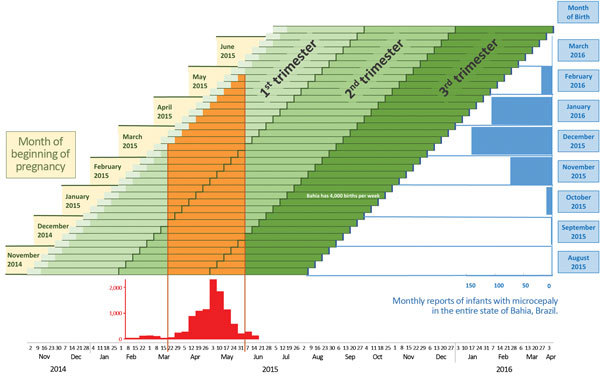
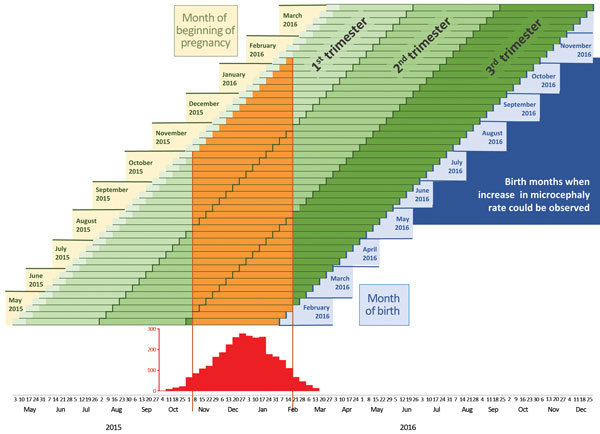
The marked increase in infants born with microcephaly in Brazil after a 2015 outbreak of Zika virus (Zika virus) disease suggests an association between maternal Zika virus infection and congenital microcephaly. To project the timing of delivery of infants born to mothers infected during early pregnancy in 1 city in Bahia State, Brazil, we incorporated data on reported Zika virus disease cases and microcephaly cases into a graphical schematic of weekly birth cohorts. We projected that these births would occur through February 2016. Applying similar projections to a hypothetical location at which Zika virus transmission started in November, we projected that full-term infants at risk for Zika virus infection would be born during April-September 2016. We also developed a modifiable spreadsheet tool that public health officials and researchers can use for their countries to plan for deliveries of infants to women who were infected with Zika virus during different pregnancy trimesters.
Keywords: Brazil; ZIKAV; Zika virus; birth defects; flavivirus; microcephaly; pregnancy; vector-borne infections; viruses.
Figures
References
-
- Pan American Health Organization, World Health Organization. Epidemiological alert: neurologic syndrome, congenital malformations, and ZIKAV infection. Implications for public health in the Americas, 1 December 2015. [cited 2016 Feb 6]. http://reliefweb.int/sites/reliefweb.int/files/resources/2015-dec-1-cha-...
MeSH terms
LinkOut - more resources
Full Text Sources
Other Literature Sources
Medical
Miscellaneous