. 2016 May 26;59(10):5011-21.
doi: 10.1021/acs.jmedchem.6b00372. Epub 2016 May 5.

Structure-Activity Relationship for the 4(3H)-Quinazolinone Antibacterials

Affiliations

Structure-Activity Relationship for the 4(3H)-Quinazolinone Antibacterials

Renee Bouley et al. J Med Chem. .

Abstract

We recently reported on the discovery of a novel antibacterial (2) with a 4(3H)-quinazolinone core. This discovery was made by in silico screening of 1.2 million compounds for binding to a penicillin-binding protein and the subsequent demonstration of antibacterial activity against Staphylococcus aureus. The first structure-activity relationship for this antibacterial scaffold is explored in this report with evaluation of 77 variants of the structural class. Eleven promising compounds were further evaluated for in vitro toxicity, pharmacokinetics, and efficacy in a mouse peritonitis model of infection, which led to the discovery of compound 27. This new quinazolinone has potent activity against methicillin-resistant (MRSA) strains, low clearance, oral bioavailability and shows efficacy in a mouse neutropenic thigh infection model.


Conflict of interest statement

The authors declare no competing financial interest.

Figures
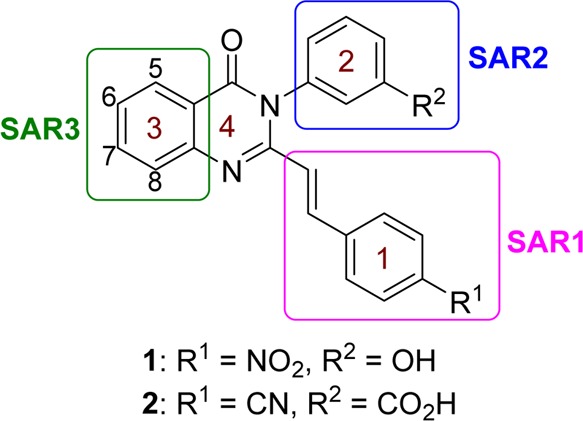
Figure 1
Figure 1
Structures of quinazolinones 1 and 2 are given. The sites for structure diversification under SAR1, SAR2, and SAR3 are highlighted by the colored boxes. Numbering of carbons on ring 3 is shown.
Scheme 1
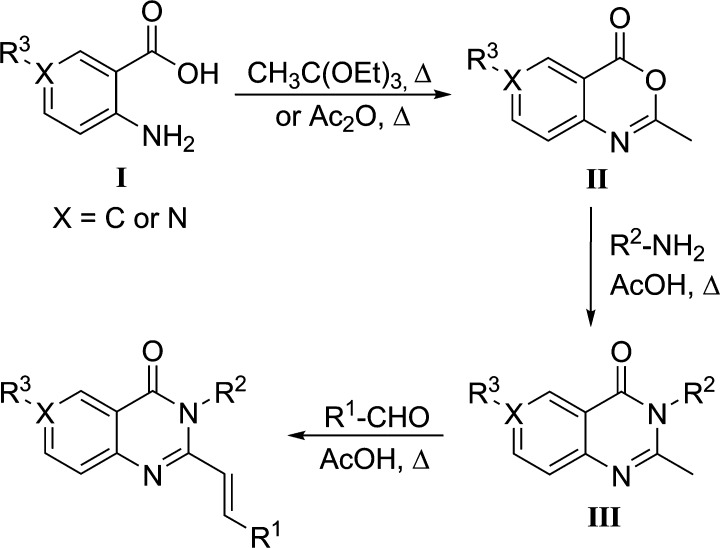
Scheme 1. General Three-Step Synthetic Route for the Quinazolinones Prepared in This Report
Figure 2
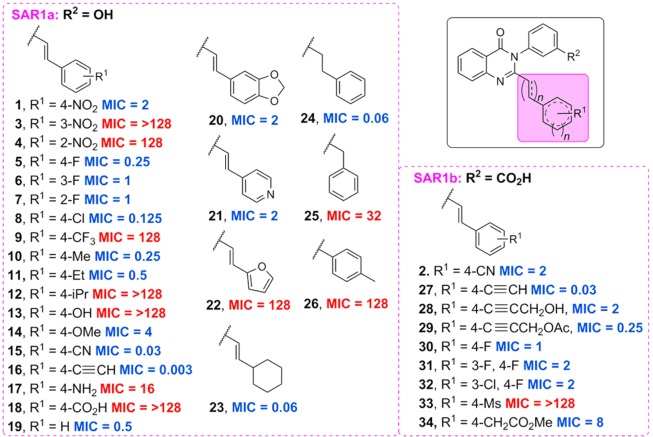
Figure 2
Antibacterial activities of the 4(3H)-quinazolinones derivatives at ring 1. The MICs (μg/mL) were determined for S. aureus ATCC 29213. Red text is for inactive compounds (MIC ≥ 16 μg/mL) and blue for active compounds (MIC ≤ 8 μg/mL).
Figure 3
Figure 3
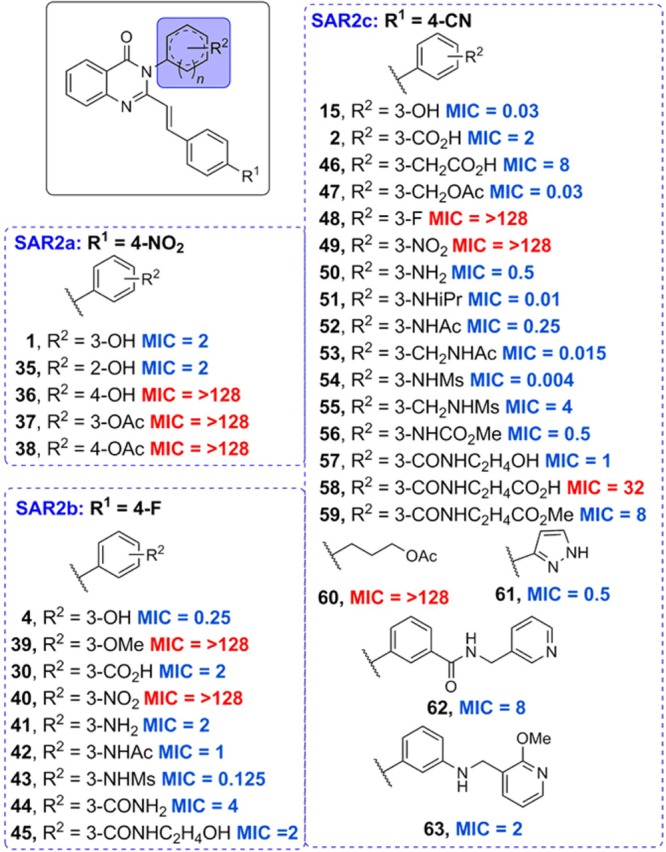
Antibacterial activities of the 4(3H)-quinazolinones derivatives at ring 2. As in Figure 2, the MICs (μg/mL) were determined for S. aureus ATCC 29213. Red text is for inactive compounds (MIC ≥ 16 μg/mL) and blue for active compounds (MIC ≤ 8 μg/mL).
Figure 4
Figure 4
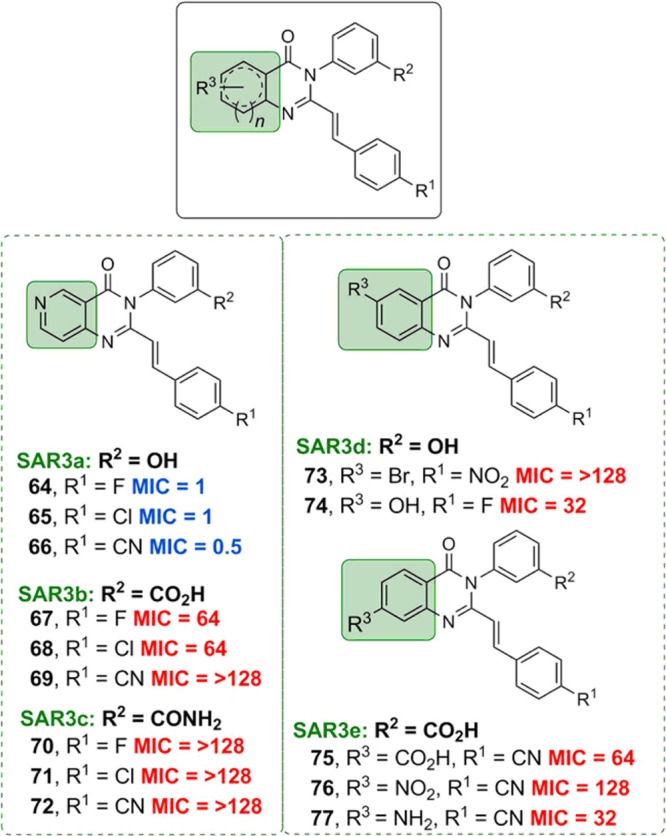
Antibacterial activities of the 4(3H)-quinazolinones derivatives at ring 3. As in Figure 2, the MICs (μg/mL) were determined for S. aureus ATCC 29213. Red text is for inactive compounds (MIC ≥ 16 μg/mL) and blue for active compounds (MIC ≤ 8 μg/mL).
Figure 5
Figure 5
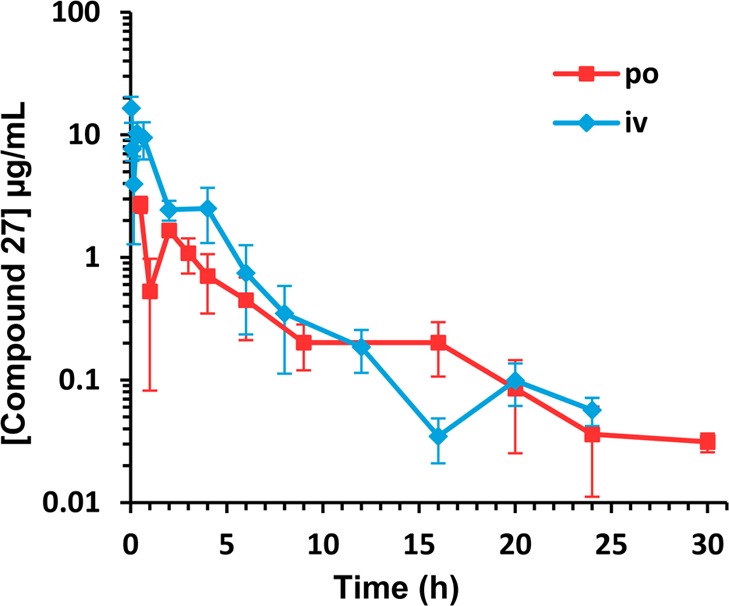
Pharmacokinetics of 27 in ICR mice after a single iv or po dose at 10 mg/kg (n = 3 per time point).
Figure 6
Figure 6
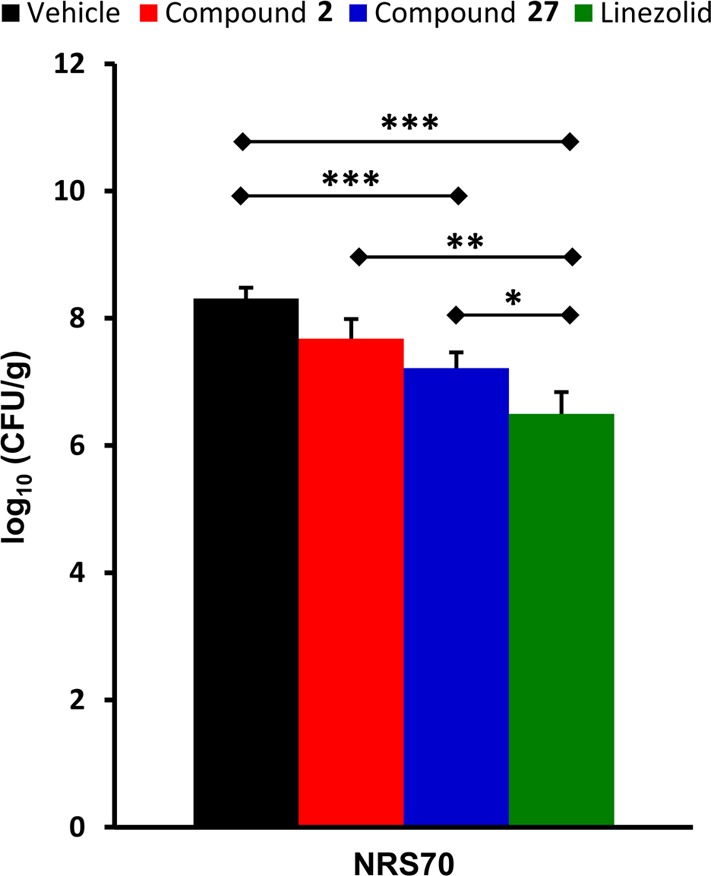
In vivo efficacy of compound 27 in a mouse neutropenic thigh infection model. The number of colony-forming units (CFU) per gram of thigh tissue was determined at 24 h after infection and averaged for each group (n = 8 mice). The initial inoculum corresponded to approximately 5.13 log10(CFU/g). Error is expressed as the standard error of the mean (SEM), and a Mann–Whitney U-test was used to determine statistical significance. Groups that were statistically significant from another are shown: (∗) p < 0.05, (∗∗) p < 0.01, or (∗∗∗) p < 0.001.

References

    1. Bassetti M.; Merelli M.; Temperoni C.; Astilean A. New antibiotics for bad bugs: where are we?. Ann. Clin. Microbiol. Antimicrob. 2013, 12, 22.10.1186/1476-0711-12-22. - DOI - PMC - PubMed
    1. Rice L. B. Federal funding for the study of antimicrobial resistance in nosocomial pathogens: no ESKAPE. J. Infect. Dis. 2008, 197, 1079–1081. 10.1086/533452. - DOI - PubMed
    1. Boucher H. W.; Talbot G. H.; Bradley J. S.; Edwards J. E.; Gilbert D.; Rice L. B.; Scheld M.; Spellberg B.; Bartlett J. Bad bugs, no drugs: no ESKAPE! An update from the Infectious Diseases Society of America. Clin. Infect. Dis. 2009, 48, 1–12. 10.1086/595011. - DOI - PubMed
    1. Centers for Disease Control (CDC). Antibiotic Resistance Threats in the United States, 2013; CDC: Atlanta, GA, 2013.
    1. Kong K. F.; Schneper L.; Mathee K. Beta-lactam antibiotics: from antibiosis to resistance and bacteriology. APMIS 2010, 118, 1–36. 10.1111/j.1600-0463.2009.02563.x. - DOI - PMC - PubMed

Publication types

MeSH terms