Comment
. 2016 May 2;126(5):1643-5.
doi: 10.1172/JCI87428. Epub 2016 Apr 18.

Sex and the single transplanted kidney

Comment

Sex and the single transplanted kidney

Sanjeev Noel et al. J Clin Invest. .

Abstract

Substantial ischemia-reperfusion injury (IRI) to the transplanted kidney occurs in 30% to 50% of transplantation patients who receive the organ from a deceased donor. IRI usually manifests as delayed graft function (DGF) and, in severe cases, results in primary nonfunction. Previous studies, primarily experimental, have demonstrated sex-specific susceptibility to IRI in kidney and other organs. In this issue of the JCI, Aufhauser Jr., Wang, and colleagues further demonstrate the importance of donor and recipient sex in IRI and elucidate the role of estrogen receptors in a murine model. Furthermore, analysis of data from 46,691 renal transplant patients in the United Network for Organ Sharing (UNOS) database revealed that sex affects DGF outcomes in humans. Manipulation of sex-driven molecular pathways offers a fertile opportunity to increase the number of organs available for transplantation and to reduce IRI in kidney and, likely, other organs.


Figures
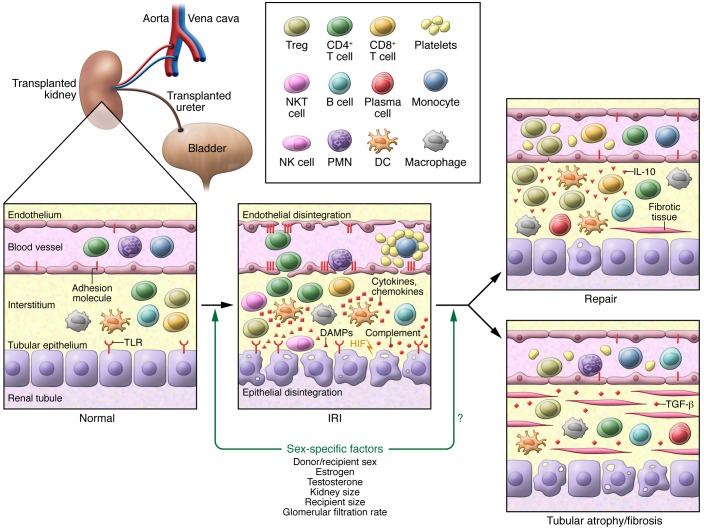
Figure 1
Figure 1. Sex affects the susceptibility and pathogenesis of IRI in a single transplanted kidney.
Exposure of a kidney transplant to warm and/or cold IR results in the activation of multiple pathological processes, including uncontrolled ROS production, activation of immune cells, proinflammatory cytokine production, endothelial and epithelial disintegration, and mitochondrial dysregulation. These effects result in acute loss of kidney function that often resolves following a complete and normal repair. Alternatively, persistent inflammation and further injury, along with defective and inefficient repair processes, can lead to tubular atrophy and fibrosis, which subsequently result in the loss of graft function. In this issue, Aufhauser Jr., Wang, and colleagues demonstrate that sex and estrogen mediate the response from the normal kidney to the IRI kidney. It remains unknown whether these factors affect recovery back toward normal kidney function or the development of atrophic and fibrosed kidney. In addition to estrogen, other factors, such as testosterone, kidney size, recipient size, and sex-specific differences in glomerular filtration rates, could also modulate recovery following IRI. It is not understood how these sex-specific factors interact with other identified pathophysiological mechanisms to determine DGF outcomes. Adapted with permission from Nature Reviews Nephrology (5). DAMPs, damage-associated molecular patterns; TLR, Toll-like receptor.

Comment on

References

    1. Chaumont M, et al. Delayed graft function in kidney transplants: time evolution, role of acute rejection, risk factors, and impact on patient and graft outcome. J Transplant. 2015;2015: - PMC - PubMed
    1. Menke J, Sollinger D, Schamberger B, Heemann U, Lutz J. The effect of ischemia/reperfusion on the kidney graft. Curr Opin Organ Transplant. 2014;19(4):395–400. doi: 10.1097/MOT.0000000000000090. - DOI - PubMed
    1. Siedlecki A, Irish W, Brennan DC. Delayed graft function in the kidney transplant. Am J Transplant. 2011;11(11):2279–2296. doi: 10.1111/j.1600-6143.2011.03754.x. - DOI - PMC - PubMed
    1. Wu WK, Famure O, Li Y, Kim SJ. Delayed graft function and the risk of acute rejection in the modern era of kidney transplantation. Kidney Int. 2015;88(4):851–858. doi: 10.1038/ki.2015.190. - DOI - PubMed
    1. Jang HR, Rabb H. Immune cells in experimental acute kidney injury. Nat Rev Nephrol. 2015;11(2):88–101. - PubMed

Publication types

Substances
