. 2016 Apr 18;11(4):e0151990.
doi: 10.1371/journal.pone.0151990. eCollection 2016.

Body Site Is a More Determinant Factor than Human Population Diversity in the Healthy Skin Microbiome

Affiliations

Body Site Is a More Determinant Factor than Human Population Diversity in the Healthy Skin Microbiome

Guillermo I Perez Perez et al. PLoS One. .

Abstract

We studied skin microbiota present in three skin sites (forearm, axilla, scalp) in men from six ethnic groups living in New York City.

Methods: Samples were obtained at baseline and after four days following use of neutral soap and stopping regular hygiene products, including shampoos and deodorants. DNA was extracted using the MoBio Power Lyzer kit and 16S rRNA gene sequences determined on the IIlumina MiSeq platform, using QIIME for analysis.

Results: Our analysis confirmed skin swabbing as a useful method for sampling different areas of the skin because DNA concentrations and number of sequences obtained across subject libraries were similar. We confirmed that skin location was the main factor determining the composition of bacterial communities. Alpha diversity, expressed as number of species observed, was greater in arm than on scalp or axilla in all studied groups. We observed an unexpected increase in α-diversity on arm, with similar tendency on scalp, in the South Asian group after subjects stopped using their regular shampoos and deodorants. Significant differences at phylum and genus levels were observed between subjects of the different ethnic origins at all skin sites.

Conclusions: We conclude that ethnicity and particular soap and shampoo practices are secondary factors compared to the ecological zone of the human body in determining cutaneous microbiota composition.


Conflict of interest statement

Competing Interests: The financial support from L’Oreal does not alter the authors’ adherence to all PLOS ONE policies on sharing data and materials and there are no restrictions on sharing of data and/or materials.

Figures

Fig 1
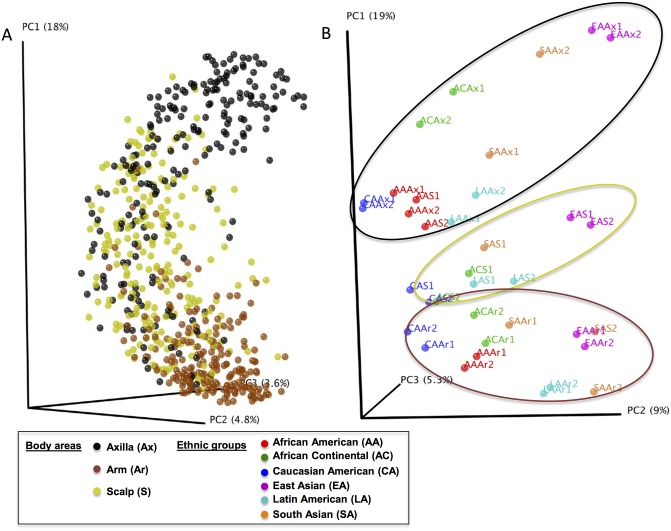
Fig 1. Cutaneous microbial diversity in 645 samples from 110 subjects, based on skin location and beta diversity analysis over time, by ethnic group.
The sequence depth is 3200/sample. Panel A. PCoA of clustering by sample location, based on unweighted pairwise UniFrac distances. The skin locations were Scalp [S (n = 215 samples)]; Arm [Ar (n = 215)]; Axilla [Ax (n = 215)]. Panel B. Analysis by ethnic group, including African-American [AA (n = 18 subjects/site)], East Asian [EA (n = 25)], Caucasian-American [CA (n = 16)], Latin American [LA (n = 16)], African-Continental [AC (n = 11)], and South Asian [SA (n = 19)]. PCoA of clustering of skin samples combining the three cutaneous sites, and the two time points; 1 = baseline and 2 = follow-up. Ellipses generally describe: axilla (black), scalp (yellow), and Arm (brown). Key to explain sites sampled and ethnic groups in all figures: The skin locations are colored as follows: yellow: Scalp (S); Brown: Arm (Ar); Black: Axilla (Ax). Ethnic groups are colored as: Orange: South Asian (SA); Light blue: Latin-American (LA); Purple: East Asian (EA); Red: African-American (AA); Blue: Caucasian-American (CA); Green: African-Continental (AC).
Fig 2
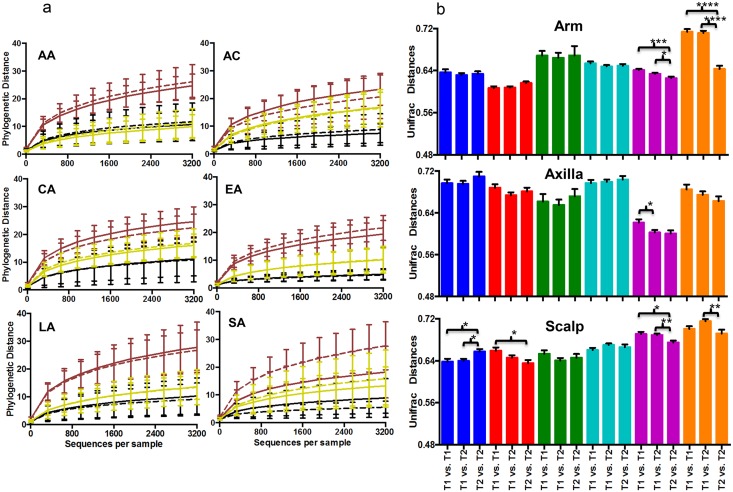
Fig 2. Comparison of diversity of the cutaneous microbiota over time, by ethnic group.
Panel A. Rarefaction analysis of cutaneous microbiota in relation to sampling time in samples from arms (Brown), axilla (Black) and scalp (Yellow), African-American (AA, n = 108 samples); African-Continental (AC, n = 66); Caucasian-American (CA, n = 96); East-Asian (EA, n = 150); Latin-American (LA, n = 114); South-Asian (SA, n = 96). Rarefaction analysis represented by phylogenetic distance. The solid and dashed lines indicate samples collected before (T1) and after (T2) a special soap wash was used, respectively. Only a significant difference between time-points was found for the SA group. Panel B. Intra- and inter-group beta-diversity over time. Mean (±SD) pairwise unweighted UniFrac distances are shown. The ethnic groups are colored as described in Fig 1. Significance was determined by one-way ANOVA with the Tukey method for correction for multiple comparisons (*<0.05; **<0.01; ***<0.001; ****<0.0001).
Fig 3
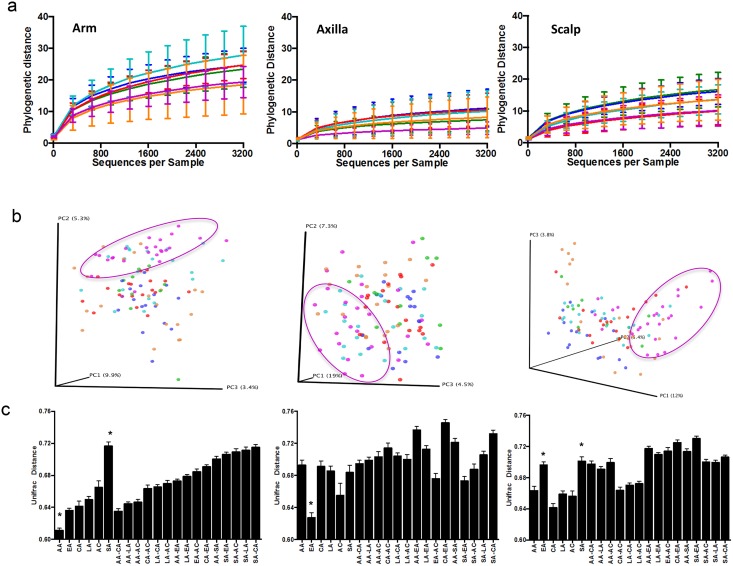
Fig 3. Analysis of cutaneous microbiota by ethnicity.
The results are from 6 ethnic groups, including Caucasian-American (n = 20/site), African-American (n = 18/site), American-Continental (n = 11/site), Latin American (n = 16/site) East Asian (n = 25/site), and South Asian (n = 20/site). Panel A. Alpha diversity represented by phylogenetic distances. Arm, significant differences were found between EA vs. LA and AA; and SA vs. LA. Axilla, between EA vs. AA, LA and CA. Scalp, between EA vs. AC and CA; AA vs. AC and CA. The ethnic groups are colored as described in Fig 1. Panel B. PCoA of clustering by ethnic group, based on unweighted pairwise Unifrac distances. The circles represent the distribution of the East Asian samples. Panel C. Intra- and inter-group beta-diversity analysis on skin location at baseline. Mean (±SD) pairwise unweighted UniFrac distances shown. The * symbol indicate that the intra-group beta diversity was significantly different (p<0.001).
Fig 4
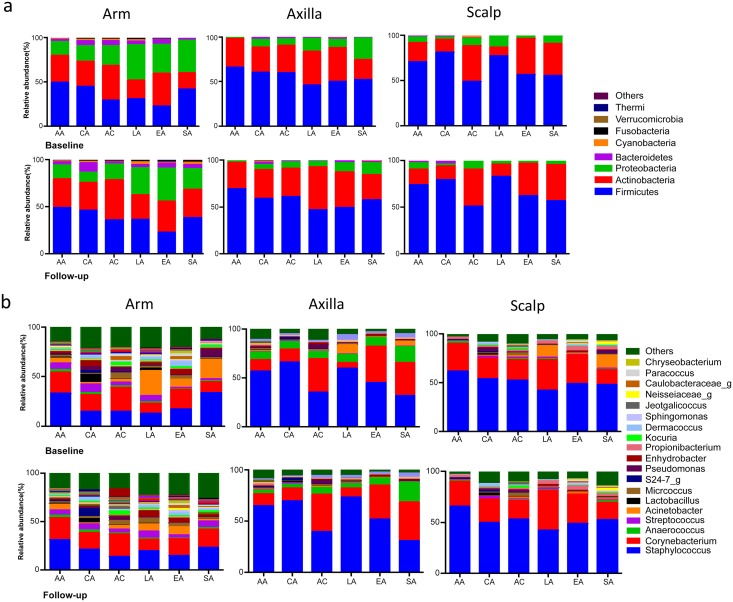
Fig 4. Taxonomic analysis of cutaneous microbiota from 110 subjects in six different subject groups.
Panel A. By site (arm, axilla, scalp) at the phylum level. A total of 41 phyla were found. The sequences for the dominant 9 phyla (>0.1% in any group) accounted for >99.7% of total sequences in all ethnic groups. Baseline: Samples collected before special soap wash used. Follow-up: Samples collected after special soap wash used. Panel B: Genus level. A total 726 genera were detected; only predominant genera (Mean>0.01%) are shown.
Fig 5
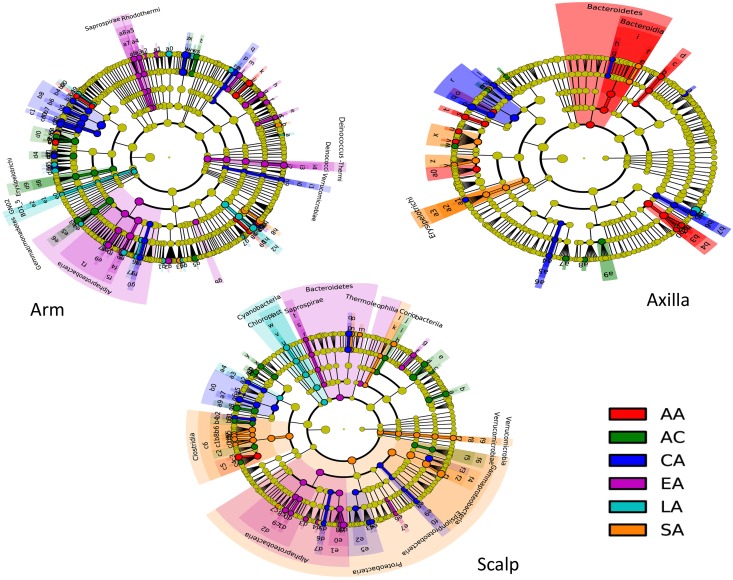
Fig 5. Comparison of microbiota differences by ethnic group, analyzed by LEfSe using baseline samples.
Taxa with relative abundance ≥ 0.1% present in at least one sample in each location were included. The cladograms indicate the phylogenetic distribution of the microbial lineages associated with ethnic group, with lineages with Linear Discriminant Analysis (LDA) score ≥2.0 displayed. Significance differences for each ethnic group of the most abundant class are indicated by color, as indicated in the key. Each node’s diameter is proportional to the taxon’s abundance. The strategy of multiclass analysis is non-strict (≥ one class differential). Nodes represent phylogenetic levels from domain to genus (from inside out) (AA, n = 18 subjects; AC, n = 11; CA, n = 16; EA, n = 25; LA, n = 19; SA, n = 20).

References

    1. Costello EK, Lauber CL, Hamady M, Fierer N, Gordon JI, Knight R (2009) Bacterial community variation in human body habitats across space and time. Science 326: 1694–7. 10.1126/science.1177486 - DOI - PMC - PubMed
    1. Gao Z, Tseng CH, Pei Z, Blaser MJ (2007) Molecular analysis of human forearm superficial skin bacterial biota. Proc Natl Acad Sci U S A 104: 2927–32. - PMC - PubMed
    1. Grice EA, Segre JA (2011) The skin microbiome. Nat Rev Microbiol 9: 244–53. 10.1038/nrmicro2537 - DOI - PMC - PubMed
    1. Li W, Han L, Yu P, Ma C, Wu X, Xu J (2014) Nested PCR-denaturing gradient gel electrophoresis analysis of human skin microbial diversity with age. Microbiol Res 169: 686–92. 10.1016/j.micres.2014.02.008 - DOI - PubMed
    1. Stanford JA, Gallo RL (2013) Functions of the skin microbiota in health and desease. Seminars in immunology 25: 370–7. 10.1016/j.smim.2013.09.005 - DOI - PMC - PubMed

Publication types

Substances