Review
. 2016 Apr 18;7(1):56.
doi: 10.1186/s13287-016-0314-3.

Should we use cells, biomaterials, or tissue engineering for cartilage regeneration?

Affiliations
Review

Should we use cells, biomaterials, or tissue engineering for cartilage regeneration?

Jonathan C Bernhard et al. Stem Cell Res Ther. .

Abstract

For a long time, cartilage has been a major focus of the whole field of tissue engineering, both because of the constantly growing need for more effective options for joint repair and the expectation that this apparently simple tissue will be easy to engineer. After several decades, cartilage regeneration has proven to be anything but easy. With gratifying progress in our understanding of the factors governing cartilage development and function, and cell therapy being successfully used for several decades, there is still a lot to do. We lack reliable methods to generate durable articular cartilage that would resemble the original tissue lost to injury or disease. The question posed here is whether the answer would come from the methods using cells, biomaterials, or tissue engineering. We present a concise review of some of the most meritorious efforts in each area, and propose that the solution will most likely emerge from the ongoing attempts to recapitulate certain aspects of native cartilage development. While an ideal recipe for cartilage regeneration is yet to be formulated, we believe that it will contain cell, biomaterial, and tissue engineering approaches, blended into an effective method for seamless repair of articular cartilage.

Keywords: Biomaterial; Bioreactor; Cartilage; Chondrocytes; Hydrogel; Implantation; Mesenchymal stem cells; Tissue engineering.


Figures
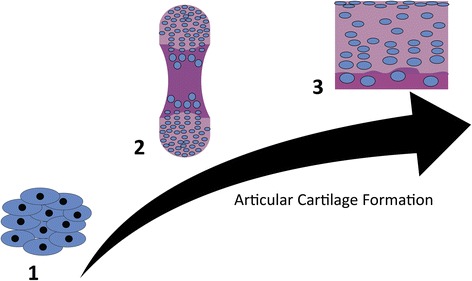
Fig. 1
Fig. 1
Chondrogenic development. (1) Mesenchymal condensation. (2) Chondrogenic differentiation of mesenchymal cells and deposition of a cartilage anlage that forms both cartilage and bone. (3) Remodeling of the anlage to form bone and mature cartilage with their inherent structural zones. Cartilage regeneration therapies have followed this approach, having investigated cellular therapies to trigger cartilage formation, biomaterial scaffolds that infiltrating cells can remodel, and tissue-engineered cartilage constructs that mimic the structure and function of native articular cartilage
Fig. 2
Fig. 2
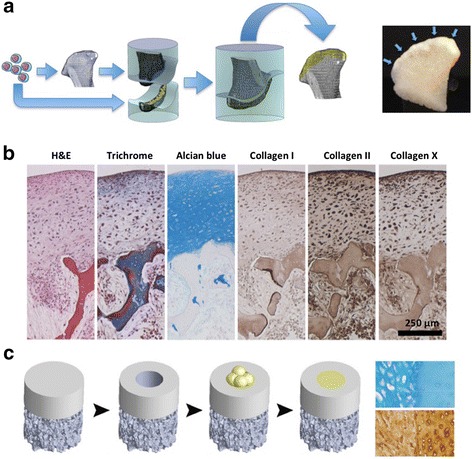
Engineering of stratified, mechanically functional human cartilage. a Human mesenchymal stem cells are induced to fuse into cell bodies which are then placed on the cartilage side of a mold in the exact shape of a condyle, an anatomically shaped bone scaffold is placed on the other side, and the two pieces are press-fit. After 5 weeks of in-vitro cultivation, an anatomical layer of articular cartilage forms at the interface with the underlying bone. b The resulting cartilage is physiologically thick and stratified, expressing all key markers, and integrated with the underlying bone. c The fusing mesenchymal stem cell bodies were also tested for their ability to repair small cartilage defects. Structural integration is shown by alcian blue and antibody stains for glycosaminoglycan and collagen type II. The newly formed tissue is shown on the left, the adjacent native cartilage on the right. Selected images are reproduced with permission from [73]. H & E hematoxylin and eosin

References

    1. Madry H, Grun UW, Knutsen G. Cartilage repair and joint preservation medical and surgical treatment options. Dtsch Arztebl Int. 2011;108(40):669–77. - PMC - PubMed
    1. Caldwell KL, Wang J. Cell-based articular cartilage repair: the link between development and regeneration. Osteoarthritis Cartilage. 2015;23(3):351–62. doi: 10.1016/j.joca.2014.11.004. - DOI - PMC - PubMed
    1. Goldring MB, Tsuchimochi K, Ijiri K. The control of chondrogenesis. J Cell Biochem. 2006;97(1):33–44. doi: 10.1002/jcb.20652. - DOI - PubMed
    1. Hayes AJ, MacPherson S, Morrison H, Dowthwaite G, Archer CW. The development of articular cartilage: evidence for an appositional growth mechanism. Anat Embryol. 2001;203(6):469–79. doi: 10.1007/s004290100178. - DOI - PubMed
    1. Brittberg M, Lindahl A, Nilsson A, Ohlsson C, Isaksson O, Peterson L. Treatment of deep cartilage defects in the knee with autologous chondrocyte transplantation. N Engl J Med. 1994;331(14):889–95. doi: 10.1056/NEJM199410063311401. - DOI - PubMed

Publication types

MeSH terms