. 2016 Apr 19:6:24543.
doi: 10.1038/srep24543.

Dynamic Changes of Functional Pain Connectome in Women with Primary Dysmenorrhea

Affiliations

Dynamic Changes of Functional Pain Connectome in Women with Primary Dysmenorrhea

Ting-Hsuan Wu et al. Sci Rep. .

Abstract

Primary dysmenorrhea (PDM) is the most prevalent gynecological problem. Many key brain systems are engaged in pain processing. In light of dynamic communication within and between systems (or networks) in shaping pain experience and behavior, the intra-regional functional connectivity (FC) in the hub regions of the systems may be altered and the functional interactions in terms of inter-regional FCs among the networks may be reorganized to cope with the repeated stress of menstrual pain in PDM. Forty-six otherwise healthy PDM subjects and 49 age-matched, healthy female control subjects were enrolled. Intra- and inter-regional FC were assessed using regional homogeneity (ReHo) and ReHo-seeded FC analyses, respectively. PDM women exhibited a trait-related ReHo reduction in the ventromedial prefrontal cortex, part of the default mode network (DMN), during the periovulatory phase. The trait-related hypoconnectivity of DMN-salience network and hyperconnectivity of DMN-executive control network across the menstrual cycle featured a dynamic transition from affective processing of pain salience to cognitive modulation. The altered DMN-sensorimotor network may be an ongoing representation of cumulative menstrual pain. The findings indicate that women with long-term PDM may develop adaptive neuroplasticity and functional reorganization with a network shift from affective processing of salience to the cognitive modulation of pain.


Figures
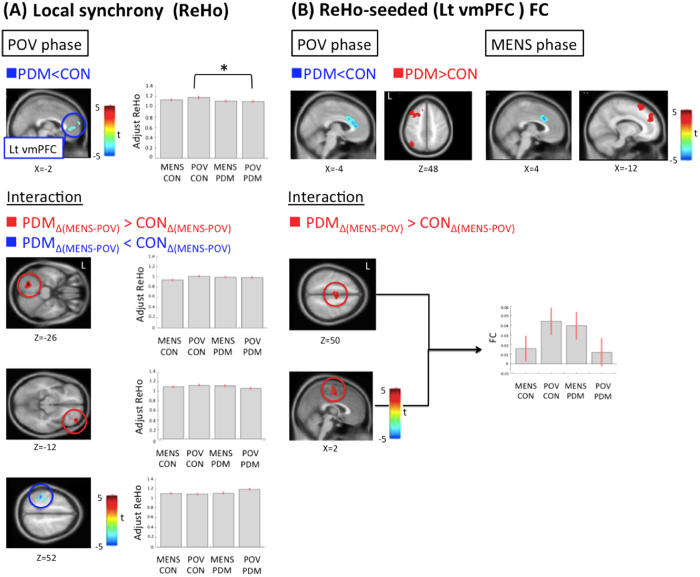
Figure 1
Figure 1. Statistical maps of ReHo, ReHo-seeded (Lt vmPFC) FC and the interaction effects.
(A) ReHo maps. PDM group shows decreased ReHo of the Lt vmPFC during the POV phase when comparing to the CON group. For the interaction effect, the between-group (PDM vs. CON) comparison of phase differences (MENS vs. POV) reveals significant greater ReHo alterations in the Lt declive and right orbitofrontal cortex (OFC), and lesser ReHo alterations in the Lt anterior intraparietal sulcus and superior parietal lobule. The bar charts show adjusted ReHo values at the peak voxel of the vmPFC. The error bar corresponds to a 90% confidence interval. (B) FC maps. For ReHo-seeded (Lt vmPFC) FC between-group comparisons, hypoconnectivity in the Lt vmPFC-dorsal anterior cingulate cortex FC and hyperconnectivity in the Lt vmPFC-dorsomedial prefrontal cortex FC are noted in the PDM group when compared to the CON group during both phases. Hypoconnectivity in the Lt vmPFC-pregenual anterior cingulate cortex FC and hyperconnectivity in the Lt vmPFC-dorsolateral prefrontal cortex and -ventral parietal lobe FCs are observed in the PDM group during the POV phase. The PDM group (vs. CON group) shows greater between-phase (MENS vs. POV) Lt vmPFC-supplementary motor area (SMA) FC. Red regions are associated with increased FC and greater phase-difference of ReHo or FC in the PDM group. Blue regions are associated with decreased ReHo, decreased FC and lesser phase-difference of ReHo or FC in the PDM group. Significance thresholded at the uncorrected voxel level p = 0.005 followed by the FWE-corrected cluster level p = 0.05. ReHo, regional homogeneity; PDM, primary dysmenorrhea; CON, control; MENS, menstrual phase; POV, periovulatory phase; FC, functional connectivity; vmPFC, ventromedial prefrontal cortex; Lt, left. *Denotes the contrast(s) that are significant in between-group comparisons.
Figure 2
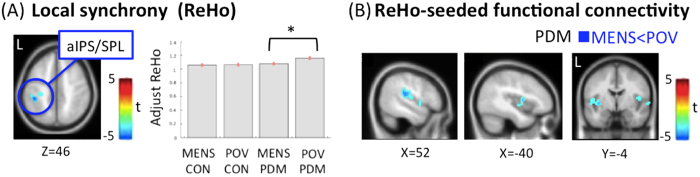
Figure 2. The state-related ReHo and FC alterations in PDM.
(A) ReHo maps. PDM group shows decreased ReHo of the anterior part of the intraparietal sulcus (aIPS) and superior parietal lobe (SPL) during the MENS phase when compared to the POV phase. The bar charts indicate the adjusted ReHo values at the peak voxel of the aIPS/SPL. The error bar corresponds to a 90% confidence interval. (B) FC maps. For ReHo-seeded (aIPS/SPL) FC between-phase comparisons, hypoconnectivity in the aIPS-bilateral posterior insula and -right postcentral gyrus FCs are observed during the MENS phase in the PDM group. Blue regions are associated with either decreased ReHo or decreased FC. Significance thresholded at the uncorrected voxel level p = 0.005 followed by the FWE-corrected cluster level p = 0.05. *Denotes the contrast(s) that are significant in between-phase comparisons. For abbreviations, see the legend of Fig. 1.
Figure 3
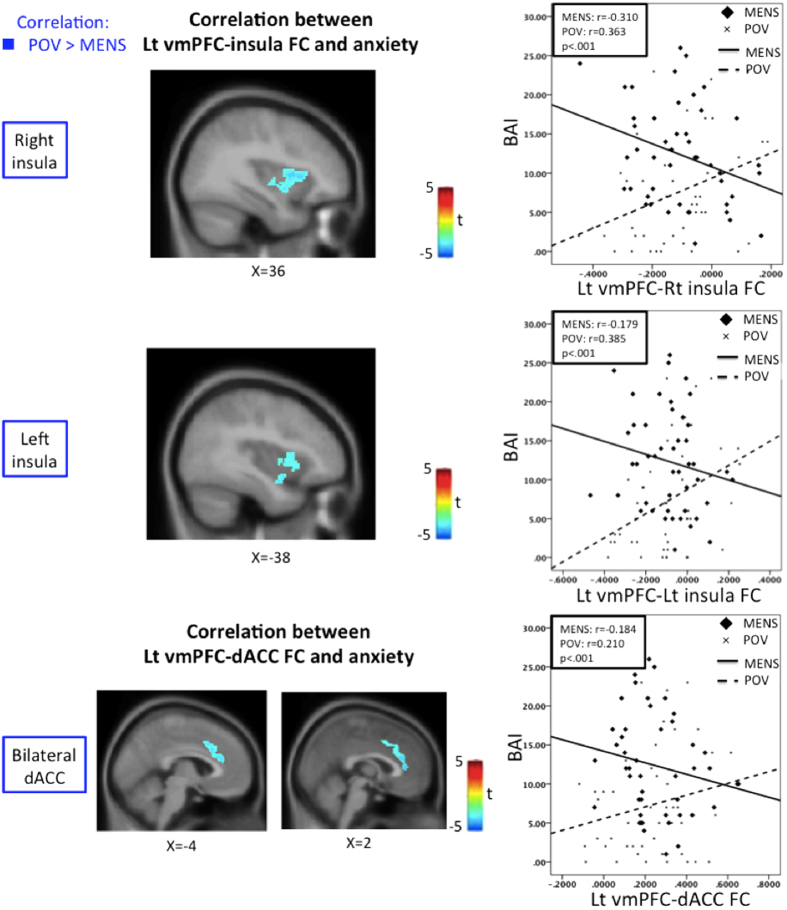
Figure 3. Correlation between FC and anxiety score inverses across phases in PDM.
The Lt vmPFC-Rt insula, -Lt insula and -bilateral dorsal anterior cingulate cortex (dACC) FCs are positively correlated with BAI during the POV phase but negatively correlated with BAI during the MENS phase. Original FC values were used for the correlation to avoid artificial and inadvertent zeroing. Blue regions are associated with lower correlation with BAI during MENS phase. Significance thresholded at the uncorrected voxel level p = 0.005 followed by the FWE-corrected cluster level p = 0.05. BAI, Beck Anxiety Inventory; Lt, left; Rt, right.

References

    1. Berkley K. J. Primary Dysmenorrhea: An Urgent Mandate. Pain: Clinical Updates 21(3), 1–8 (2013).
    1. Li W. C. et al. High prevalence of incidental brain findings in primary dysmenorrhoea. Eur J Pain 19, 1071–1074 (2015). - PubMed
    1. Lee L. C. et al. Association of brain-derived neurotrophic factor gene Val66Met polymorphism with primary dysmenorrhea. Plos One 9, e112766 (2014). - PMC - PubMed
    1. Tu C. H. et al. Brain morphological changes associated with cyclic menstrual pain. Pain 150, 462–468 (2010). - PubMed
    1. Tu C. H. et al. Menstrual pain is associated with rapid structural alterations in the brain. Pain 154, 1718–1724 (2013). - PubMed

Publication types