


An exploratory study of volumetric analysis for assessing tumor response with (18)F-FAZA PET/CT in patients with advanced non-small-cell lung cancer (NSCLC)
- PMID: 27090118
- PMCID: PMC4835394
- DOI: 10.1186/s13550-016-0187-6
An exploratory study of volumetric analysis for assessing tumor response with (18)F-FAZA PET/CT in patients with advanced non-small-cell lung cancer (NSCLC)
Abstract
Background: Hypoxia is associated with resistance to chemotherapy and radiotherapy and is randomly distributed within malignancies. Characterization of changes in intratumoral hypoxic regions is possible with specially developed PET tracers such as (18)F-fluoroazomycin arabinoside ((18)F-FAZA) while tumor metabolism can be measured with 2-deoxy-2-[(18)F]fluoro-D-glucose ((18)F-FDG). The purpose of this study was to study the effects of chemotherapy on (18)F-FAZA and (18)F-FDG uptake simultaneously in non-small-cell lung cancer (NSCLC) patients
Methods: At baseline and after the second chemotherapy cycle, both PET/CT with (18)F-FDG and (18)F-FAZA was performed in seven patients with metastasized NSCLC. (18)F-FAZA and (18)F-FDG scans were aligned with deformable image registration using Mirada DBx. The primary tumors were contoured, and on the (18)F-FDG scan, volumes of interest (VOI) were drawn using a 41 % adaptive threshold technique. Subsequently, the resulting VOI was transferred to the (18)F-FAZA scan. (18)F-FAZA maximum tumor-to-background (T/Bgmax) ratio and the fractional hypoxic volume (FHV) were assessed. Measurements were corrected for partial volume effects. Finally, a voxel-by-voxel analysis of the primary tumor was performed to assess regional uptake differences.
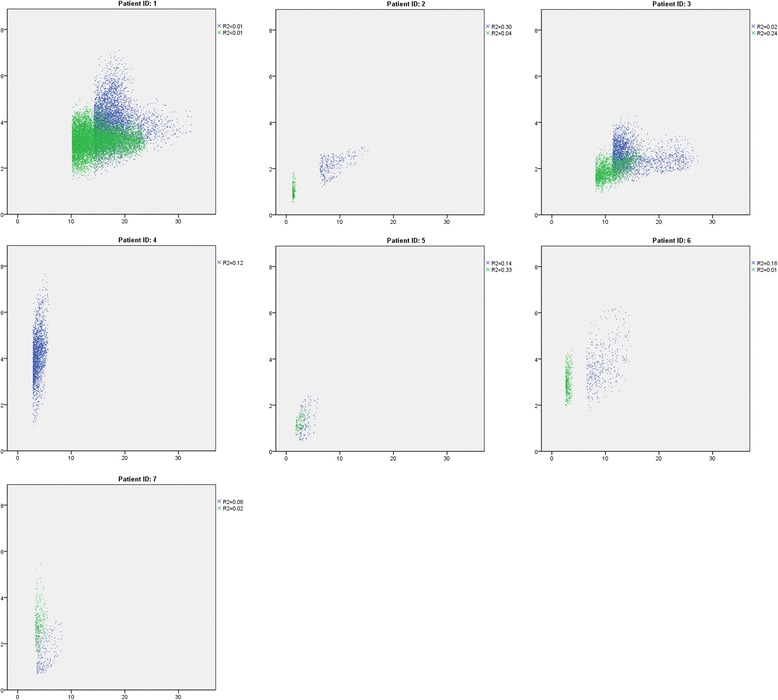
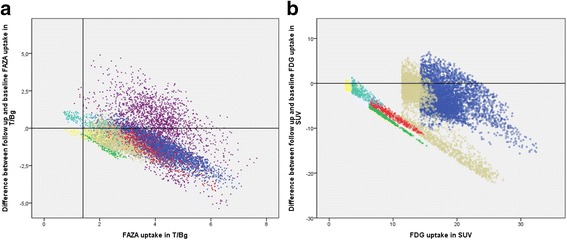
Results: In the primary tumor of all seven patients, median (18)F-FDG standard uptake value (SUVmax) decreased significantly (p = 0.03). There was no significant decrease in (18)F-FAZA uptake as measured with T/Bgmax (p = 0.24) or the FHV (p = 0.35). Additionally, volumetric voxel-by-voxel analysis showed that low hypoxic tumors did not significantly change in hypoxic status between baseline and two cycles of chemotherapy, whereas highly hypoxic tumors did. Individualized volumetric voxel-by-voxel analysis revealed that hypoxia and metabolism were not associated before and after 2 cycles of chemotherapy.
Conclusions: Tumor hypoxia and metabolism are independent dynamic events as measured by (18)F-FAZA PET and (18)F-FDG PET, both prior to and after treatment with chemotherapy in NSCLC patients.
Keywords: 18F-FAZA; 18F-FDG; Chemotherapy; NSCLC.
Figures
References
-
- Tochon-Danguy HJ, Sachinidis JI, Chan F, Chan JG, Hall C, Cher L, Stylli S, Hill J, Kaye A, Scott AM. Imaging and quantitation of the hypoxic cell fraction of viable tumor in an animal model of intracerebral high grade glioma using [18F]fluoromisonidazole (FMISO) Nucl Med Biol. 2002;29:191–7. doi: 10.1016/S0969-8051(01)00298-0. - DOI - PubMed
-
- Sorger D, Patt M, Kumar P, Wiebe LI, Barthel H, Seese A, Dannenberg C, Tannapfel A, Kluge R, Sabri O. [18F]Fluoroazomycinarabinofuranoside (18FAZA) and [18F]Fluoromisonidazole (18FMISO): a comparative study of their selective uptake in hypoxic cells and PET imaging in experimental rat tumors. Nucl Med Biol. 2003;30:317–26. doi: 10.1016/S0969-8051(02)00442-0. - DOI - PubMed
LinkOut - more resources
Full Text Sources
Other Literature Sources
