


Cumulative early life adversity predicts longevity in wild baboons
- PMID: 27091302
- PMCID: PMC4838827
- DOI: 10.1038/ncomms11181
Cumulative early life adversity predicts longevity in wild baboons
Abstract
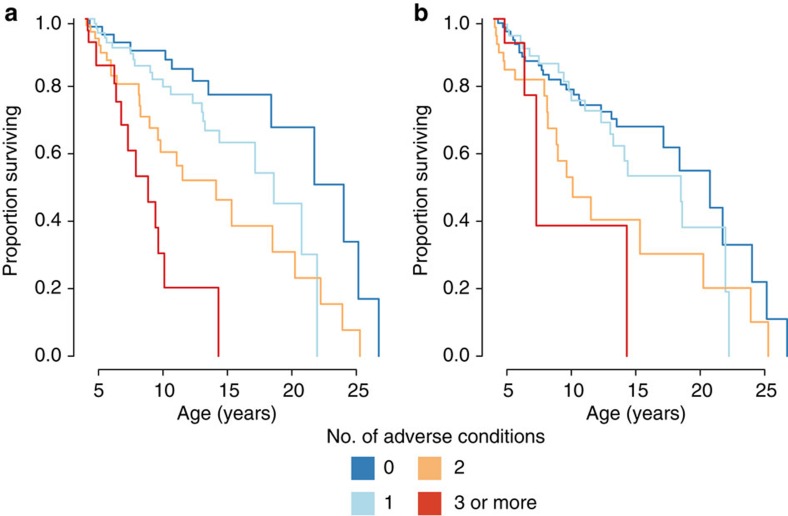
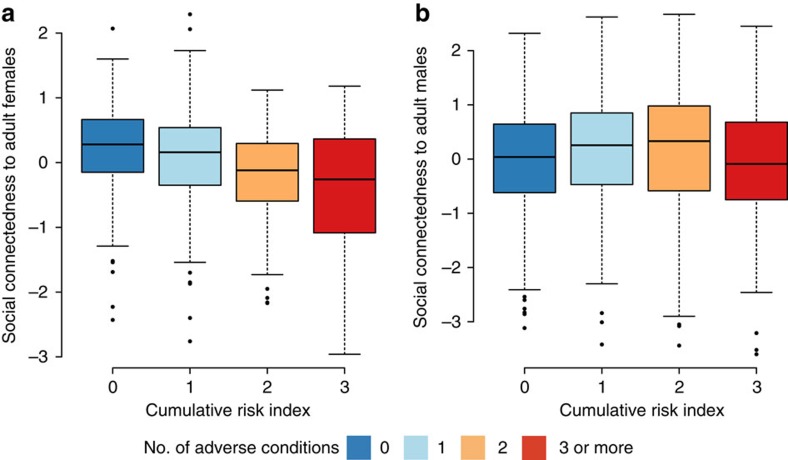
In humans and other animals, harsh circumstances in early life predict morbidity and mortality in adulthood. Multiple adverse conditions are thought to be especially toxic, but this hypothesis has rarely been tested in a prospective, longitudinal framework, especially in long-lived mammals. Here we use prospective data on 196 wild female baboons to show that cumulative early adversity predicts natural adult lifespan. Females who experience ≥3 sources of early adversity die a median of 10 years earlier than females who experience ≤1 adverse circumstances (median lifespan is 18.5 years). Females who experience the most adversity are also socially isolated in adulthood, suggesting that social processes partially explain the link between early adversity and adult survival. Our results provide powerful evidence for the developmental origins of health and disease and indicate that close ties between early adversity and survival arise even in the absence of health habit and health care-related explanations.
Figures
References
-
- Felitti V. J. et al. Relationship of childhood abuse and household dysfunction to many of the leading causes of death in adults. The Adverse Childhood Experiences (ACE) Study. Am. J. Prev. Med. 14, 245–258 (1998). - PubMed
-
- Lynch J. & Smith D. G. A life course approach to chronic disease epidemiology. Annu. Rev. Publ. Health 26, 1–35 (2005). - PubMed
-
- Kittleson M. M. et al. Association of childhood socioeconomic status with subsequent coronary heart disease in physicians. Arch. Intern. Med. 166, 2356–2361 (2006). - PubMed
-
- Barker D. J. P., Eriksson J. G., Forsen T. & Osmond C. Fetal origins of adult disease: strength of effects and biological basis. Int. J. Epidemiol. 31, 1235–1239 (2002). - PubMed
-
- O'Rand A. M. & Hamil-Luker J. Processes of cumulative adversity: childhood disadvantage and increased risk of heart attack across the life course. J. Gerontol. B Psychol. Sci. Soc. Sci. 60, 117–124 (2005). - PubMed
Publication types
MeSH terms
Grants and funding
LinkOut - more resources
Full Text Sources
Other Literature Sources
Medical
