. 2016 Apr 5:7:416.
doi: 10.3389/fmicb.2016.00416. eCollection 2016.

In Search of Alternative Antibiotic Drugs: Quorum-Quenching Activity in Sponges and their Bacterial Isolates

Affiliations

In Search of Alternative Antibiotic Drugs: Quorum-Quenching Activity in Sponges and their Bacterial Isolates

Kumar Saurav et al. Front Microbiol. .

Abstract

Owing to the extensive development of drug resistance in pathogens against the available antibiotic arsenal, antimicrobial resistance is now an emerging major threat to public healthcare. Anti-virulence drugs are a new type of therapeutic agent aiming at virulence factors rather than killing the pathogen, thus providing less selective pressure for evolution of resistance. One promising example of this therapeutic concept targets bacterial quorum sensing (QS), because QS controls many virulence factors responsible for bacterial infections. Marine sponges and their associated bacteria are considered a still untapped source for unique chemical leads with a wide range of biological activities. In the present study, we screened extracts of 14 sponge species collected from the Red and Mediterranean Sea for their quorum-quenching (QQ) potential. Half of the species showed QQ activity in at least 2 out of 3 replicates. Six out of the 14 species were selected for bacteria isolation, to test for QQ activity also in isolates, which, once cultured, represent an unlimited source of compounds. We show that ≈20% of the isolates showed QQ activity based on a Chromobacterium violaceum CV026 screen, and that the presence or absence of QQ activity in a sponge extract did not correlate with the abundance of isolates with the same activity from the same sponge species. This can be explained by the unknown source of QQ compounds in sponge-holobionts (host or symbionts), and further by the possible non-symbiotic nature of bacteria isolated from sponges. The potential symbiotic nature of the isolates showing QQ activity was tested according to the distribution and abundance of taxonomically close bacterial Operational Taxonomic Units (OTUs) in a dataset including 97 sponge species and 178 environmental samples (i.e., seawater, freshwater, and marine sediments). Most isolates were found not to be enriched in sponges and may simply have been trapped in the filtration channels of the sponge at the time of collection. Our results highlight potential for QQ-bioactive lead molecules for anti-virulence therapy both from sponges and the bacteria isolated thereof, independently on the symbiotic nature of the latter.

Keywords: Pseudomonas aeruginosa; anti-virulence; biofilm inhibition; porifera; pyocyanin; quorum sensing.


Figures
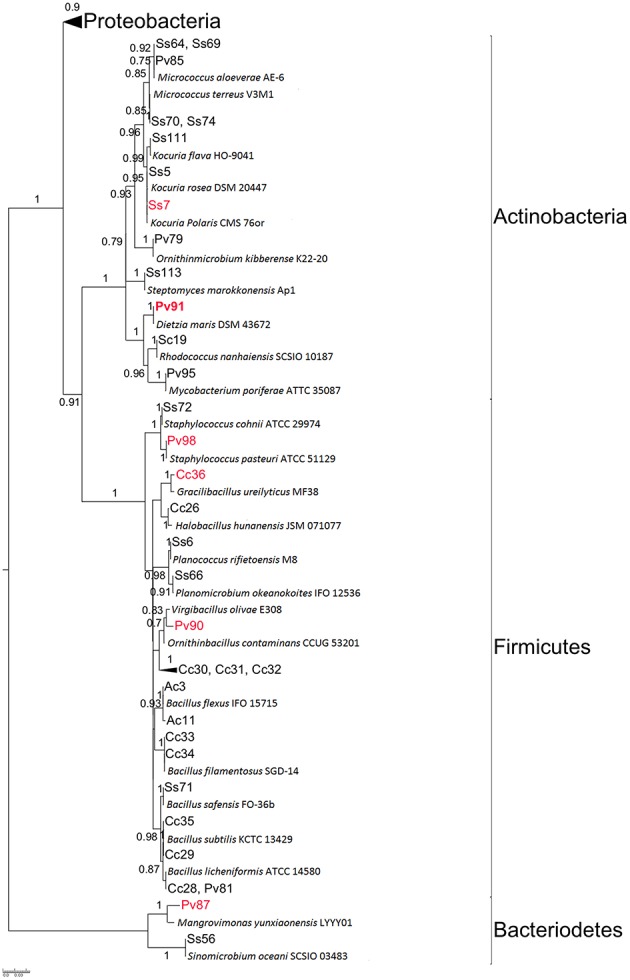
Figure 1
Figure 1
Maximum likelihood tree of isolates and their closest EzTaxon hits. The detailed view on the Proteobacteria is shown in Figure 2. Isolates with QQ activity are highlighted in red. Isolates in bold were used for further chemical analysis by LC-MS/MS. Bootstrap values > 70% (0.7) are shown. Strain ID provides information on the sponge source of each isolate: Ac, Amphimedon chloros; Cc, Crella cyathophora; Pv, Pione vastifica; Ss, Sarcotragus sp.; Sc, Suberites clavatus.
Figure 2
Figure 2
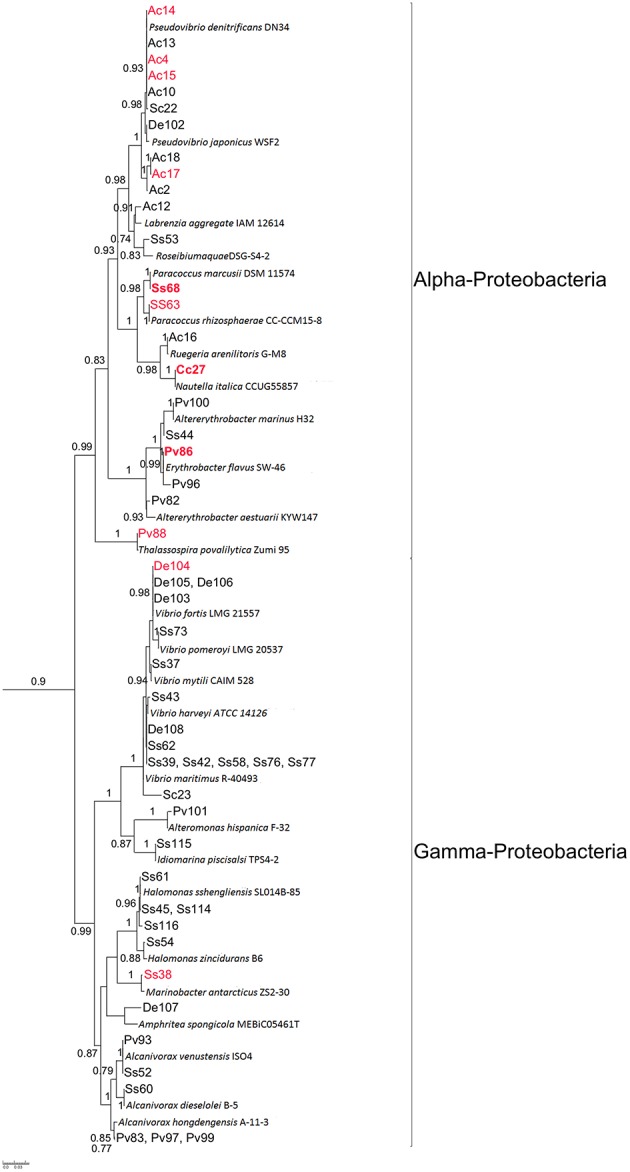
Detailed view on Proteobacteria sub-tree from the maximum likelihood tree shown in Figure 1. Isolates with QQ activity are highlighted in red. Isolates in bold were used for further chemical analysis by LC-MS/MS. Bootstrap values >70% (0.7) are shown. Strain ID provides information on the sponge source of each isolate: Ac, Amphimedon chloros; Cc, Crella cyathophora; Pv, Pione vastifica; Ss, Sarcotragus sp.; Sc, Suberites clavatus.
Figure 3
Figure 3
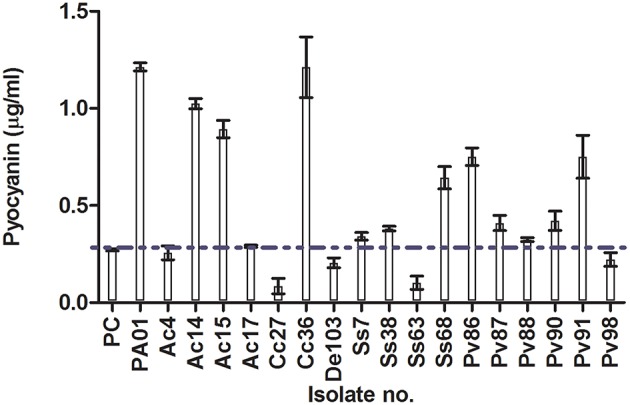
Inhibition of pyocyanin production (μg/mL) by extracts of 17 isolated strains selected based on QQ activity. Taxonomic information on strains can be found in Table 2. PC, Positive control (penicillic acid); PAO1, P. aeruginosa PAO1 grown with methanol (solvent used to dissolve extracts). Horizontal blue dotted line shows 70% of pyocyanin inhibition. Data is expressed as mean ± standard error.
Figure 4
Figure 4
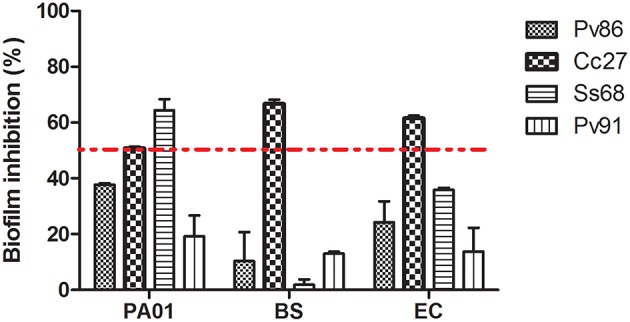
Inhibition of biofilm formation by four selected isolates (Pv86, Cc27, Ss68, and Pv91) calculated as inhibition of biofilm formation by the isolate extract compared to that of the negative control (methanol). Results for biofilm inhibition in (1) P.aeruginosa PAO1 (PA01), (2) Bacillus subtilis (BS), and (3) E. coli (EC). Red dotted line represents 50% biofilm inhibition. Results for extracts from additional strains are shown in Supplemental Material (Figure S2). Note that some activities may have resulted from growth inhibition. Specifically extracts Ss68, Pv91, and Ss7 showed growth inhibition against BS and extract Ac4 inhibited growth of EC (see Table S2 for details on MIC). Data is expressed as mean ± standard error.
Figure 5
Figure 5
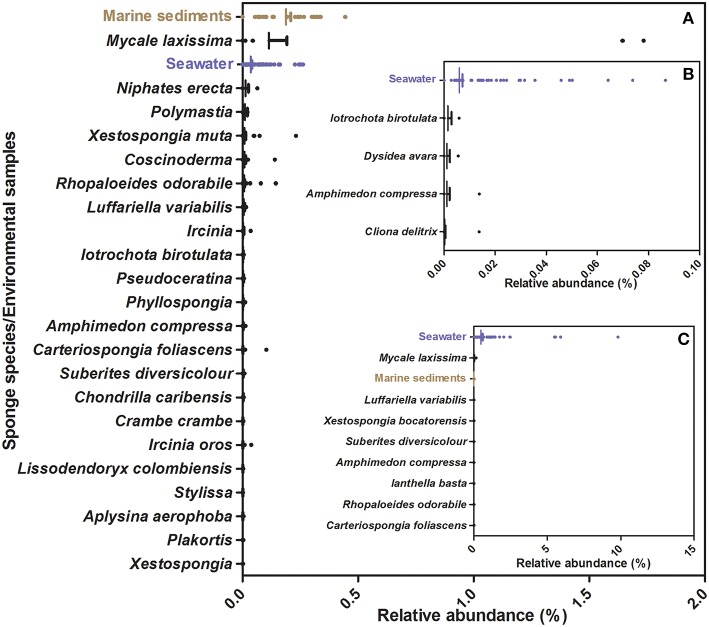
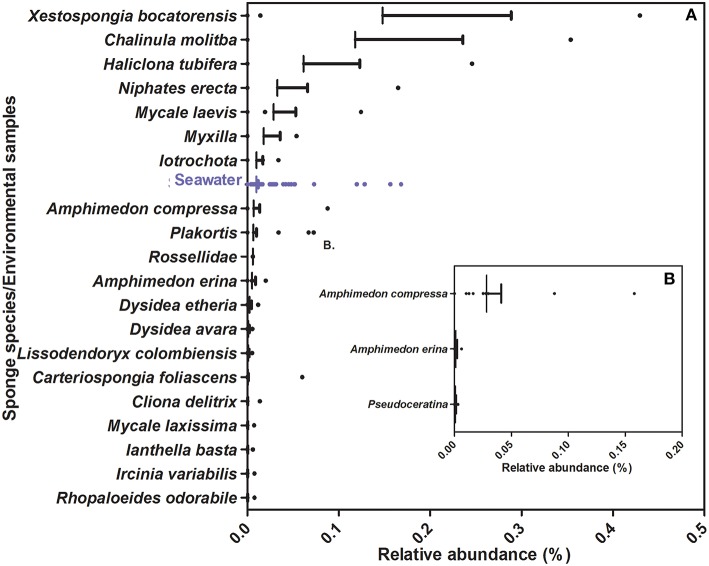
Relative abundance of OTUs from the Sponge Microbiome Project with ≥98% identity to 16S rRNA sequences from strains isolated in this study. (A) Information relative to OTUs closely affiliated to isolate Cc27, (B) Information relative to OTUs closely affiliated with isolate Pv91. (C) Information relative to OTUs closely affiliated with isolates Pv86. Vertical bar represents the mean, the hinge represents SEM (Standard Error of Mean), and dots represent outlier values beyond mean.
Figure 6
Figure 6
Relative abundance of OTUs from the Sponge Microbiome Project with ≥98% identity to 16S rRNA sequences from strains isolated in this study. (A) Information relative to OTUs closely affiliated to isolate Ss68, (B) Information relative to OTUs closely affiliated with isolate Ac17. Vertical bar represents the mean, the hinge represents SEM (Standard Error of Mean) and dots represent outlier values beyond mean.
Figure 7
Figure 7
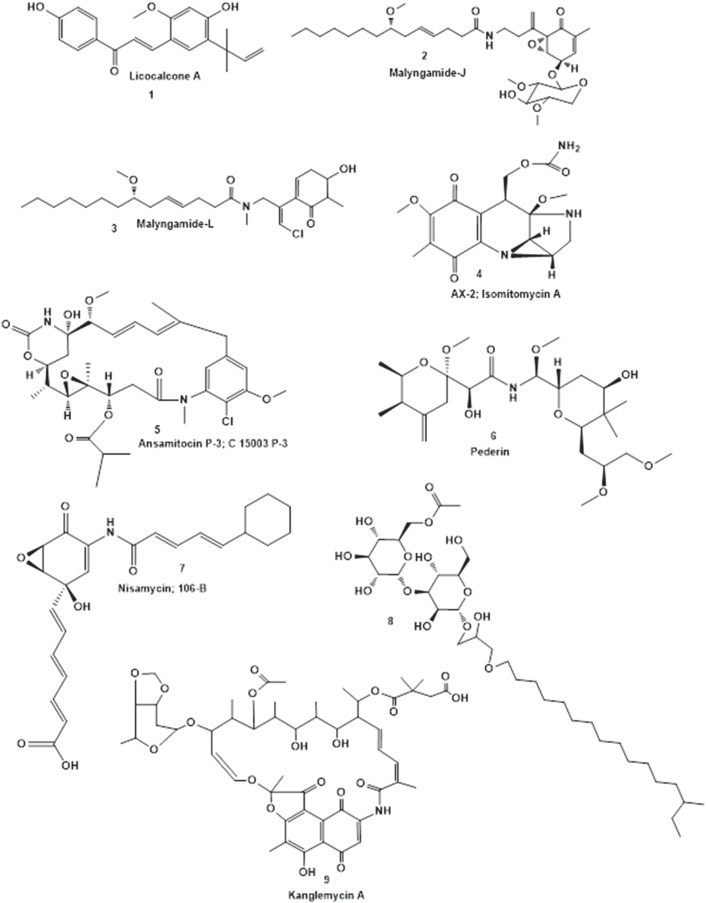
Chemical structures of representative secondary metabolites putatively identified by LC-HRMS/MS in crude extracts of Cc27 (1-3), Ss68, Pv86 (4-6), and Pv91 (7-9) using AntiMarin database.

References

    1. Abdelmohsen U. R., Pimentel-Elardo S. M., Hanora A., Radwan M., Abou-El-Ela S. H., Ahmed S., et al. (2010). Isolation, phylogenetic analysis and anti-infective activity screening of marine sponge-associated actinomycetes. Mar. Drugs 8, 399–412. 10.3390/md8030399 - DOI - PMC - PubMed
    1. Abed C., Legrave N., Dufies M., Robert G., Guerineau V., Vacelet J., et al. (2011). A new hydroxylated nonaprenylhydroquinone from the Mediterranean marine sponge Sarcotragus spinosulus. Mar Drugs 9, 1210–1219. 10.3390/md9071210 - DOI - PMC - PubMed
    1. Ainslie R. D., Barchi J. J., Kuniyoshi M., Moore R. E., Mynderse J. S. (1985). Structure of malyngamide C. J. Organ. Chem. 50, 2859–2862.
    1. Alex A., Antunes A. (2015). Whole genome sequencing of the symbiont Pseudovibrio sp. from the intertidal marine sponge Polymastia penicillus revealed a gene repertoire for host-switching permissive lifestyle. Genome Biol. Evol. 7, 3022–3032. 10.1093/gbe/evv199 - DOI - PMC - PubMed
    1. Altschul S. F., Madden T. L., Schaffer A. A., Zhang J., Zhang Z., Miller W., et al. (1997). Gapped BLAST and PSI-BLAST: a new generation of protein database search programs. Nucleic Acids Res. 25, 3389–3402. - PMC - PubMed

LinkOut - more resources