


Exploring the Symbiodinium rare biosphere provides evidence for symbiont switching in reef-building corals
- PMID: 27093048
- PMCID: PMC5113844
- DOI: 10.1038/ismej.2016.54
Exploring the Symbiodinium rare biosphere provides evidence for symbiont switching in reef-building corals
Abstract
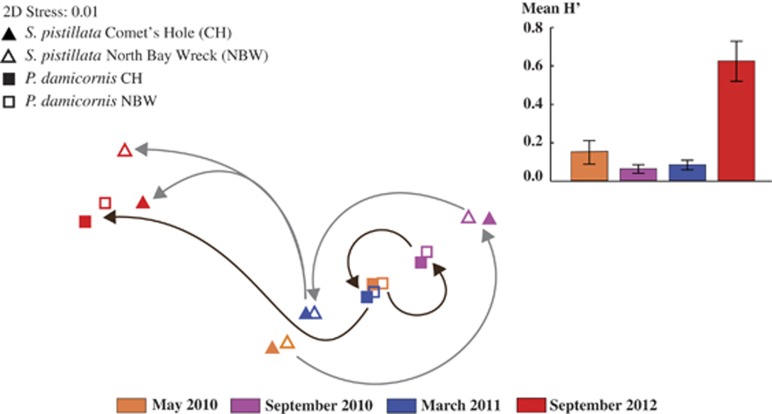
Reef-building corals possess a range of acclimatisation and adaptation mechanisms to respond to seawater temperature increases. In some corals, thermal tolerance increases through community composition changes of their dinoflagellate endosymbionts (Symbiodinium spp.), but this mechanism is believed to be limited to the Symbiodinium types already present in the coral tissue acquired during early life stages. Compelling evidence for symbiont switching, that is, the acquisition of novel Symbiodinium types from the environment, by adult coral colonies, is currently lacking. Using deep sequencing analysis of Symbiodinium rDNA internal transcribed spacer 2 (ITS2) PCR amplicons from two pocilloporid coral species, we show evidence consistent with de novo acquisition of Symbiodinium types from the environment by adult corals following two consecutive bleaching events. Most of these newly detected symbionts remained in the rare biosphere (background types occurring below 1% relative abundance), but one novel type reached a relative abundance of ~33%. Two de novo acquired Symbiodinium types belong to the thermally resistant clade D, suggesting that this switching may have been driven by consecutive thermal bleaching events. Our results are particularly important given the maternal mode of Symbiodinium transmission in the study species, which generally results in high symbiont specificity. These findings will cause a paradigm shift in our understanding of coral-Symbiodinium symbiosis flexibility and mechanisms of environmental acclimatisation in corals.
Figures

References
-
- Ateweberhan M, Feary DA, Keshavmurthy S, Chen A, Schleyer MH, Sheppard CR. (2013). Climate change impacts on coral reefs: synergies with local effects, possibilities for acclimation, and management implications. Mar Pollut Bull 74: 526–539. - PubMed
-
- Ayre DJ, Hughes TP. (2004). Climate change, genotypic diversity and gene flow in reef-building corals. Ecol Lett 7: 273–278.
-
- Baker AC, Starger CJ, McClanahan TR, Glynn PW. (2004). Corals' adaptive response to climate change: Shifting to new algal symbionts may safeguard devastated reefs from extinction. Nature 430: 741. - PubMed
-
- Baker AC. (2003). Flexibility and specificity in coral-algal symbiosis: diversity, ecology, and biogeography of Symbiodinium. Annu Rev Ecol Evol Syst 34: 661–689.
MeSH terms
LinkOut - more resources
Full Text Sources
Other Literature Sources
Miscellaneous
