


Reduced habituation of auditory evoked potentials indicate cortical hyper-excitability in Fragile X Syndrome
- PMID: 27093069
- PMCID: PMC4872406
- DOI: 10.1038/tp.2016.48
Reduced habituation of auditory evoked potentials indicate cortical hyper-excitability in Fragile X Syndrome
Abstract
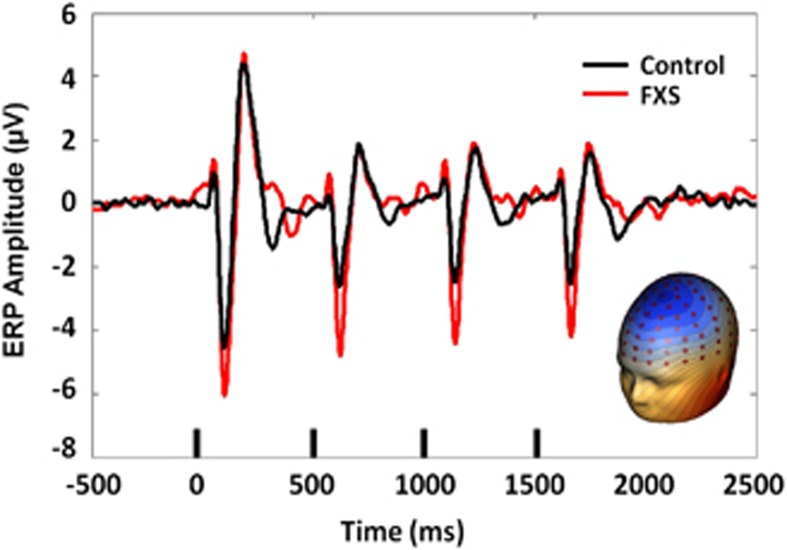
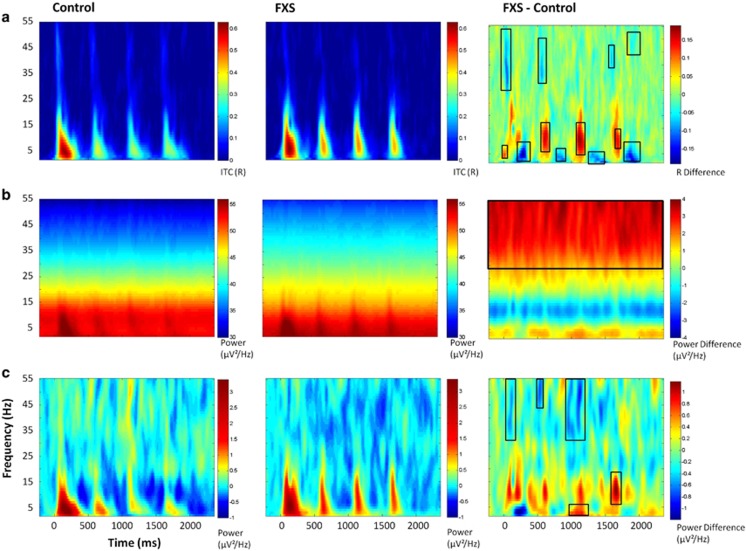
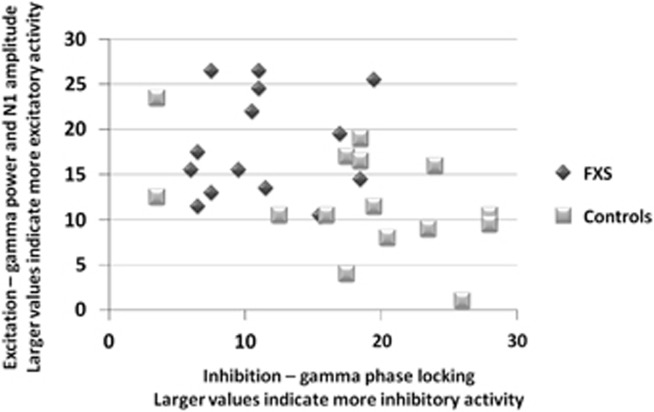
Sensory hypersensitivities are common, clinically distressing features of Fragile X Syndrome (FXS). Preclinical evidence suggests this abnormality may result from synaptic hyper-excitability in sensory systems. This model predicts reduced sensory habituation to repeated stimulus presentation. Fourteen adolescents and adults with FXS and 15 age-matched controls participated in a modified auditory gating task using trains of 4 identical tones during dense array electroencephalography (EEG). Event-related potential and single trial time-frequency analyses revealed decreased habituation of the N1 event-related potential response in FXS, and increased gamma power coupled with decreases in gamma phase-locking during the early-stimulus registration period. EEG abnormalities in FXS were associated with parent reports of heightened sensory sensitivities and social communication deficits. Reduced habituation and altered gamma power and phase-locking to auditory cues demonstrated here in FXS patients parallels preclinical findings with Fmr1 KO mice. Thus, the EEG abnormalities seen in FXS patients support the model of neocortical hyper-excitability in FXS, and may provide useful translational biomarkers for evaluating novel treatment strategies targeting its neural substrate.
Conflict of interest statement
JAS served as a consultant to Takeda, Roche and Lilly. MJB reports research grant funding and speaker's bureau support from Otsuka. The remaining authors declare no conflict of interest.
Figures
References
-
- Matsuzaki J, Kagitani-Shimono K, Goto T, Sanefuji W, Yamamoto T, Sakai S et al. Differential responses of primary auditory cortex in autistic spectrum disorder with auditory hypersensitivity. Neuroreport 2012; 23: 113–118. - PubMed
Publication types
MeSH terms
Grants and funding
LinkOut - more resources
Full Text Sources
Other Literature Sources
Medical
Research Materials
