


Dimensions of depressive symptoms and cingulate volumes in older adults
- PMID: 27093070
- PMCID: PMC4872407
- DOI: 10.1038/tp.2016.49
Dimensions of depressive symptoms and cingulate volumes in older adults
Abstract
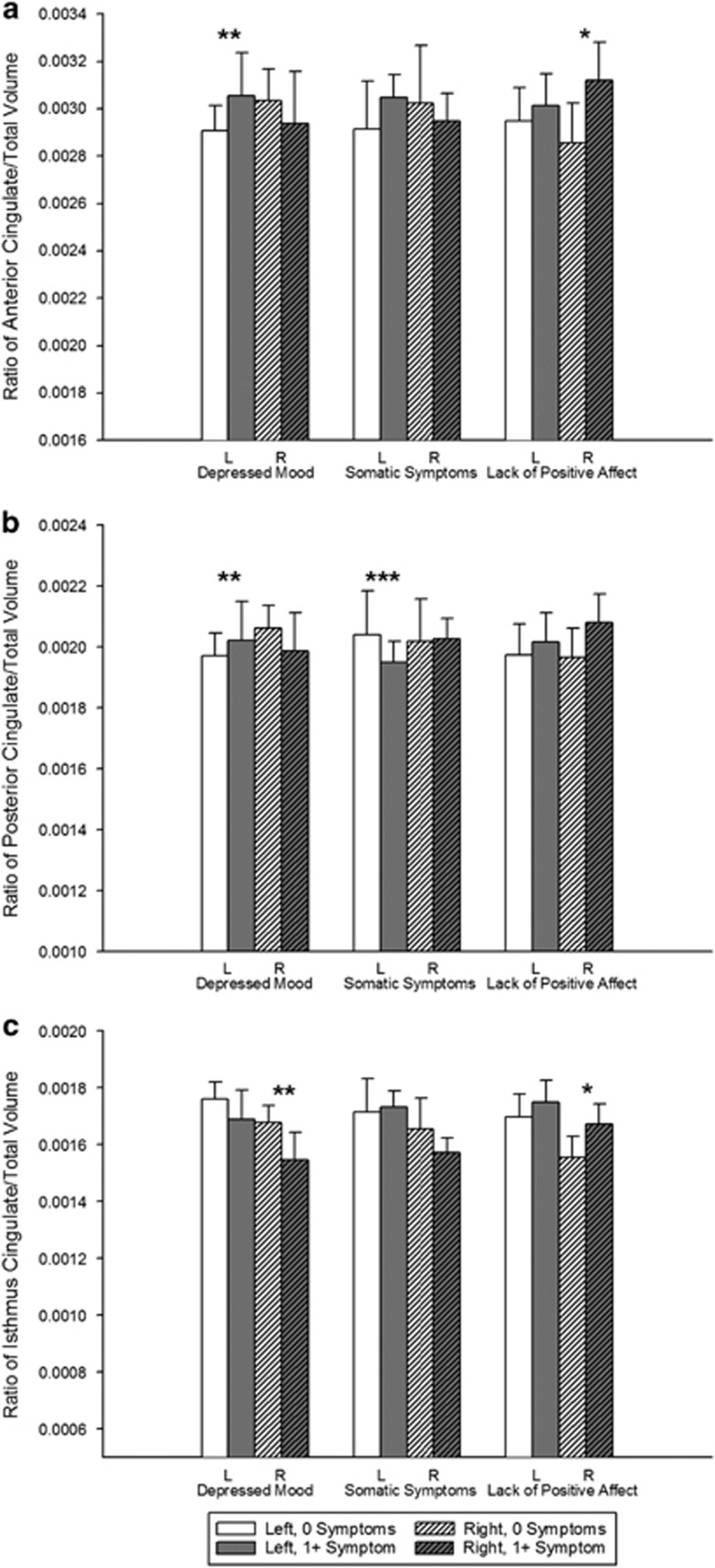
Clinical depression and subthreshold depressive symptoms in older adults have been linked to structural changes in the cingulate gyrus. The cingulate comprises functionally distinct subregions that may have distinct associations with different types, or symptom dimensions, of depression. This study examined the relationship between symptom dimensions of depression and gray matter volumes in the anterior cingulate, posterior cingulate and isthmus of the cingulate in a nonclinical sample. The study included 41 community-dwelling older adults between the ages of 55 and 81. Participants received a structural magnetic resonance imaging scan and completed the Center for Epidemiologic Studies Depression Scale. Subscale scores for depressed mood, somatic symptoms and lack of positive affect were calculated, and Freesurfer was used to extract cingulate gray matter volumes. Regression analyses were conducted to examine the relationship between depressive symptoms and volumes of cingulate subregions while controlling for sex, age and estimated total intracranial volume. Higher scores on the depressed mood subscale were associated with larger volumes in the left posterior cingulate and smaller volumes in the isthmus cingulate. Higher scores on the somatic symptoms subscale were significantly related to smaller volumes in the posterior cingulate. A trend was observed for a positive relationship between higher scores on the lack of positive affect subscale and larger volumes in the anterior cingulate cortex. These results are consistent with previous findings of altered cingulate volumes with increased depressive symptomatology and suggest specific symptom dimensions of depression may differ in their relationship with subregions of the cingulate.
Figures
References
-
- Naismith SL, Norrie LM, Mowszowski L, Hickie IB. The neurobiology of depression in later-life: clinical, neuropsychological, neuroimaging and pathophysiological features. Prog Neurobiol 2012; 98: 99–143. - PubMed
-
- Kumar A, Schweizer E, Zhisong J, Miller D, Bilker W, Swan LL et al. Neuroanatomical substrates of late-life minor depression: a quantitative magnetic resonance imaging study. Arch Neurol 1997; 54: 613–617. - PubMed
-
- Taki Y, Kinomura S, Awata S, Inoue K, Sato K, Ito H et al. Male elderly subthreshold depression patients have smaller volume of medial part of prefrontal cortex and precentral gyrus compared with age-matched normal subjects: a voxel-based morphometry. J Affect Disord 2005; 88: 313–320. - PubMed
Publication types
MeSH terms
Grants and funding
LinkOut - more resources
Full Text Sources
Other Literature Sources
