. 2016 Sep;55(3):439-49.
doi: 10.1165/rcmb.2015-0304OC.

DJ-1 Modulates Nuclear Erythroid 2-Related Factor-2-Mediated Protection in Human Primary Alveolar Type II Cells in Smokers

Affiliations

DJ-1 Modulates Nuclear Erythroid 2-Related Factor-2-Mediated Protection in Human Primary Alveolar Type II Cells in Smokers

Karim Bahmed et al. Am J Respir Cell Mol Biol. 2016 Sep.

Abstract

Cigarette smoke (CS) is a main source of oxidative stress and a key risk factor for emphysema, which consists of alveolar wall destruction. Alveolar type (AT) II cells are in the gas exchange regions of the lung. We isolated primary ATII cells from deidentified organ donors whose lungs were not suitable for transplantation. We analyzed the cell injury obtained from nonsmokers, moderate smokers, and heavy smokers. DJ-1 protects cells from oxidative stress and induces nuclear erythroid 2-related factor-2 (Nrf2) expression, which activates the antioxidant defense system. In ATII cells isolated from moderate smokers, we found DJ-1 expression by RT-PCR, and Nrf2 and heme oxygenase (HO)-1 translocation by Western blotting and immunocytofluorescence. In ATII cells isolated from heavy smokers, we detected Nrf2 and HO-1 cytoplasmic localization. Moreover, we found high oxidative stress, as detected by 4-hydroxynonenal (4-HNE) (immunoblotting), inflammation by IL-8 and IL-6 levels by ELISA, and apoptosis by terminal deoxynucleotidyl transferase dUTP nick end labeling (TUNEL) assay in ATII cells obtained from heavy smokers. Furthermore, we detected early DJ-1 and late Nrf2 expression after ATII cell treatment with CS extract. We also overexpressed DJ-1 by adenovirus construct and found that this restored Nrf2 and HO-1 expression and induced nuclear translocation in heavy smokers. Moreover, DJ-1 overexpression also decreased ATII cell apoptosis caused by CS extract in vitro. Our results indicate that DJ-1 activates the Nrf2-mediated antioxidant defense system. Furthermore, DJ-1 overexpression can restore the impaired Nrf2 pathway, leading to ATII cell protection in heavy smokers. This suggests a potential therapeutic strategy for targeting DJ-1 in CS-related lung diseases.

Keywords: DJ-1; alveolar type II cells; cigarette smoke; nuclear erythroid 2–related factor-2.


Figures
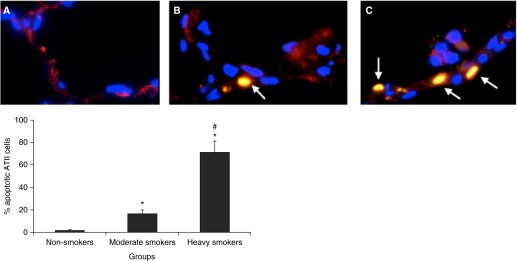
Figure 1.
Figure 1.
Cigarette smoke (CS) induces apoptosis in alveolar type (AT) II cells isolated from heavy smokers ex vivo. (A) nonsmokers; (B) moderate smokers; (C) heavy smokers. ATII cells in the lung tissue sections were identified by staining with prosurfactant protein-C (red), and apoptotic cells were detected by terminal deoxynucleotidyl transferase dUTP nick end labeling (TUNEL) assay. Nuclei were stained with 4′,6-diamidino-2-phenylindole (DAPI, blue). Apoptotic ATII cells are shown by arrows. *Statistically significant increase compared with control (P < 0.05); #statistically significant increase compared with moderate smokers (n = 6). Data are shown as the mean (±SEM).
Figure 2.
Figure 2.
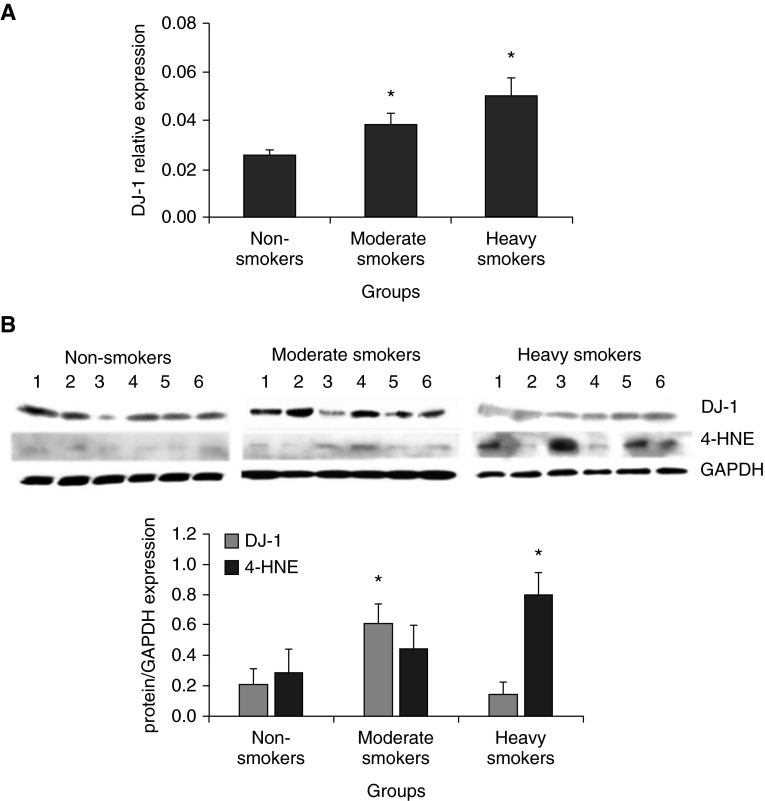
DJ-1 mRNA and protein expression in ATII cells ex vivo. DJ-1 mRNA expression by RT-PCR (A) and protein (B) levels (immunoblotting) were analyzed from freshly isolated ATII cells obtained from nonsmokers, moderate smokers, and heavy smokers. Relative expression is also shown. *Statistically significant increase in comparison with control (P < 0.05; n = 6). Data are shown as the mean (±SEM). 4-HNE, 4-hydroxynonenal.
Figure 3.
Figure 3.
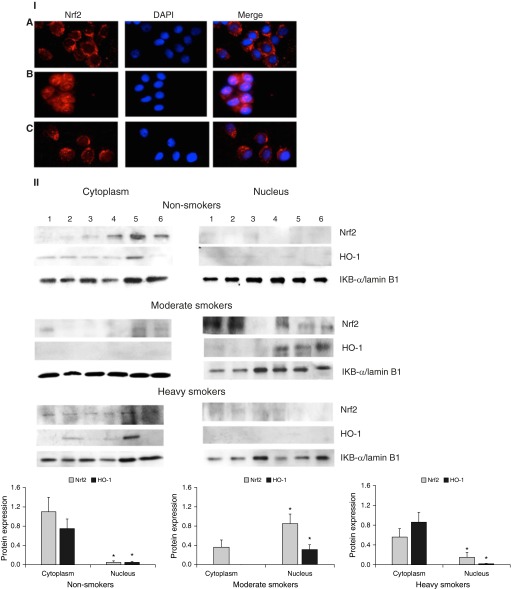
Nuclear erythroid 2–related factor-2 (Nrf2) localization in ATII cells isolated from moderate smokers ex vivo. Panel I: representative pictures of Nrf2 localization in ATII cell cytospin on the day of isolation. (A) Nonsmoker; (B) moderate smoker; (C) heavy smoker (immunocytofluorescence). Panel II: Nrf2 and heme oxygenase (HO)-1 localization in nuclear and cytoplasmic fractions in freshly isolated ATII cells obtained from nonsmokers, moderate smokers, and heavy smokers (immunoblotting). IκB-α and lamin B1 were used for cytoplasmic and nuclear fractions, respectively. Relative expression is also shown. Data are shown as the mean (±SEM), n = 6, *P < 0.05.
Figure 4.
Figure 4.
CS extract (CSE) induces early DJ-1 and late Nrf2 expression in ATII cells in vitro. ATII cells were isolated from nonsmokers, cultured, and treated with 3% CSE in vitro, as described in the Materials and Methods section for different times (immunoblotting; C, control). Relative expression of these proteins is also shown. *Statistically significant increase in comparison with control (P < 0.05; n = 3). Data are shown as the mean (±SEM).
Figure 5.
Figure 5.
High IL-8 and IL-6 levels in ATII cells isolated from heavy smokers ex vivo. IL-8 and IL-6 levels were analyzed in freshly isolated ATII cells obtained from nonsmokers, moderate smokers, and heavy smokers by ELISA. *Statistically significant increase compared with nonsmokers; #statistically significant increase compared with moderate smokers (P < 0.05; n = 6). Data are shown as the mean (±SEM).
Figure 6.
Figure 6.
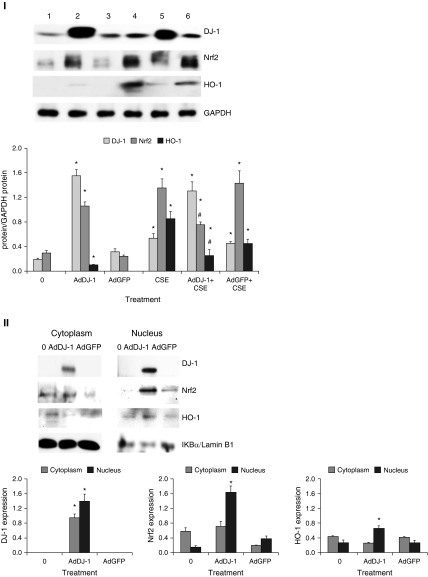
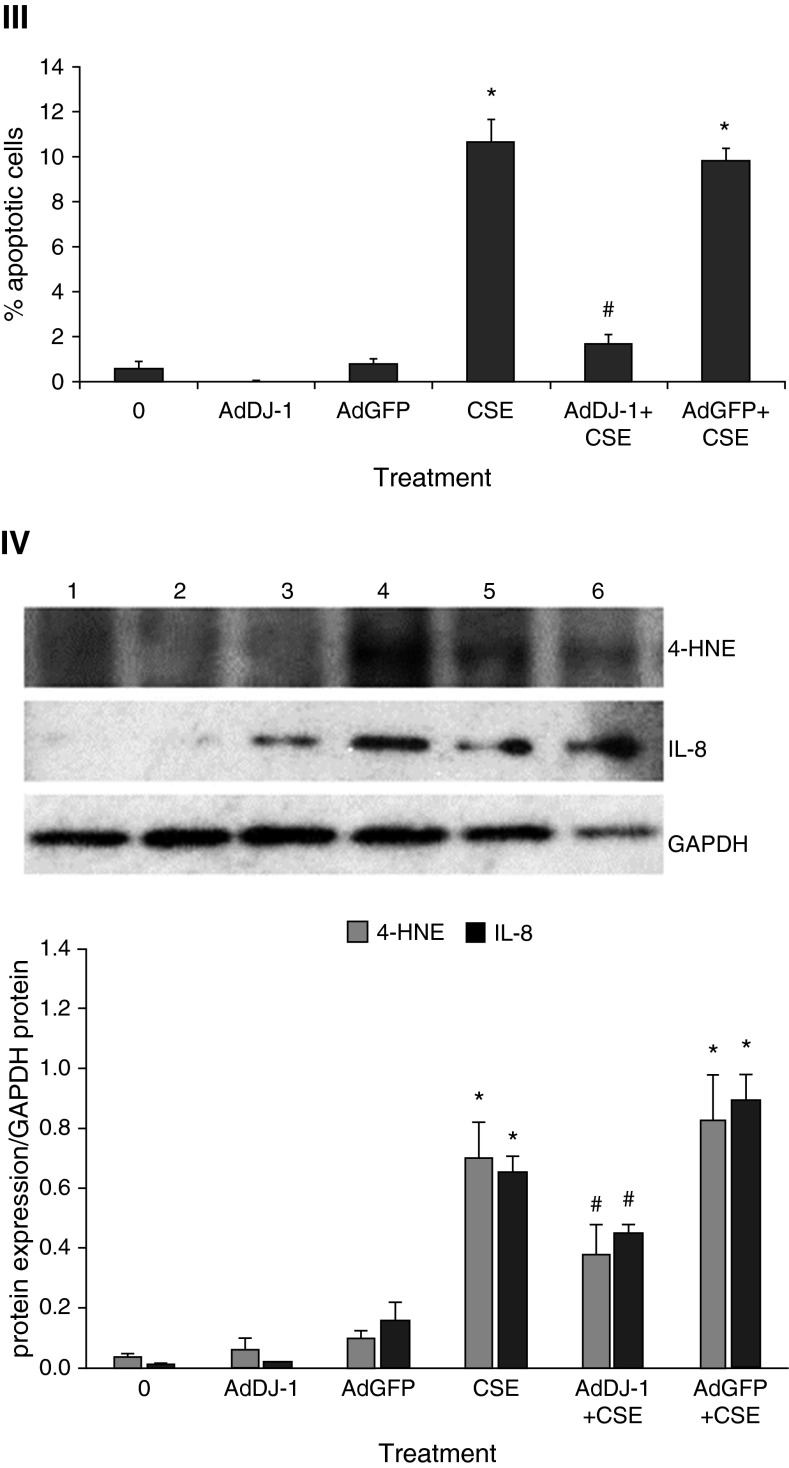
DJ-1 overexpression activates Nrf2 and decreases apoptosis of ATII cells induced by CSE in vitro. ATII cells were cultured, infected with adenovirus (Ad) DJ-1 or AdGFP, and treated with 3% CSE for 24 hours, as described in the Materials and Methods section. Panel I: AdDJ-1 increases Nrf2 and HO-1 expression. Lane 1, control; lane 2, AdDJ-1; lane 3, AdGFP; lane 4, CSE; lane 5, AdDJ-1 + CSE; lane 6, AdGFP + CSE. Relative expression is also shown. *Statistically significant increase in comparison with control. #Statistically significant decrease compared with CSE alone (P < 0.05; n = 3). Panel II: AdDJ-1 restores Nrf2 and HO-1 nuclear expression in ATII cells isolated from heavy smokers. Relative expression of these proteins is shown. *Statistically significant increase in comparison with control (P < 0.05; n = 6). Panel III: AdDJ-1 decreases apoptosis of ATII cells induced by 3% CSE in vitro. Cells were infected with AdDJ-1 followed by treatment with 3% CSE, as described in the Materials and Methods section. Apoptosis was analyzed by TUNEL assay. *Statistically significant increase in comparison with control. #Statistically significant decrease compared with CSE alone (P < 0.05; n = 3). Panel IV: AdDJ-1 decreases oxidative stress and inflammatory response induced by 3% CSE in ATII cells as measured by 4-HNE and IL-8 expression, respectively. Lane 1, control; lane 2, AdDJ-1; lane 3, AdGFP; lane 4, CSE; lane 5, AdDJ-1 + CSE; lane 6, AdGFP + CSE. Relative expression is also shown. *Statistically significant increase in comparison with control. #Statistically significant decrease compared with CSE alone (P < 0.05; n = 3). Data are shown as the mean (±SEM).
Figure 6.
Figure 6.
DJ-1 overexpression activates Nrf2 and decreases apoptosis of ATII cells induced by CSE in vitro. ATII cells were cultured, infected with adenovirus (Ad) DJ-1 or AdGFP, and treated with 3% CSE for 24 hours, as described in the Materials and Methods section. Panel I: AdDJ-1 increases Nrf2 and HO-1 expression. Lane 1, control; lane 2, AdDJ-1; lane 3, AdGFP; lane 4, CSE; lane 5, AdDJ-1 + CSE; lane 6, AdGFP + CSE. Relative expression is also shown. *Statistically significant increase in comparison with control. #Statistically significant decrease compared with CSE alone (P < 0.05; n = 3). Panel II: AdDJ-1 restores Nrf2 and HO-1 nuclear expression in ATII cells isolated from heavy smokers. Relative expression of these proteins is shown. *Statistically significant increase in comparison with control (P < 0.05; n = 6). Panel III: AdDJ-1 decreases apoptosis of ATII cells induced by 3% CSE in vitro. Cells were infected with AdDJ-1 followed by treatment with 3% CSE, as described in the Materials and Methods section. Apoptosis was analyzed by TUNEL assay. *Statistically significant increase in comparison with control. #Statistically significant decrease compared with CSE alone (P < 0.05; n = 3). Panel IV: AdDJ-1 decreases oxidative stress and inflammatory response induced by 3% CSE in ATII cells as measured by 4-HNE and IL-8 expression, respectively. Lane 1, control; lane 2, AdDJ-1; lane 3, AdGFP; lane 4, CSE; lane 5, AdDJ-1 + CSE; lane 6, AdGFP + CSE. Relative expression is also shown. *Statistically significant increase in comparison with control. #Statistically significant decrease compared with CSE alone (P < 0.05; n = 3). Data are shown as the mean (±SEM).

References

    1. Witschi H, Espiritu I, Peake JL, Wu K, Maronpot RR, Pinkerton KE. The carcinogenicity of environmental tobacco smoke. Carcinogenesis. 1997;18:575–586. - PubMed
    1. Bhalla DK, Hirata F, Rishi AK, Gairola CG. Cigarette smoke, inflammation, and lung injury: a mechanistic perspective. J Toxicol Environ Health B Crit Rev. 2009;12:45–64. - PubMed
    1. Yoshida T, Mett I, Bhunia AK, Bowman J, Perez M, Zhang L, Gandjeva A, Zhen L, Chukwueke U, Mao T, et al. Rtp801, a suppressor of mTOR signaling, is an essential mediator of cigarette smoke–induced pulmonary injury and emphysema. Nat Med. 2010;16:767–773. - PMC - PubMed
    1. Barnes PJ. Chronic obstructive pulmonary disease. N Engl J Med. 2000;343:269–280. - PubMed
    1. Betarbet R, Canet-Aviles RM, Sherer TB, Mastroberardino PG, McLendon C, Kim JH, Lund S, Na HM, Taylor G, Bence NF, et al. Intersecting pathways to neurodegeneration in Parkinson’s disease: effects of the pesticide rotenone on DJ-1, α-synuclein, and the ubiquitin-proteasome system. Neurobiol Dis. 2006;22:404–420. - PubMed

Publication types