


Long versus short cephalomedullary nail for trochanteric femur fractures (OTA 31-A1, A2 and A3): a systematic review
- PMID: 27093971
- PMCID: PMC5071234
- DOI: 10.1007/s10195-016-0405-z
Long versus short cephalomedullary nail for trochanteric femur fractures (OTA 31-A1, A2 and A3): a systematic review
Abstract
Background: Both long and short cephalomedullary nails (CMN) may be used to treat trochanteric femur fractures. The objective of this paper was to compare the clinical outcomes between long and short CMN in the treatment of trochanteric hip fractures.
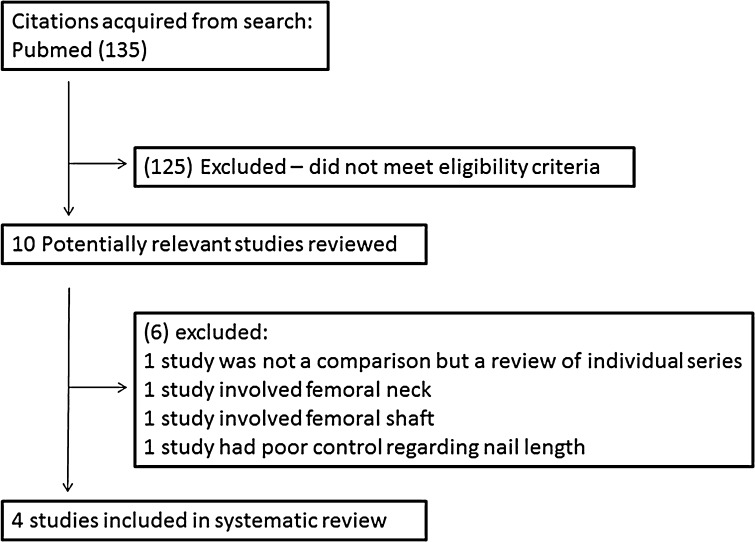
Materials and methods: A literature search was performed, identifying 135 papers; 4 of which met inclusion and exclusion criteria. Papers included were those that compared cohorts of long and short nails for stable trochanteric femur fractures of level III evidence or superior. Data was pooled and analyzed, focusing on reoperation rate, secondary femoral shaft fracture rate, estimated blood loss, transfusion rate, operative time and length of stay.
Results: Included in the analysis were 1276 patients, with 438 short and 838 long CMN. The average age was 82.0 years for short CMN and 79.0 years for long CMN (P = 0.0002). The average follow up was 18 months, 46 % were male, and 71 % had an ASA (American Society of Anesthesiologists score) classification ≥3. The rate of reoperation was 5.0 % and 3.8 % for short and long CMN, respectively (P = 0.31). The rate of refracture was 1.6 % and 0.95 % for short and long CMN, respectively (P = 0.41). As compared to long nails, short nails had an average blood loss of 39 mL less (P = 0.0003), an 8.8 % decrease in transfusion rate (P = 0.07), and incurred 19 min less operative time (P < 0.0001). No significant differences between short and long nails were observed for either other complications, hardware complications, non-union, or mortality.
Conclusions: For trochanteric femur fractures, short CMN have a low reoperation rate while significantly decreasing operative time and estimated blood loss with the additional benefit of being cost effective.
Level of evidence: Level 3.
Keywords: Cephalomedullary nail; Hip fracture; Hospital cost; Reoperation.
Conflict of interest statement
Compliance with ethical standards Funding None. Research involving human participants/animals This article does not contain any studies with human participants or animals performed by any of the authors. Conflict of interest The authors declare that they have no conflict of interest. Informed consent For this type of study formal consent is not required. Disclaimers Some authors are employees of the United States Federal Government and the US Army. The opinions or assertions contained herein are the private views of the authors and are not to be construed as official or reflecting the views of William Beaumont Army Medical Center, the Department of Defense, or US government. The American College of Surgeons National Surgical Quality Improvement Program and the hospitals participating in the ACS NSQIP are the source of the data used herein; they have not verified and are not responsible for the statistical validity of the data analysis or the conclusions derived by the authors.
References
Publication types
MeSH terms
LinkOut - more resources
Full Text Sources
Other Literature Sources
Medical
Research Materials
Miscellaneous
