Epidermal growth factor receptor mutation and pattern of brain metastasis in patients with non-small cell lung cancer
- PMID: 27093978
- PMCID: PMC5768530
- DOI: 10.3904/kjim.2015.158
Epidermal growth factor receptor mutation and pattern of brain metastasis in patients with non-small cell lung cancer
Abstract
Background/aims: We investigated the time taken for patients with metastatic non-small cell lung cancer (NSCLC) to develop brain metastases (BM), as well as their subsequent overall median survival following diagnosis, considering the epidermal growth factor receptor (EGFR) mutational status.
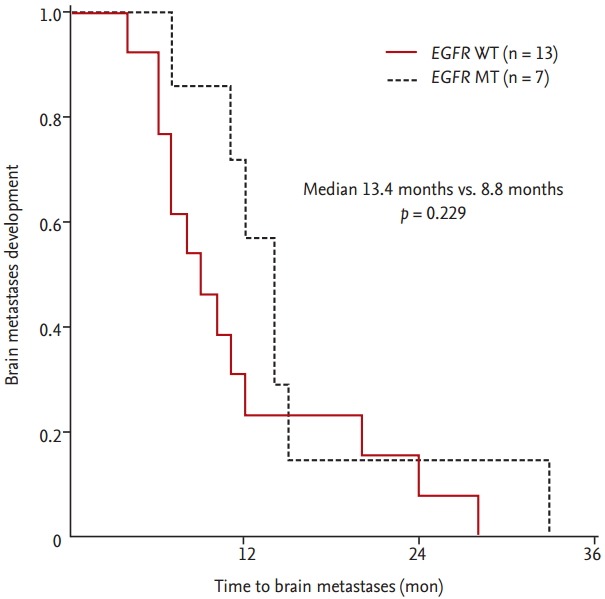
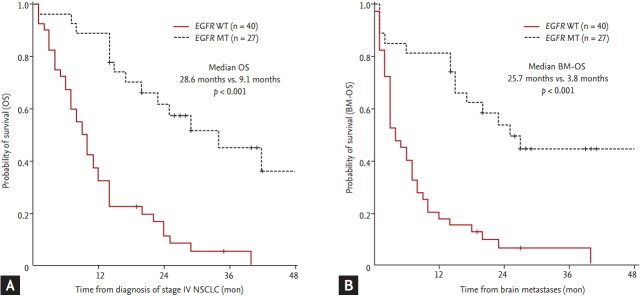
Methods: We retrospectively investigated the medical records of 259 patients diagnosed with advanced NSCLC from January 2010 to August 2013, who were tested for EGFR mutations. The time from the diagnosis of advanced NSCLC to the development of BM and the overall median survival after BM development (BM-OS) were evaluated and compared by EGFR mutational status.
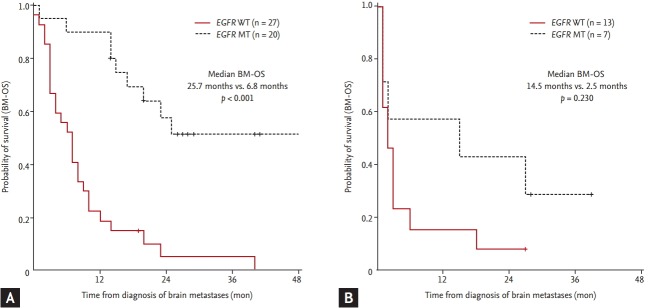
Results: Sixty-seven patients (25.9%) developed BM. Synchronous BM occurred more often in patients with EGFR mutation type (MT) (n = 20, 27.4%) compared with EGFR wild type (WT) (n = 27, 14.5%, p < 0.009). The median BM-OS was significantly longer in patients with EGFR MT than in those with EGFR WT (25.7 months vs. 3.8 months, p < 0.001), and a similar trend was noticed for patients with synchronous BM (25.7 months for EGFR MT vs. 6.8 months for EGFR WT, p < 0.001). However, in patients with metachronous BM development, the difference in BM-OS between patients with EGFR MT (14.6 months) and EGFR WT (2.5 months) did not reach statistical significance (p = 0.230).
Conclusions: Synchronous BM was more common in NSCLC patients with EGFR MT than in those with EGFR WT. However, EGFR mutations were associated with significantly longer median BM-OS, especially when the brain was the first metastatic site.
Keywords: Brain metastases; Carcinoma, non-small-cell lung; Prognosis; Receptor, epidermal growth factor.
Conflict of interest statement
No potential conflict of interest relevant to this article was reported.
Figures
References
-
- Maemondo M, Inoue A, Kobayashi K, et al. Gefitinib or chemotherapy for non-small-cell lung cancer with mutated EGFR. N Engl J Med. 2010;362:2380–2388. - PubMed
-
- Mok TS, Wu YL, Thongprasert S, et al. Gefitinib or carboplatin-paclitaxel in pulmonary adenocarcinoma. N Engl J Med. 2009;361:947–957. - PubMed
-
- Zhou C, Wu YL, Chen G, et al. Erlotinib versus chemotherapy as first-line treatment for patients with advanced EGFR mutation-positive non-small-cell lung cancer (OPTIMAL, CTONG-0802): a multicentre, open-label, randomised, phase 3 study. Lancet Oncol. 2011;12:735–742. - PubMed
-
- Shin DY, Na II, Kim CH, Park S, Baek H, Yang SH. EGFR mutation and brain metastasis in pulmonary adenocarcinomas. J Thorac Oncol. 2014;9:195–199. - PubMed
MeSH terms
Substances
LinkOut - more resources
Full Text Sources
Other Literature Sources
Medical
Research Materials
Miscellaneous