


Study of surveillance data for class B notifiable disease in China from 2005 to 2014
- PMID: 27094249
- PMCID: PMC7110548
- DOI: 10.1016/j.ijid.2016.04.010
Study of surveillance data for class B notifiable disease in China from 2005 to 2014
Abstract
Background: The surveillance of infection is very important for public health management and disease control. It has been 10 years since China implemented its new web-based infection surveillance system, which covers the largest population in the world.
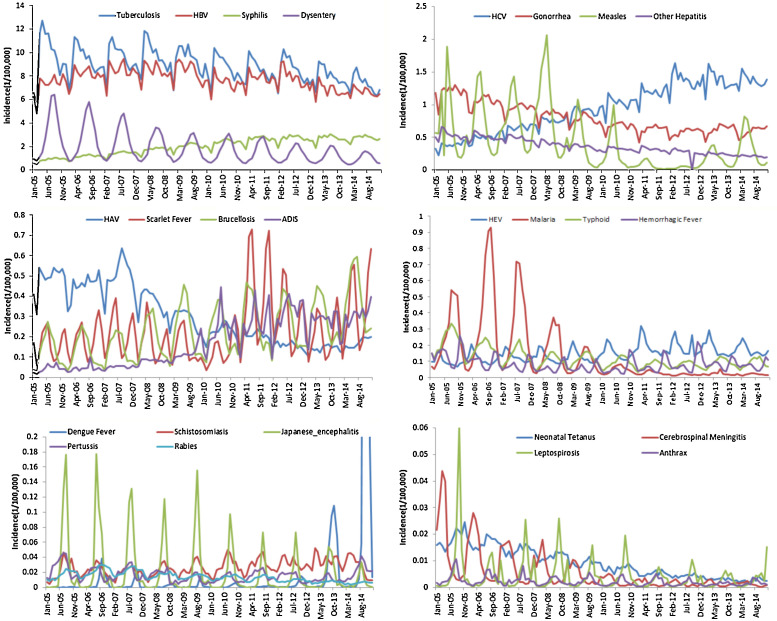
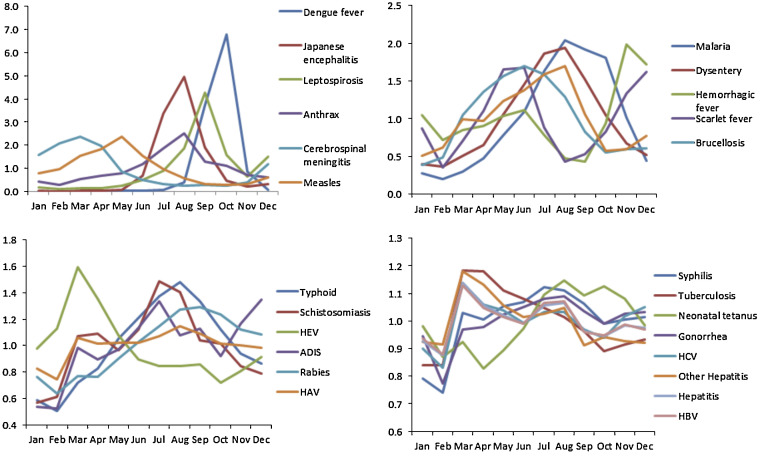
Methods: In this study, time series data were collected for 28 infectious diseases reported from 2005 to 2014 . Seasonality and long-term trends were explored using decomposition methods. Seasonality was expressed by calculating the seasonal indices. Long-term trends in the diseases were assessed using a linear regression model on the deseasonalized series.
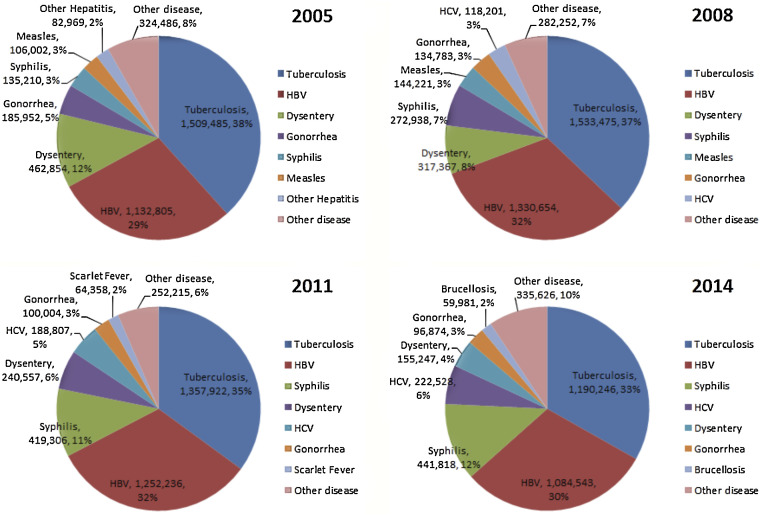
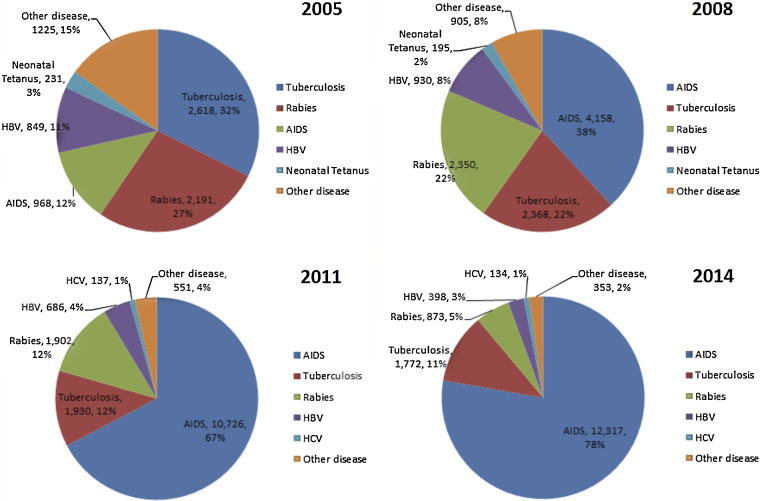
Results: During the 10-year period, 38 982 567 cases and 126 372 deaths were reported in the system. The proportion of deaths caused by AIDS increased from 12% in 2005 to 78% in 2014. There were six diseases for which the seasonal index range was greater than 2: dengue fever, Japanese encephalitis, leptospirosis, anthrax, cerebrospinal meningitis, and measles . Among the 28 diseases, the incidence of syphilis increased fastest, with an average increase of 0.018626/100 000 every month after adjustment for seasonality.
Conclusions: Effective surveillance is helpful in gaining a better understanding of the infection behaviour of infectious diseases; this will greatly facilitate disease control and management.
Keywords: Infectious disease; Long-term trend; Seasonality; Time series.
Copyright © 2016 The Authors. Published by Elsevier Ltd.. All rights reserved.
Figures
References
-
- Wang L, Wang Y, Yang G, Ma J, Wang L, Qi XP. China Information System for Disease Control and Prevention (CISDCP). .
-
- Kass-Hout T., Zhang X. CRC Press; 2010. Biosurveillance: methods and case studies.
-
- Guo Q., Zhang C., Ji Y., Wang L. Investigation of infectious disease direct reporting network management in Chinese medical institutions. Dis Surveill. 2010;25:410–413.
MeSH terms
LinkOut - more resources
Full Text Sources
Other Literature Sources
