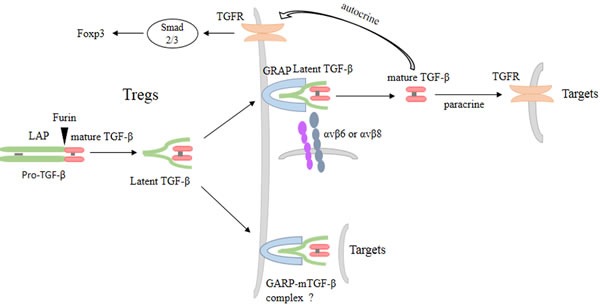
GARP: a surface molecule of regulatory T cells that is involved in the regulatory function and TGF-β releasing
- PMID: 27095576
- PMCID: PMC5173174
- DOI: 10.18632/oncotarget.8753
GARP: a surface molecule of regulatory T cells that is involved in the regulatory function and TGF-β releasing
Abstract
There are many molecules that define regulatory T cells (Tregs) phenotypically and functionally. Glycoprotein A repetitions predominant (GARP) is a transmembrane protein containing leucine rich repeats. Recently, GARP is found to express highly on the surface of activated Tregs. The combination of GARP and other surface molecules isolates Tregs with higher purity. Besides, GARP is a cell surface molecule of Tregs that maintains their regulatory function and homeosatsis. GARP has also been proved to promote the activation and secretion of transforming growth factor β (TGF-β). Moreover, its potential value in cancer immunotherapy is also discussed in this work.
Keywords: glycoprotein A repetitions predominant; regulatory T cells; transforming growth factor β.
Conflict of interest statement
The authors declare no conflict of interest.
Figures
References
-
- Schmetterer KG, Neunkirchner A, Pickl WF. Naturally occurring regulatory T cells: markers, mechanisms, and manipulation. FASEB journal. 2012;26(6):2253–2276. - PubMed
-
- Bluestone JA, Abbas AK. Natural versus adaptive regulatory T cells. Nature reviews Immunology. 2003;3(3):253–257. - PubMed
-
- Bilate AM, Lafaille JJ. Induced CD4+Foxp3+ regulatory T cells in immune tolerance. Annual review of immunology. 2012;30:733–758. - PubMed
-
- Horwitz DA, Zheng SG, Gray JD. Natural and TGF-beta-induced Foxp3(+)CD4(+) CD25(+) regulatory T cells are not mirror images of each other. Trends in immunology. 2008;29(9):429–435. - PubMed
Publication types
MeSH terms
Substances
LinkOut - more resources
Full Text Sources
Other Literature Sources