


The effect of adrenomedullin and proadrenomedullin N-terminal 20 peptide on angiotensin II induced vascular smooth muscle cell proliferation
- PMID: 27096064
- PMCID: PMC4823616
The effect of adrenomedullin and proadrenomedullin N-terminal 20 peptide on angiotensin II induced vascular smooth muscle cell proliferation
Abstract
Objectives: The study aimed to investigate the effects of adrenomedullin (ADM) and proadrenomedullin N- terminal 20 peptide (PAMP) on angiotensin (AngII)-stimulated proliferation in vascular smooth muscle cells (VSMCs).
Materials and methods: Thoracic aorta was obtained from Wistar rats and VSMCs were isolated from aorta tissues and then cultured. In vitro cultured VSMCs were stimulated with Ang II (10(-8) mol/l) followed by various doses of PAMP or ADM (10(-9), 10(-8), or 10(-7) mol/l). Cell proliferation as assessed by (3)H-TdR incorporation. Protein kinase C (PKC) activity was measured by counting γ-(32)P radioactivity with liquid scintillation. In a separate cohort, in vitro cultured rat aortic vessels were treated with different doses of Ang II or PAMP (10(-9), 10(-8), or 10(-7) mol/l). Cellular and secreted levels of PAMP, ADM and Ang II were measured using radioimmunoassay in the tissues and intubation mediums, respectively.
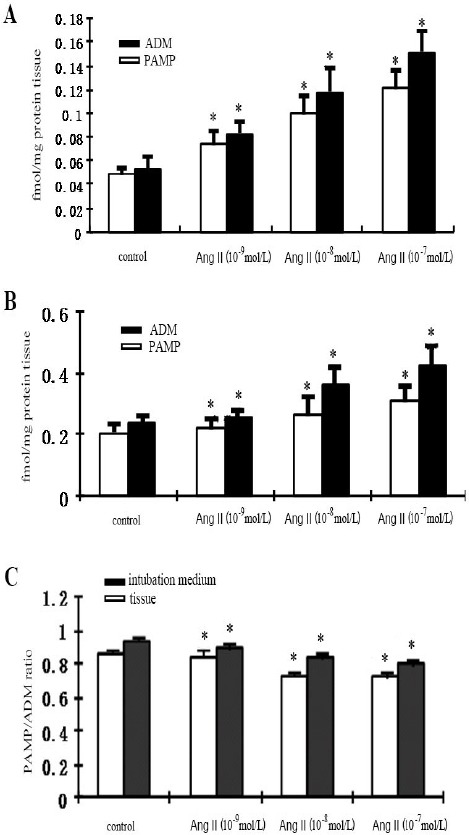
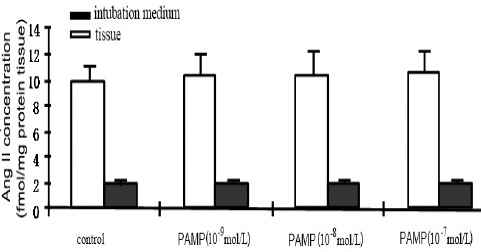
Results: Ang II (10(-8) mol/l) treatment significantly increased both (3)H-TdR incorporation and PKC activity in VSMCs (by 2.68 and 1.02-fold, respectively; both P<0.01 vs. the control). However, Ang II-induced elevation of (3)H-TdR incorporation, and PKC activity was significantly inhibited by various doses of ADM and PAMP (all P<0.01 vs. the Ang II group). In rat aortic vascular tissues or intubation media, Ang II treatments stimulated the expression and secretion of PAMP and ADM in a dose-dependent manner, while PAMP treatments had no significant effects on Ang II levels.
Conclusion: ADM and PAMP inhibit Ang II-induced VSMCs proliferation. The interaction of Ang II, ADM and PAMP may regulate VSMCs and cardiovascular function.
Keywords: Adrenomedulin; Angiotension II; Proadrenomedullin N-terminal 20 peptide; Proliferation; Vascular smooth muscle-cell.
Figures
References
-
- Nishikimi T, Kuwahara K, Nakagawa Y, Kangawa K, Nakao K. Adrenomedullin in cardiovascular diseases: a useful biomarker, its pathological roles and therapeutic application. Curr Protein Pept Sci. 2013;14:256–67. - PubMed
-
- Hirata Y, Takagi Y, Takata S, Fukuda Y, Yoshimi H, Fujita T. Calcitonin gene-related peptide receptor in cultured vascular smooth muscle and endothelial cells. Biochem Biophys Res Commun. 1988;151:1113–1121. - PubMed
-
- Haller H, Baur E, Quass P, Behrend M, Lindschau C, Distler A, et al. High glucose concentrations and protein kinase C isoforms in vascular smooth muscle cells. Kidney Int. 1995;47:1057–1067. - PubMed
-
- Shimosawa T, Fujita T. Hypotensive effect of a newly identified peptide, proadrenomedullin N-terminal 20 peptide. Hypertension. 1996;28:325–329. - PubMed
-
- Sugo S, Minamino N, Kangawa K, Miyamoto K, Kitamura K, Sakata J, et al. Endothelial cells actively synthesize and secrete adrenomedullin. Biochem Biophys Res Commun. 1994;201:1160–1166. - PubMed
LinkOut - more resources
Full Text Sources
Miscellaneous