


Are We There Yet? Compliance with Physical Activity Standards in YMCA Afterschool Programs
- PMID: 27096191
- PMCID: PMC4964753
- DOI: 10.1089/chi.2015.0223
Are We There Yet? Compliance with Physical Activity Standards in YMCA Afterschool Programs
Abstract
Background: In 2011, the YMCA of the United States adopted physical activity standards for all their afterschool programs (ASPs), which call for children to accumulate 30 minutes of moderate-to-vigorous physical activity (MVPA) while attending YMCA ASPs. The extent to which youth attending YMCA ASPs achieve this standard is unknown.
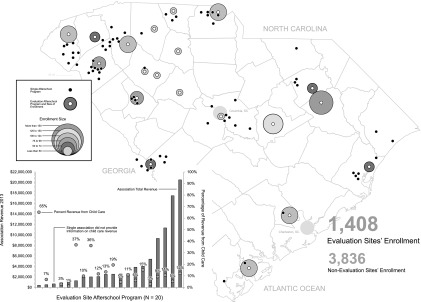
Methods: Using a cluster-stratified design, 20 ASPs were sampled from all YMCA-operated ASPs across South Carolina (N = 102). ASPs were visited on four unannounced, nonconsecutive weekdays. Accelerometer-derived minutes spent in MVPA were dichotomized to ≥30 min/d of MVPA and <30 min/d of MVPA. Program characteristics were measured through document review and direct observation and compared to MVPA levels using random-effects quantile regression.
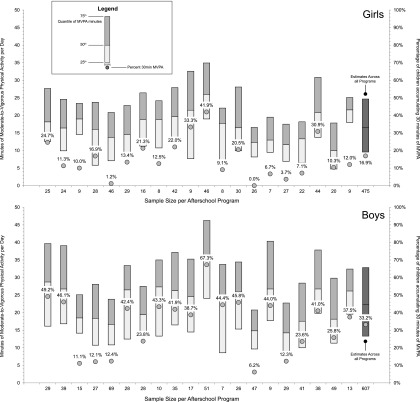
Results: Boys (n = 607) and girls (n = 475) accumulated a median of 25.3 and 17.1 min/d of MVPA, respectively, which translated into 33% (range 6.2%-67.3%) and 17% (0%-42.6%) achieving the 30 min/d of MVPA standard, respectively. Increase in time scheduled for activity (10.7-11.7 min/d of MVPA), limited sedentary choices during activity time (6.9-8.9 min/d of MVPA), and staff activity-promotion training (4.8-7.9 min/d of MVPA) were associated with higher accumulated minutes of MVPA for boys and girls. Program revenue, percent activity structure that was for free play, and indoor/outdoor space were inconsistently related to meeting the MVPA standard.
Conclusions: Modifiable programmatic structures were associated with higher amounts of MVPA. These findings suggest that simple programmatic changes could help ASPs to achieve the MVPA standard, regardless of infrastructure or finances.
Figures
References
-
- Beets MW, Rooney L, Tilley F, et al. Evaluation of policies to promote physical activity in afterschool programs: Are we meeting current benchmarks? Prev Med 2010;51:299–301 - PubMed
-
- Beets MW, Shah R, Weaver RG, et al. Physical activity in afterschool programs: Comparison to physical activity policies. J Phys Act Health 2015;12:1–7 - PubMed
-
- Beets MW, Beighle A, Bottai M, et al. Pedometer-determined step count guidelines for afterschool programs. J Phys Act Health 2012;9:71–77 - PubMed
MeSH terms
Grants and funding
LinkOut - more resources
Full Text Sources
Other Literature Sources
Medical
Miscellaneous
