


Rotavirus Surveillance at a WHO-Coordinated Invasive Bacterial Disease Surveillance Site in Bangladesh: A Feasibility Study to Integrate Two Surveillance Systems
- PMID: 27096958
- PMCID: PMC4838211
- DOI: 10.1371/journal.pone.0153582
Rotavirus Surveillance at a WHO-Coordinated Invasive Bacterial Disease Surveillance Site in Bangladesh: A Feasibility Study to Integrate Two Surveillance Systems
Abstract
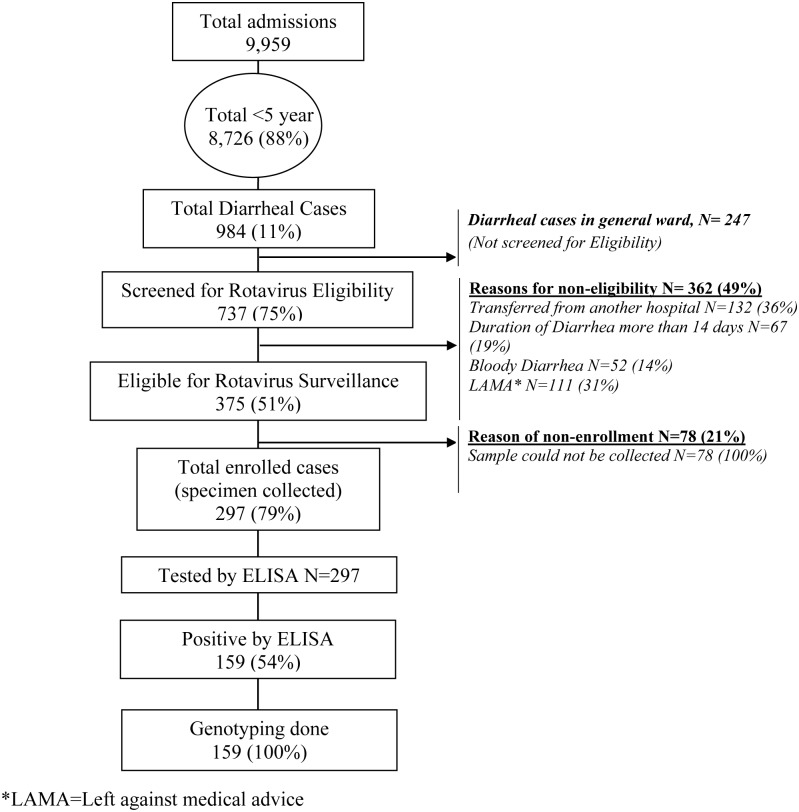
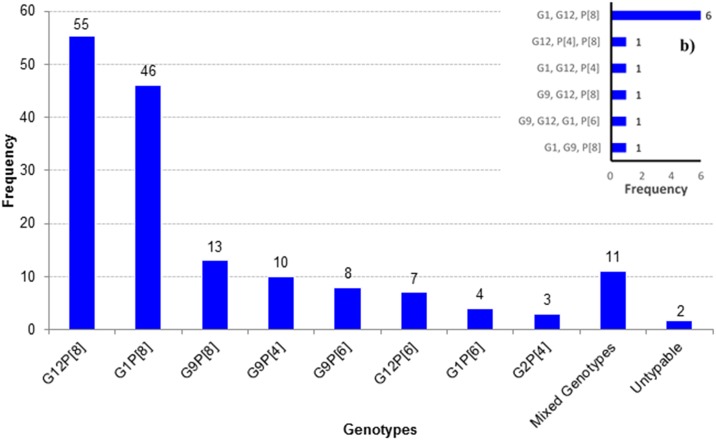
The World Health Organization (WHO) currently coordinates rotavirus diarrhea and invasive bacterial disease (IBD) surveillance at 178 sentinel sites in 60 countries. However, only 78 sites participate in both surveillance systems using a common sentinel site. Here, we explored the feasibility of extending a WHO-IBD surveillance platform to generate data on the burden of rotaviral diarrhea and its epidemiological characteristics to prepare the countries to measure the impact of rotaviral vaccine. A six-month (July to December, 2012) surveillance, managed by IBD team, collected stool samples and clinical data from under-five children with acute watery diarrhea at an IBD sentinel site. Samples were tested for rotavirus antigen by ELISA and genotyped by PCR at the regional reference laboratory (RRL). Specimens were collected from 79% (n=297) of eligible cases (n=375); 100% of which were tested for rotavirus by ELISA and 54% (159/297) of them were positive. At RRL, all the cases were confirmed by PCR and genotyped (99%; 158/159). The typing results revealed the predominance of G12 (40%; 64/159) genotype, followed by G1 (31%; 50/159) and G9 (19%; 31/159). All in all, this exploratory surveillance collected the desired demographic and epidemiological data and achieved almost all the benchmark indicators of WHO, starting from enrollment number to quality assurance through a number of case detection, collection, and testing of specimens and genotyping of strains at RRL. The success of this WHO-IBD site in achieving these benchmark indicators of WHO can be used by WHO as a proof-of-concept for considering integration of rotavirus surveillance with WHO-IBD platforms, specifically in countries with well performing IBD site and no ongoing rotavirus surveillance.
Conflict of interest statement
Figures
References
-
- Widdowson M-A, Steele D, Vojdani J, Wecker J, Parashar U. Global rotavirus surveillance: determining the need and measuring the impact of rotavirus vaccines. Journal of Infectious Diseases. 2009;200(Supplement 1):S1–S8. - PubMed
-
- Naghavi M, Wang H, Lozano R, Davis A, Liang X, Zhou M, et al. Global, regional, and national age-sex specific all-cause and cause-specific mortality for 240 causes of death, 1990–2013: a systematic analysis for the Global Burden of Disease Study 2013. Lancet. 2015;385(9963):117–71. 10.1016/S0140-6736(14)61682-2 - DOI - PMC - PubMed
-
- Tate JE, Burton AH, Boschi-Pinto C, Steele AD, Duque J, Parashar UD. 2008 estimate of worldwide rotavirus-associated mortality in children younger than 5 years before the introduction of universal rotavirus vaccination programmes: a systematic review and meta-analysis. The Lancet infectious diseases. 2012;12(2):136–41. 10.1016/S1473-3099(11)70253-5 - DOI - PubMed
-
- Bhutta ZA, Das JK, Walker N, Rizvi A, Campbell H, Rudan I, et al. Interventions to address deaths from childhood pneumonia and diarrhoea equitably: what works and at what cost? The Lancet. 2013;381(9875):1417–29. - PubMed
Publication types
MeSH terms
Substances
LinkOut - more resources
Full Text Sources
Other Literature Sources
Medical
