


Associations between Psychological Problems and Quality of Life in Pediatric Short Stature from Patients' and Parents' Perspectives
- PMID: 27097033
- PMCID: PMC4838264
- DOI: 10.1371/journal.pone.0153953
Associations between Psychological Problems and Quality of Life in Pediatric Short Stature from Patients' and Parents' Perspectives
Abstract
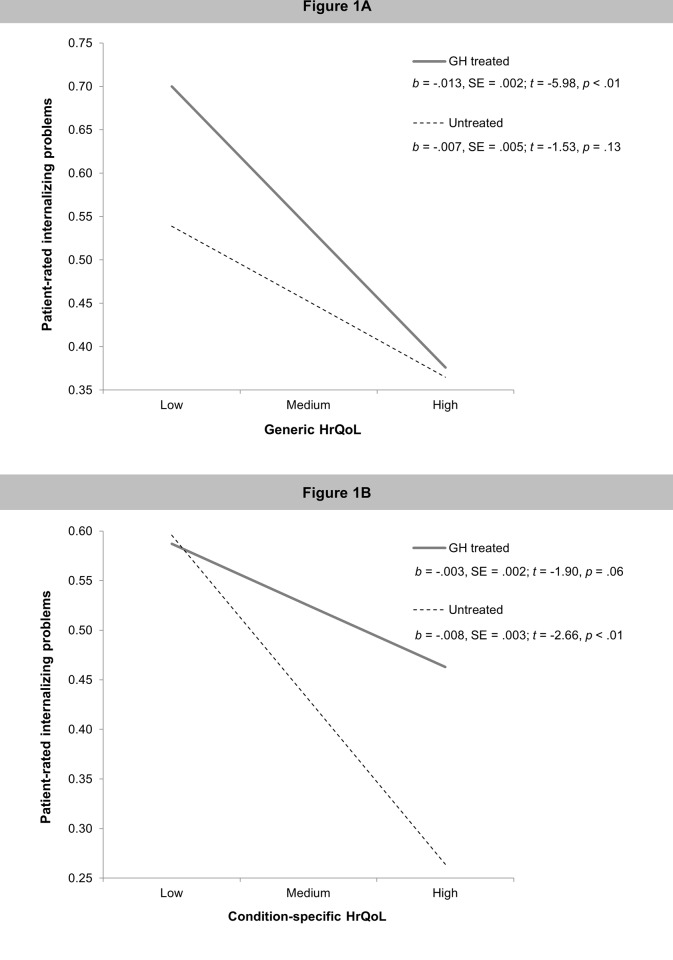
Short stature has been associated with psychosocial impairments, but whether treatments and achieved height impact on health-related quality of life (HrQoL) and psychological functioning of children/adolescents is still controversial. This study aimed to examine the effects of height deviation and treatment status on psychosocial adaptation outcomes and to identify clinical and psychosocial determinants of internalizing/externalizing problems in a large cohort of short statured children/adolescents from seven European countries. Participants were 345 children aged 8-18 years with a clinical diagnosis of short stature and 421 parents of 4-18 year-old patients. Children and parents reported on psychological problems (Strengths and Difficulties Questionnaire), generic (KIDSCREEN) and condition-specific HrQoL (QoLISSY). According to analyses of covariance, children/adolescents with current short stature presented more parent-reported internalizing problems and lower self- and parent-reported condition-specific HrQoL, compared to patients with an achieved height above -2SD. Treated children self-reported better HrQoL than the untreated group. Hierarchical regression analysis showed that, rather than height-related clinical variables, children's sex, younger age and poorer HrQoL were the best predictors of psychological problems, explaining 39% of the variance in patient- and 42% in parent-reported internalizing problems, and 22% of the variance in patient- and 24% in parent-reported externalizing problems. Treatment status also moderated the negative links between patient-reported HrQoL and internalizing problems, explaining 2% of additional variance. These results suggest that children with current short stature are at greater risk for internalizing problems. Routine assessment of HrQoL in pediatric healthcare may help identify children for referral to specialized psychological assessment and intervention.
Conflict of interest statement
Figures
References
-
- Barlow J.H. and Ellard D.R., The psychosocial well-being of children with chronic disease, their parents and siblings: an overview of the research evidence base. Child: Care, Health and Development, 2006. 32(1): p. 19–31. - PubMed
-
- Sandberg D.E. and Colsman M., Growth hormone treatment of short stature: status of the quality of life rationale. Hormone Research, 2005. 63(6): p. 275–83. - PubMed
-
- Batty G.D., et al. , Height, wealth, and health: an overview with new data from three longitudinal studies. Economics & Human Biology, 2009. 7(2): p. 137–52. - PubMed
Publication types
MeSH terms
LinkOut - more resources
Full Text Sources
Other Literature Sources
Medical
