


Morningness-Eveningness and Physical Activity in Adolescent Girls: Menarche as a Transition Point
- PMID: 27097124
- PMCID: PMC4939120
- DOI: 10.1111/cdev.12539
Morningness-Eveningness and Physical Activity in Adolescent Girls: Menarche as a Transition Point
Abstract
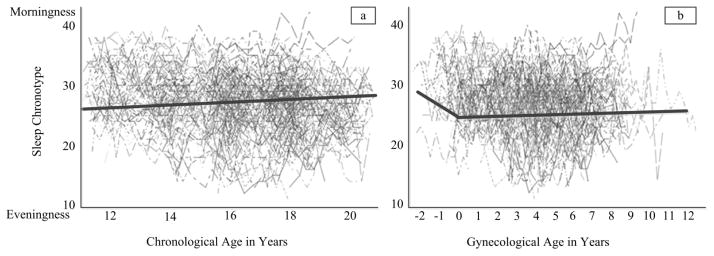
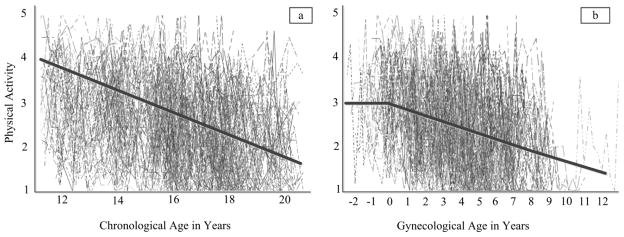
This study identified trajectories of morningness-eveningness (M-E) and physical activity when chronological (i.e., time since birth) versus gynecological (i.e., time since menarche) age is used to indicate maturation. Piecewise models were fit for girls (N = 262, ages 11-19) using chronological or gynecological age as the time metric. Girls stayed up later (i.e., eveningness) as they approach menarche. After menarche no change in M-E was observed. In contrast, no change in M-E was detected with chronological age. No change in physical activity was observed before menarche, and physical activity declined after menarche. With chronological age, physical activity declined as girls got older. Gynecological age may be more appropriate than chronological age as a metric for understanding changes in M-E and physical activity.
© 2016 The Authors. Child Development © 2016 Society for Research in Child Development, Inc.
Figures
References
-
- Adan A, Archer SN, Hidalgo MP, Di Milia L, Natale V, Randler C. Circadian typology: a comprehensive review. Chronobiology International. 2012;29(9):1153–1175. - PubMed
-
- Balzer BW, Duke SA, Hawke CI, Steinbeck KS. The effects of estradiol on mood and behavior in human female adolescents: a systematic review. European Journal of Pediatrics. 2015;174(3):289–298. - PubMed
Publication types
MeSH terms
Grants and funding
LinkOut - more resources
Full Text Sources
Other Literature Sources
Medical
