


Association Between Resilience and Family Member Psychologic Symptoms in Critical Illness
- PMID: 27097294
- PMCID: PMC4949118
- DOI: 10.1097/CCM.0000000000001673
Association Between Resilience and Family Member Psychologic Symptoms in Critical Illness
Abstract
Objectives: There are increased rates of depression, anxiety, and stress disorders in families of critically ill patients. Interventions directed at family members may help their ability to cope with this stress. Specifically, resilience is a teachable psychologic construct describing a person's ability to adapt to traumatic situations. Resilience can inherently assist individuals to diminish adverse psychologic outcomes. Consequently, we determined the relationship between resilience and symptoms of depression, anxiety, and acute stress in family members of critically ill patients.
Design: This is a cross-sectional study.
Setting: Three medical ICUs were screened by study staff.
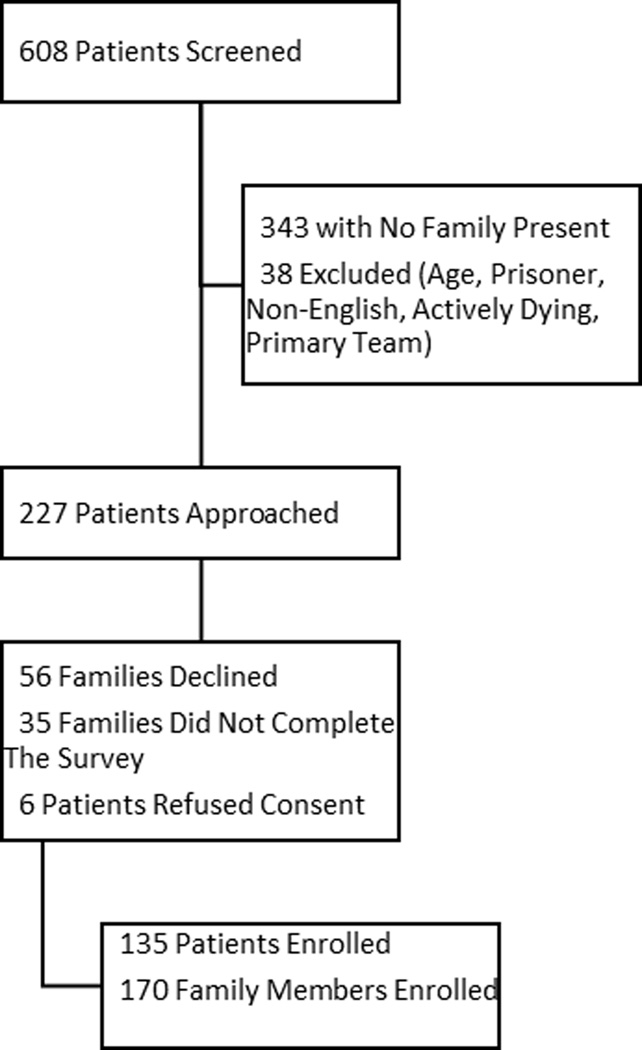
Patients: Family members of ICU patients admitted for greater than 48 hours were approached for enrollment.
Interventions: The Connor-Davidson Resilience Scale was used to stratify family members as resilient or nonresilient.
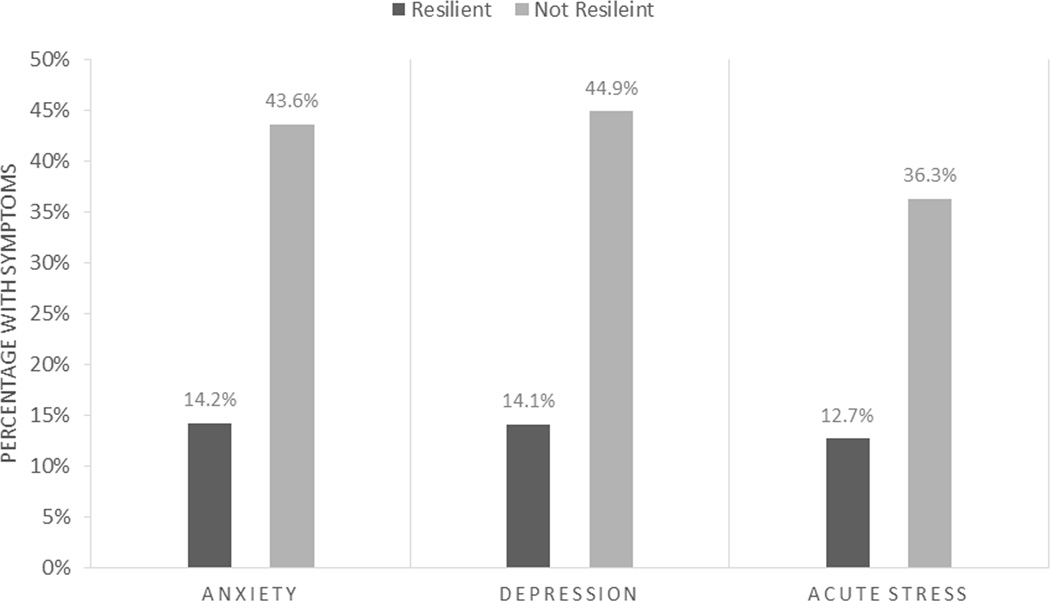
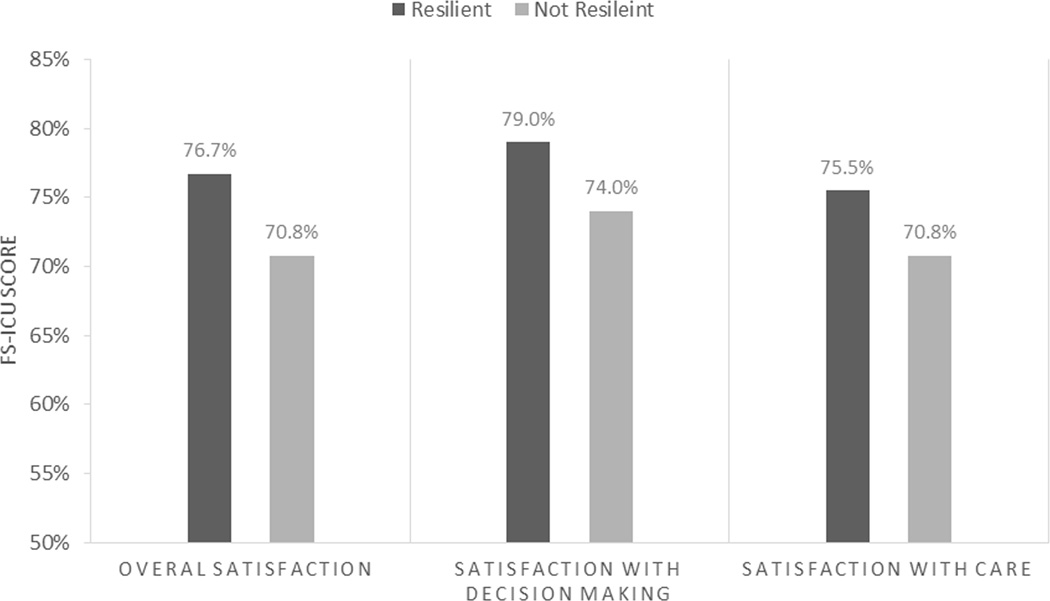
Measurements and main results: The Hospital Anxiety and Depression Scale, Impact of Event Scale-Revised, and Family Satisfaction in the ICU were collected prior to ICU discharge to measure symptoms of depression, anxiety, and acute stress, as well as satisfaction with care. One-hundred and seventy family members were enrolled. Seventy-eight family members were resilient. Resilient family members had fewer symptoms of anxiety (14.2% vs 43.6%; p < 0.001), depression (14.1% vs 44.9%; p < 0.001), and acute stress (12.7% vs 36.3%; p = 0.001). Resilient family members were more satisfied with care in the ICU (76.7 vs 70.8; p = 0.008). Resilience remained independently associated with these outcomes after adjusting for family member age and gender, as well as the patient's need for mechanical ventilation.
Conclusions: When caring for the critically ill, resilient family members have fewer symptoms of depression, anxiety, and acute stress. Resilient families were generally better satisfied with the care delivered. These data suggest that interventions aimed at increasing resilience may improve a family member's experience in the ICU.
Conflict of interest statement
The remaining authors have disclosed that they do not have any potential conflicts of interest.
Figures
References
-
- Christakis NA, Allison PD. Mortality after the hospitalization of a spouse. [Internet] [cited 2013 Nov 2];N Engl J Med. 2006 354:719–730. Available from: http://www.ncbi.nlm.nih.gov/pubmed/16481639. - PubMed
-
- Azoulay E, Pochard F, Kentish-Barnes N, et al. Risk of post-traumatic stress symptoms in family members of intensive care unit patients. [Internet] [cited 2013 Aug 24];Am J Respir Crit Care Med. 2005 171:987–994. Available from: http://www.ncbi.nlm.nih.gov/pubmed/15665319. - PubMed
-
- Lemiale V, Kentish-Barnes N, Chaize M, et al. Health-related quality of life in family members of intensive care unit patients. [Internet] [cited 2013 Nov 2];J Palliat Med. 2010 13:1131–1137. Available from: http://www.ncbi.nlm.nih.gov/pubmed/20836638. - PubMed
-
- Anderson WG, Arnold RM, Angus DC, et al. Posttraumatic stress and complicated grief in family members of patients in the intensive care unit. [Internet] [cited 2013 Aug 28];J Gen Intern Med. 2008 23:1871–1876. Available from: http://www.pubmedcentral.nih.gov/articlerender.fcgi?artid=2585673&tool=p.... - PMC - PubMed
-
- Kross EK, Engelberg Ra, Gries CJ, et al. ICU care associated with symptoms of depression and posttraumatic stress disorder among family members of patients who die in the ICU. [Internet] [cited 2013 Aug 13];Chest. 2011 139:795–801. Available from: http://www.pubmedcentral.nih.gov/articlerender.fcgi?artid=3071273&tool=p.... - PMC - PubMed
Publication types
MeSH terms
Grants and funding
LinkOut - more resources
Full Text Sources
Other Literature Sources
Medical
