


Moving knowledge about family violence into public health policy and practice: a mixed method study of a deliberative dialogue
- PMID: 27098267
- PMCID: PMC4839163
- DOI: 10.1186/s12961-016-0100-9
Moving knowledge about family violence into public health policy and practice: a mixed method study of a deliberative dialogue
Abstract
Background: There is a need to understand scientific evidence in light of the context within which it will be used. Deliberative dialogues are a promising strategy that can be used to meet this evidence interpretation challenge.
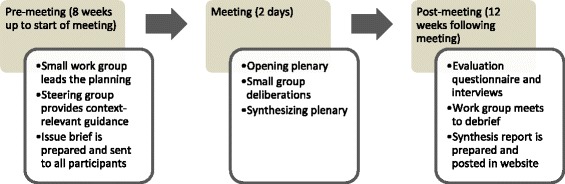
Methods: We evaluated a deliberative dialogue held by a transnational violence prevention network. The deliberative dialogue included researchers and knowledge user partners of the Preventing Violence Across the Lifespan (PreVAiL) Research Network and was incorporated into a biennial full-team meeting. The dialogue included pre- and post-meeting activities, as well as deliberations embedded within the meeting agenda. The deliberations included a preparatory plenary session, small group sessions and a synthesizing plenary. The challenge addressed through the process was how to mobilize research to orient health and social service systems to prevent family violence and its consequences. The deliberations focused on the challenge, potential solutions for addressing it and implementation factors. Using a mixed-methods approach, data were collected via questionnaires, meeting minutes, dialogue documents and follow-up telephone interviews.
Results: Forty-four individuals (all known to each other and from diverse professional roles, settings and countries) participated in the deliberative dialogue. Ten of the 12 features of the deliberative dialogue were rated favourably by all respondents. The mean behavioural intention score was 5.7 on a scale from 1 (strongly disagree) to 7 (strongly agree), suggesting that many participants intended to use what they learned in their future decision-making. Interviews provided further insight into what might be done to facilitate the use of research in the violence prevention arena.
Conclusion: Findings suggest that participants will use dialogue learnings to influence practice and policy change. Deliberative dialogues may be a viable strategy for collaborative sensemaking of research related to family violence prevention, and other public health topics.
Keywords: Collaborative sensemaking; Evidence-informed decision-making; Family violence; Knowledge translation; Public health policy.
Figures
References
-
- Lomas J, Culyer T, McCutcheon C, McAuley L, Law S. Conceptualizing and combining evidence for health system guidance. Ottawa: Canadian Health Services Research Foundation; 2005.
-
- Culyer AJ, Lomas J. Deliberative processes and evidence-informed decision-making in health care: do they work and how might we know? Evid Policy. 2006;2:357–71. doi: 10.1332/174426406778023658. - DOI
Publication types
MeSH terms
Grants and funding
LinkOut - more resources
Full Text Sources
Other Literature Sources
