


The Lung Screen Uptake Trial (LSUT): protocol for a randomised controlled demonstration lung cancer screening pilot testing a targeted invitation strategy for high risk and 'hard-to-reach' patients
- PMID: 27098676
- PMCID: PMC4839109
- DOI: 10.1186/s12885-016-2316-z
The Lung Screen Uptake Trial (LSUT): protocol for a randomised controlled demonstration lung cancer screening pilot testing a targeted invitation strategy for high risk and 'hard-to-reach' patients
Abstract
Background: Participation in low-dose CT (LDCT) lung cancer screening offered in the trial context has been poor, especially among smokers from socioeconomically deprived backgrounds; a group for whom the risk-benefit ratio is improved due to their high risk of lung cancer. Attracting high risk participants is essential to the success and equity of any future screening programme. This study will investigate whether the observed low and biased uptake of screening can be improved using a targeted invitation strategy.
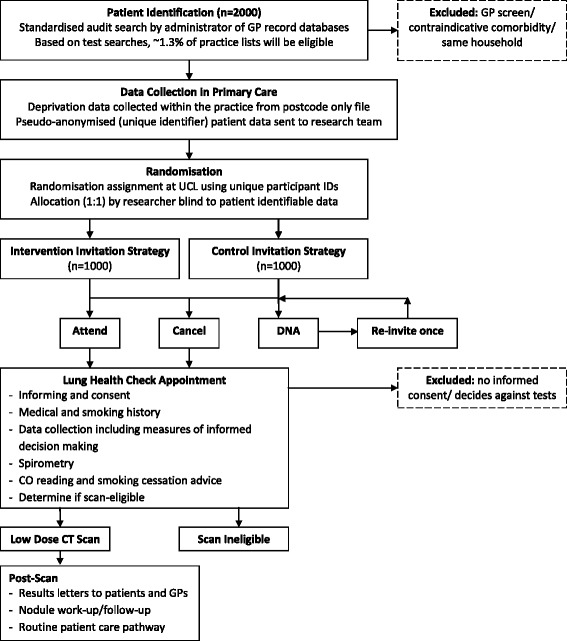
Methods/design: A randomised controlled trial design will be used to test whether targeted invitation materials are effective at improving engagement with an offer of lung cancer screening for high risk candidates. Two thousand patients aged 60-75 and recorded as a smoker within the last five years by their GP, will be identified from primary care records and individually randomised to receive either intervention invitation materials (which take a targeted, stepped and low burden approach to information provision prior to the appointment) or control invitation materials. The primary outcome is uptake of a nurse-led 'lung health check' hospital appointment, during which patients will be offered a spirometry test, an exhaled carbon monoxide (CO) reading, and an LDCT if eligible. Initial data on demographics (i.e. age, sex, ethnicity, deprivation score) and smoking status will be collected in primary care and analysed to explore differences between attenders and non-attenders with respect to invitation group. Those who attend the lung health check will have further data on smoking collected during their appointment (including pack-year history, nicotine dependence and confidence to quit). Secondary outcomes will include willingness to be screened, uptake of LDCT and measures of informed decision-making to ensure the latter is not compromised by either invitation strategy.
Discussion: If effective at improving informed uptake of screening and reducing bias in participation, this invitation strategy could be adopted by local screening pilots or a national programme.
Trial registration: This study was registered with the ISRCTN (International Standard Registered Clinical/soCial sTudy Number: ISRCTN21774741) on the 23rd September 2015 and the NIH ClinicalTrials.gov database (NCT0255810) on the 22nd September 2015.
Trial registration: ClinicalTrials.gov NCT02558101.
Keywords: Cancer screening; Health inequalities; Lung cancer; Smoking.
References
-
- Cancer Research UK: Cancer mortality statistics (2014). http://www.cancerresearchuk.org/cancer-info/cancerstats/mortality/uk-can.... Accessed 4 Aug 2015.
-
- ONS. Cancer Registration Statistics, England (Series MB1), No. 42, 2011 (2013). http://www.ons.gov.uk/ons/rel/vsob1/cancer-statistics-registrations--eng.... Accessed 4 Aug 2015.
-
- ONS. Statistical Bulletin Cancer Survival in England: Adults Diagnosed, 2009 to 2013, followed up to 2014 (2015). http://www.ons.gov.uk/peoplepopulationandcommunity/healthandsocialcare/c.... Accessed 4 Aug 2015.
-
- Cancer Research UK. Statistics and outlook for lung cancer (2014). http://www.cancerresearchuk.org/about-cancer/type/lung-cancer/treatment/.... Accessed 4 Aug 2015.
-
- National Cancer Intelligence Network. Stage Breakdown by CCG 2013. London: NCIN; 2015. http://www.ncin.org.uk/publications/survival_by_stage. Accessed 16 Apr 2016.
Publication types
MeSH terms
Substances
Associated data
Grants and funding
LinkOut - more resources
Full Text Sources
Other Literature Sources
Medical
