


Case Reports
doi: 10.1002/ccr3.511.
eCollection 2016 Apr.
Polyhydramnios and cerebellar atrophy: a prenatal presentation of mitochondrial encephalomyopathy caused by mutations in the FBXL4 gene
Affiliations
- PMID: 27099744
- PMCID: PMC4831400
- DOI: 10.1002/ccr3.511
Item in Clipboard
Case Reports
Polyhydramnios and cerebellar atrophy: a prenatal presentation of mitochondrial encephalomyopathy caused by mutations in the FBXL4 gene
Clin Case Rep.
.
Abstract
Severe recessive mitochondrial myopathy caused by FBXL4 gene mutations may present prenatally with polyhydramnios and cerebellar hypoplasia. Characteristic dysmorphic features are: high and arched eyebrows, triangular face, a slight upslant of palpebral fissures, and a prominent pointed chin. Metabolic investigations invariably show increased serum lactate and pyruvate levels.
Keywords: Cerebellar atrophy; FBXL4 gene; encephalomyopathy; lactate; mitochondrial encephalopathy; polyhydramnios; pyruvate.
Figures
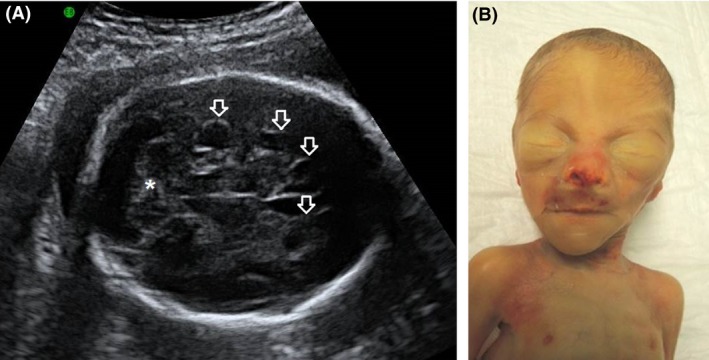
(A) Fetal cerebral ultrasound at GA 25 + 5 showed cerebellar hypoplasia (*) and borderline dilatation of the ventricles. In retrospect, the outlines of some of the periventricular cysts are also discernible (see arrows). (B) shows the postmortem facial features. Note the prominent eyebrows and the triangular face with pointed chin. The bruises around the nose and philtrum, and the asymmetry of the nostrils are the effect of ventilation.
References
-
- Harman, C. 2008. Amniotic fluid abnormalities. Semin. Perinatol. 32:288–294. - PubMed
-
- Dashe, J. , McIntire D., Ramus R., Santos‐Ramos R., and Twickler D. M.. 2002. Hydramnios: anomaly prevalence and sonographic detection. Obstet. Gynecol. 100:134–139. - PubMed
-
- Raju, G. P. , Li H.‐C., Bali D., Chen Y. T., Urion D. K., Lidov H. G., et al. 2008. A case of congenital glycogen storage disease type IV with a novel GBE1 mutation. J. Child Neurol. 23:349–352. - PubMed
-
- Magann, E. , Chauhan S., Doherty D., Lutgendorf M. A., Magann M. I., Morrison J. C., et al. 2007. A review of idiopathic hydramnios and pregnancy outcomes. Obstet. Gynecol. Surv. 62:795–802. - PubMed
Publication types
LinkOut - more resources
Full Text Sources
Other Literature Sources
