


Cancer patients participating in a lifestyle intervention during chemotherapy greatly over-report their physical activity level: a validation study
- PMID: 27099757
- PMCID: PMC4837555
- DOI: 10.1186/s13102-016-0035-z
Cancer patients participating in a lifestyle intervention during chemotherapy greatly over-report their physical activity level: a validation study
Abstract
Background: The short form of the International Physical Activity Questionnaire (IPAQ-sf) is a validated questionnaire used to assess physical activity (PA) in healthy adults and commonly used in both apparently healthy adults and cancer patients. However, the IPAQ-sf has not been previously validated in cancer patients undergoing oncologic treatment. The objective of the present study was to compare IPAQ-sf with objective measures of physical activity (PA) in cancer patients undergoing chemotherapy.
Methods: The present study was part of a 12-month prospective individualized lifestyle intervention focusing on diet, PA, stress management and smoking cessation in 100 cancer patients undergoing chemotherapy. During the first two months of the lifestyle intervention, participants were wearing an activity monitor (SenseWear™ Armband (SWA)) for five consecutive days while receiving chemotherapy before completing the IPAQ-sf. From SWA, Moderate-to-Vigorous intensity PA (MVPA) in bouts ≥10 min was compared with self-reported MVPA from the IPAQ-sf. Analyses both included and excluded walking in MVPA from the IPAQ-sf. Results were extrapolated to a wearing time of seven days.
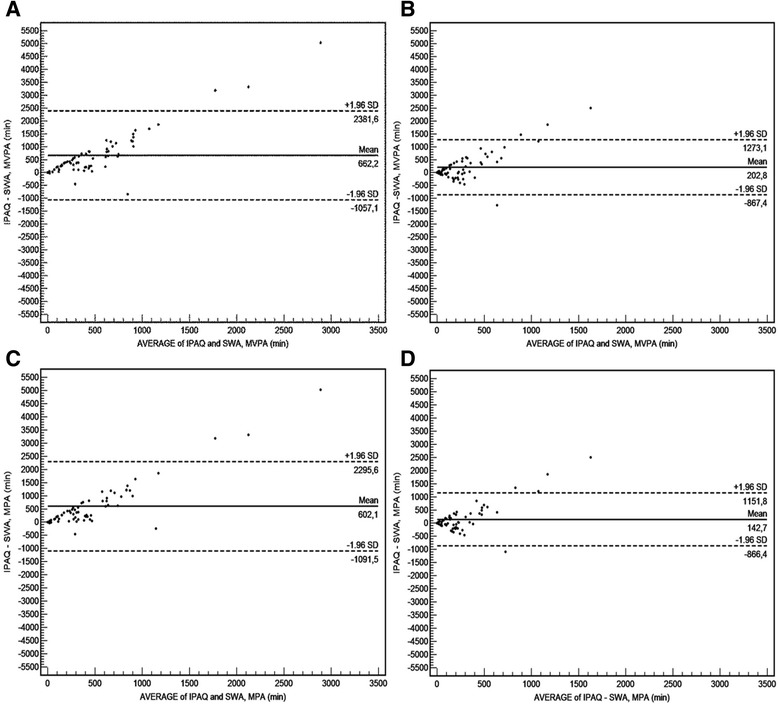
Results: Sixty-six patients completed IPAQ-sf and wore the SWA over five days. Mean difference and limit of agreement between the IPAQ-sf and SWA including walking was 662 (±1719) min(.)wk(-1). When analyzing time spent in the different intensity levels separately, IPAQ-sf reported significantly higher levels of moderate (602 min(.)wk(-1), p = 0.001) and vigorous (60 min(.)wk(-1), p = 0.001) PA compared to SWA.
Conclusions: Cancer patients participating in a lifestyle intervention during chemotherapy reported 366 % higher MVPA level from the past seven days using IPAQ-sf compared to objective measures. The IPAQ-sf appears insufficient when assessing PA level in cancer patients undergoing oncologic treatment. Activity monitors or other objective tools should alternatively be considered, when assessing PA in this population.
Keywords: Accelerometer; Cancer patient; IPAQ; Oncology; Physical activity; Validation.
Figures
Similar articles
-
International Physical Activity Questionnaire Short Form and accelerometer-assessed physical activity: concurrent validity using six cut-points in HF patients.ESC Heart Fail. 2024 Feb;11(1):126-135. doi: 10.1002/ehf2.14514. Epub 2023 Oct 16. ESC Heart Fail. 2024. PMID: 37842962 Free PMC article.
-
Reliability and concurrent validity of the International Physical Activity Questionnaire short form among pregnant women.BMC Sports Sci Med Rehabil. 2017 Mar 14;9:7. doi: 10.1186/s13102-017-0070-4. eCollection 2017. BMC Sports Sci Med Rehabil. 2017. PMID: 28316789 Free PMC article.
-
Comparison of the International Physical Activity Questionnaire (IPAQ) with a multi-sensor armband accelerometer in women with fibromyalgia: the al-Ándalus project.Clin Exp Rheumatol. 2013 Nov-Dec;31(6 Suppl 79):S94-101. Epub 2013 Dec 2. Clin Exp Rheumatol. 2013. PMID: 24373367
-
Validity and reliability of International Physical Activity Questionnaire-Short Form in Chinese youth.Res Q Exerc Sport. 2013 Dec;84 Suppl 2:S80-6. doi: 10.1080/02701367.2013.850991. Res Q Exerc Sport. 2013. PMID: 24527570
-
Criterion validity of the International Physical Activity Questionnaire Short Form (IPAQ-SF) for use in patients with rheumatoid arthritis: comparison with the SenseWear Armband.Physiotherapy. 2015 Jun;101(2):193-7. doi: 10.1016/j.physio.2014.07.005. Epub 2014 Sep 22. Physiotherapy. 2015. PMID: 25442297
Cited by
-
Development and Evaluation of an Accelerometer-Based Protocol for Measuring Physical Activity Levels in Cancer Survivors: Development and Usability Study.JMIR Mhealth Uhealth. 2020 Sep 24;8(9):e18491. doi: 10.2196/18491. JMIR Mhealth Uhealth. 2020. PMID: 32969828 Free PMC article.
-
International Physical Activity Questionnaire Short Form and accelerometer-assessed physical activity: concurrent validity using six cut-points in HF patients.ESC Heart Fail. 2024 Feb;11(1):126-135. doi: 10.1002/ehf2.14514. Epub 2023 Oct 16. ESC Heart Fail. 2024. PMID: 37842962 Free PMC article.
-
Influence of perioperative step volume on complication rate and length of hospital stay after colorectal cancer surgery (IPOS trial): study protocol for a randomised controlled single-centre trial at a German university hospital.BMJ Open. 2023 Dec 19;13(12):e076298. doi: 10.1136/bmjopen-2023-076298. BMJ Open. 2023. PMID: 38114280 Free PMC article.
-
Validation of two short questionnaires assessing physical activity in colorectal cancer patients.BMC Sports Sci Med Rehabil. 2018 May 29;10:8. doi: 10.1186/s13102-018-0096-2. eCollection 2018. BMC Sports Sci Med Rehabil. 2018. PMID: 29854408 Free PMC article.
-
Promise of Wearable Physical Activity Monitors in Oncology Practice.J Oncol Pract. 2017 Feb;13(2):82-89. doi: 10.1200/JOP.2016.016857. J Oncol Pract. 2017. PMID: 28387544 Free PMC article. Review.
References
-
- Ferlay J, Soerjomataram I, Ervik M, Dikshit R, Eser S, Mathers C, et al. GLOBOCAN 2012 v1.0, Cancer Incidence and Mortality Worldwide: IARC CancerBase No. 11 International Agency for Research on Cancer, Lyon, France. 2013. http://globocan.iarc.fr. Accessed 17 Mar 2015.
LinkOut - more resources
Full Text Sources
Other Literature Sources
Miscellaneous
