


Non-Heme Iron Absorption and Utilization from Typical Whole Chinese Diets in Young Chinese Urban Men Measured by a Double-Labeled Stable Isotope Technique
- PMID: 27099954
- PMCID: PMC4839665
- DOI: 10.1371/journal.pone.0153885
Non-Heme Iron Absorption and Utilization from Typical Whole Chinese Diets in Young Chinese Urban Men Measured by a Double-Labeled Stable Isotope Technique
Abstract
Background: This study was to observe the non-heme iron absorption and biological utilization from typical whole Chinese diets in young Chinese healthy urban men, and to observe if the iron absorption and utilization could be affected by the staple food patterns of Southern and Northern China.
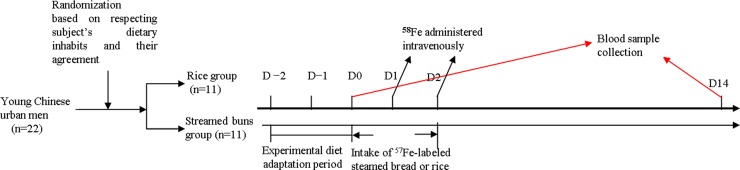
Materials and methods: Twenty-two young urban men aged 18-24 years were recruited and randomly assigned to two groups in which the staple food was rice and steamed buns, respectively. Each subject received 3 meals containing approximately 3.25 mg stable 57FeSO4 (the ratio of 57Fe content in breakfast, lunch and dinner was 1:2:2) daily for 2 consecutive days. In addition, approximately 2.4 mg 58FeSO4 was administered intravenously to each subject at 30-60 min after dinner each day. Blood samples were collected from each subject to measure the enrichment of the 57Fe and 58Fe. Fourteen days after the experimental diet, non-heme iron absorption was assessed by measuring 57Fe incorporation into red blood cells, and absorbed iron utilization was determined according to the red blood cell incorporation of intravenously infused 58Fe SO4.
Results: Non-heme iron intake values overall, and in the rice and steamed buns groups were 12.8 ±2.1, 11.3±1.3 and 14.3±1.5 mg, respectively; the mean 57Fe absorption rates were 11±7%, 13±7%, and 8±4%, respectively; and the mean infused 58Fe utilization rates were 85±8%, 84±6%, and 85±10%, respectively. There was no significantly difference in the iron intakes, and 57Fe absorption and infused 58Fe utilization rates between rice and steamed buns groups (all P>0.05).
Conclusion: We present the non-heme iron absorption and utilization rates from typical whole Chinese diets among young Chinese healthy urban men, which was not affected by the representative staple food patterns of Southern and Northern China. This study will provide a basis for the setting of Chinese iron DRIs.
Conflict of interest statement
References
-
- U.S. Centers for Disease Control and Prevention (April 2012 [cited 2013 Feb 4]). Second national report on biochemical indicators of diet and nutrition in the U.S. population 2012. Atlanta (GA): National Center for Environmental Health. Available from: http://www.cdc.gov/nutritionreport.
Publication types
MeSH terms
Substances
LinkOut - more resources
Full Text Sources
Other Literature Sources
Medical
