


Chronic Conditions and Utility-Based Health-Related Quality of Life in Adult Childhood Cancer Survivors
- PMID: 27102402
- PMCID: PMC5939850
- DOI: 10.1093/jnci/djw046
Chronic Conditions and Utility-Based Health-Related Quality of Life in Adult Childhood Cancer Survivors
Abstract
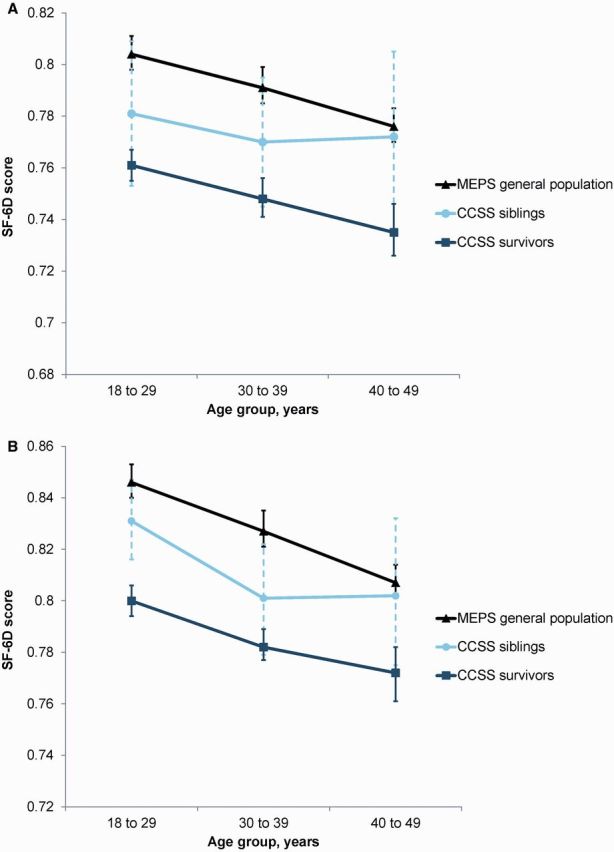
Health utility, a summary measure of quality of life, has not been previously used to compare outcomes among childhood cancer survivors and individuals without a cancer history. We estimated health utility (0, death; 1, perfect health) using the Short Form-6D (SF-6D) in survivors (n = 7105) and siblings of survivors (n = 372) (using the Childhood Cancer Survivor Study cohort) and the general population (n = 12 803) (using the Medical Expenditures Panel Survey). Survivors had statistically significantly lower SF-6D scores than the general population (mean = 0.769, 95% confidence interval [CI] = 0.766 to 0.771, vs mean = 0.809, 95% CI = 0.806 to 0.813, respectively, ITALIC! P< .001, two-sided). Young adult survivors (age 18-29 years) reported scores comparable with general population estimates for people age 40 to 49 years. Among survivors, SF-6D scores were largely determined by number and severity of chronic conditions. No clinically meaningful differences were identified between siblings and the general population (mean = 0.793, 95% CI = 0.782 to 0.805, vs mean = 0.809, 95% CI = 0.806 to 0.813, respectively). This analysis illustrates the importance of chronic conditions on long-term survivor quality of life and provides encouraging results on sibling well-being. Preference-based utilities are informative tools for outcomes research in cancer survivors.
© The Author 2016. Published by Oxford University Press. All rights reserved. For Permissions, please e-mail: journals.permissions@oup.com.
Figures
References
-
- Gold MR, Siegel JE, Russel LB, Weinstein MC , eds. Cost-Effectiveness in Health and Medicine . New York: : Oxford University Press; ; 1996. .
-
- Howlader N, Noone AM, Krapcho M , et al. . SEER Cancer Statistics Review, 1975-2012, http://seer.cancer.gov/csr/1975_2012/ , based on November 2014 SEER data submission, posted to the SEER web site, April 2015. Bethesda, MD: National Cancer Institute. Accessed July 18, 2015. .
-
- Oeffinger KC, Mertens AC, Sklar CA , et al. . Chronic health conditions in adult survivors of childhood cancer . N Engl J Med. 2006. ; 355 ( 15 ): 1572 – 1582 . - PubMed
-
- Woodgate RL. Siblings' experiences with childhood cancer: a different way of being in the family . Cancer Nurs . 2006. ; 29 ( 5 ): 406 – 414 . - PubMed
Publication types
MeSH terms
Grants and funding
LinkOut - more resources
Full Text Sources
Other Literature Sources
Medical
