Review
. 2016 Apr 21;8(1):46.
doi: 10.1186/s13073-016-0296-x.

Microbial metabolism of dietary components to bioactive metabolites: opportunities for new therapeutic interventions

Affiliations
Review

Microbial metabolism of dietary components to bioactive metabolites: opportunities for new therapeutic interventions

Linda S Zhang et al. Genome Med. .

Abstract

Mass spectrometry- and nuclear magnetic resonance-based metabolomic studies comparing diseased versus healthy individuals have shown that microbial metabolites are often the compounds most markedly altered in the disease state. Recent studies suggest that several of these metabolites that derive from microbial transformation of dietary components have significant effects on physiological processes such as gut and immune homeostasis, energy metabolism, vascular function, and neurological behavior. Here, we review several of the most intriguing diet-dependent metabolites that may impact host physiology and may therefore be appropriate targets for therapeutic interventions, such as short-chain fatty acids, trimethylamine N-oxide, tryptophan and tyrosine derivatives, and oxidized fatty acids. Such interventions will require modulating either bacterial species or the bacterial biosynthetic enzymes required to produce these metabolites, so we briefly describe the current understanding of the bacterial and enzymatic pathways involved in their biosynthesis and summarize their molecular mechanisms of action. We then discuss in more detail the impact of these metabolites on health and disease, and review current strategies to modulate levels of these metabolites to promote human health. We also suggest future studies that are needed to realize the full therapeutic potential of targeting the gut microbiota.


Figures
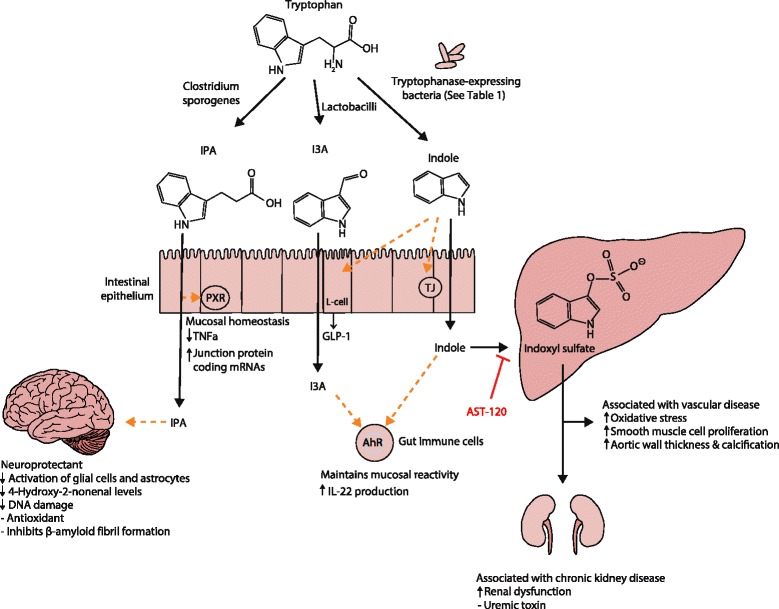
Fig. 1
Fig. 1
Molecular mechanisms of action of indole and its metabolites on host physiology and disease. Tryptophan in the colonic lumen is catabolized by bacteria to yield indole and indole derivatives. Indole-3-propionate (IPA) acts on intestinal cells via pregnane X receptors (PXR) to maintain mucosal homeostasis and barrier function. IPA can also act on other organs such as the brain, where it confers neuroprotective effects against ischemia-induced neuronal damage or against Alzheimer’s disease. Indole-3-aldehyde (I3A) acts on the aryl hydrocarbon receptor (AhR) found on intestinal immune cells and increases interleukin-22 (IL-22) production. Activation of AhR plays a crucial role in gut immunity, such as in maintaining the epithelial barrier function and promoting immune tolerance to promote microbial commensalism while protecting against pathogenic infections. Indole has a number of roles, such as a signaling molecule to intestinal L cells to produce glucagon-like protein 1 (GLP-1) or as a ligand for AhR. Indole is also metabolized by the liver to indoxyl sulfate, where an excess is detrimental to human health. Accumulation of indoxyl sulfate in physiologic fluid is toxic and associated with vascular disease and renal dysfunction. AST-120, an orally administered intestinal sorbent, adsorbs indole and decreases serum concentrations of indoxyl sulfate, and is a potential treatment for managing chronic kidney disease

References

    1. LeBlanc JG, Milani C, de Giori GS, Sesma F, van Sinderen D, Ventura M. Bacteria as vitamin suppliers to their host: a gut microbiota perspective. Curr Opin Biotechnol. 2013;24(2):160–168. doi: 10.1016/j.copbio.2012.08.005. - DOI - PubMed
    1. Ridlon JM, Kang DJ, Hylemon PB. Bile salt biotransformations by human intestinal bacteria. J Lipid Res. 2006;47(2):241–259. doi: 10.1194/jlr.R500013-JLR200. - DOI - PubMed
    1. Holmes E, Kinross J, Gibson GR, Burcelin R, Jia W, Pettersson S, et al. Therapeutic modulation of microbiota-host metabolic interactions. Sci Transl Med. 2012;4(137):137rv6. doi: 10.1126/scitranslmed.3004244. - DOI - PubMed
    1. Claus SP, Tsang TM, Wang Y, Cloarec O, Skordi E, Martin FP, et al. Systemic multicompartmental effects of the gut microbiome on mouse metabolic phenotypes. Mol Syst Biol. 2008;4:219. doi: 10.1038/msb.2008.56. - DOI - PMC - PubMed
    1. Yap IK, Li JV, Saric J, Martin FP, Davies H, Wang Y, et al. Metabonomic and microbiological analysis of the dynamic effect of vancomycin-induced gut microbiota modification in the mouse. J Proteome Res. 2008;7(9):3718–3728. doi: 10.1021/pr700864x. - DOI - PubMed

Publication types
