. 2016 Apr 21:16:175.
doi: 10.1186/s12879-016-1508-0.

Sero-epidemiological assessment of Chlamydia trachomatis infection and sub-fertility in Samoan women

Affiliations

Sero-epidemiological assessment of Chlamydia trachomatis infection and sub-fertility in Samoan women

S Menon et al. BMC Infect Dis. .

Abstract

Background: In our recent village-based cross-sectional study, the prevalence of nucleic acid amplification technique (NAAT) diagnosed Chlamydia trachomatis (CT) in sexually active Samoan women was very high (36 %), and test positivity was associated with sub-fertility. We conducted a serological and epidemiological analysis in these participants to identify if serological data can provide further insight into the potential contribution of CT to sub-fertility in this population.

Methods: Serological prediction of CT associated sub-fertility was conducted using a series of commercial tests. The correlation between fertility or sub-fertility, behavioral factors, and serologically predicted CT associated sub-fertility was determined.

Results: A positive antibody reaction against the Chlamydia Major Outer Membrane Protein (MOMP) was significantly associated with sub-fertility, with 50 % of infertile women being positive. Serum IgG and IgA antibodies against MOMP correlated with current infection measured by urine NAAT, suggesting longer term infections are common in this population. Chlamydia pneumoniae antibodies were frequently detected in this population (84 %), and unexpectedly, were significantly associated with sub-fertility.

Conclusions: The high prevalence of chlamydial infection and of positive chlamydial sub-fertility results suggests that CT is an important and frequent contributory factor to sub-fertility in this population.

Keywords: Chlamydia; Pacific islands; diagnosis; female sub-fertility; samoa; serology.


Figures
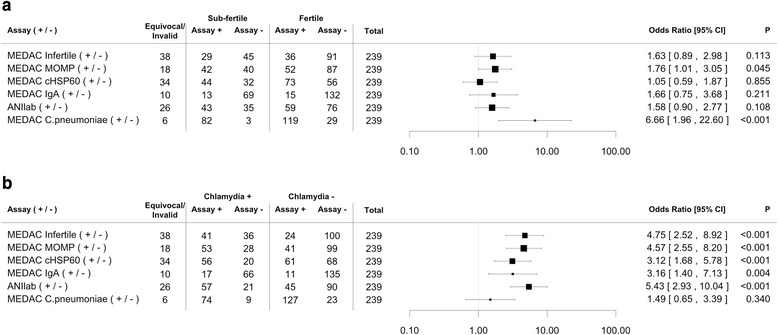
Fig. 1
Fig. 1
Analysis of the association of serological responses to Chlamydia with fertility and CT infection status. a. The figure shows Forest plots and Odds Ratio of the association of a positive reaction in the serological assay listed to the right with being infertile. The assay is indicated in the left column. The number of participants that were positive or negative in the serum assay(s) according to their fertile or infertile status are shown on the figure. All 239 participant specimens were tested in each assay. Samples that were unequivocal or not reproducible upon multiple testing were excluded for each assay and these are indicated in the column titled invalid/unequivocal on the table. b. The number of participants positive or negative in each serological assay, grouped according to also being positive or negative for current CT infection by urine NAAT (Chlamydia +/−) are shown on the figure. OR with 95 % CI and P values are indicated at the right of the figures
Fig. 2
Fig. 2
Venn diagram to demonstrate concordance between serological assays and CT NAAT results. The diagram shows the number of participants positive in each of the assays and those who were positive in more than one assay. The two MOMP assays (MEDAC IgG and ANIlab) and NAAT results showed considerable concordance. The samples that were negative in all assays are also indicated on the figure, only the 162 samples that had a valid result in all of these assays are included in the Venn diagram

References

    1. Adams EJ, Charlett A, Edmunds WJ, Hughes G. Chlamydia trachomatis in the United Kingdom: a systematic review and analysis of prevalence studies. Sex Transm Infect. 2004;80(5):354–362. doi: 10.1136/sti.2003.005454. - DOI - PMC - PubMed
    1. Kohli R, Konya WP, Obura T, Stones W, Revathi G. Prevalence of genital Chlamydia infection in urban women of reproductive age, Nairobi, Kenya. BMC Res Notes. 2013;6:44. doi: 10.1186/1756-0500-6-44. - DOI - PMC - PubMed
    1. Lewis D, Newton DC, Guy RJ, Ali H, Chen MY, Fairley CK, Hocking JS. The prevalence of Chlamydia trachomatis infection in Australia: a systematic review and meta-analysis. Bmc Infect Dis. 2012;12:113. doi: 10.1186/1471-2334-12-113. - DOI - PMC - PubMed
    1. Sullivan EA, Koro S, Tabrizi S, Kaldor J, Poumerol G, Chen S, O'Leary M, Garland SM. Prevalence of sexually transmitted diseases and human immunodeficiency virus among women attending prenatal services in Apia, Samoa. Int J Std Aids. 2004;15(2):116–119. doi: 10.1258/095646204322764316. - DOI - PubMed
    1. Cliffe SJ, Tabrizi S, Sullivan EA, Pacific Islands Second Generation HIVSG Chlamydia in the Pacific region, the silent epidemic. Sex Transm Dis. 2008;35(9):801–806. doi: 10.1097/OLQ.0b013e318175d885. - DOI - PubMed

Publication types

MeSH terms
