


Impact of an emergency medical dispatch system on survival from out-of-hospital cardiac arrest: a population-based study
- PMID: 27103151
- PMCID: PMC4840865
- DOI: 10.1186/s13049-016-0247-y
Impact of an emergency medical dispatch system on survival from out-of-hospital cardiac arrest: a population-based study
Abstract
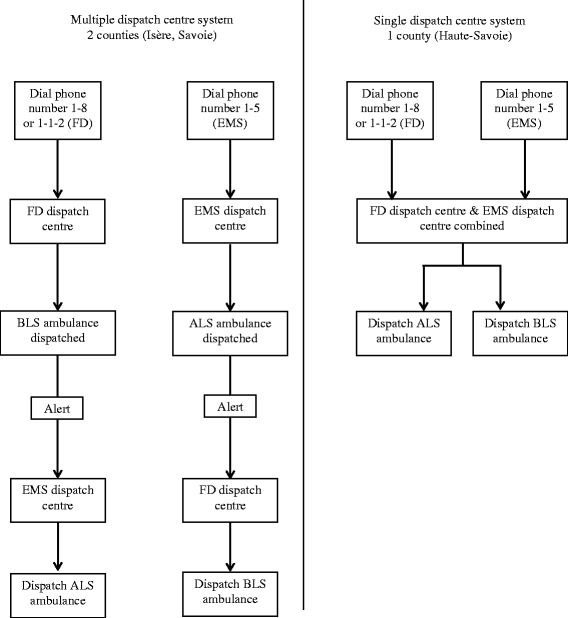
Background: In countries where a single public emergency telephone number is not in operation, different emergency telephone numbers corresponding to multiple dispatch centres (police, fire, emergency medical service) may create confusion for the population about the most appropriate service to call. In particular, out-of-hospital cardiac arrest (OHCA) requires a prompt and effective response. We compare two different dispatch systems on OHCA patient survival at 30 days in a national system with multiple emergency telephone numbers.
Methods: We conducted an observational retrospective study of 6871 patients aged 18 years or older with presumed OHCA of cardiac origin between 2005 and 2013 in three counties of the Northern French Alps region. One county had a single dispatch centre combining medical and fire emergencies, and two had multiple dispatch centres. Propensity score matching analyses were performed to compare patient survival at 30 days.
Results: A total of 2257 emergency calls for OHCA were managed by a single dispatch centre and 4614 by a multiple dispatch centre. A single dispatch centre was associated with an increase in survival (adjusted odds ratio [OR] for all patients: 1.7; 95 % confidence interval [CI] = 1.3-2.2; p <0.001; adjusted OR for propensity-matched patients: 2.0; 95 % CI = 1.2-3.4; p = 0.012).
Conclusions: A single dispatch centre was associated with a markedly improved increase of survival among OHCA patients at 30 days in a system with several emergency telephone numbers.
Keywords: Cardiopulmonary resuscitation; Dispatch centre; Emergency phone number; Out-of-hospital cardiac arrest; Survival.
Figures


References
-
- Cummins RO, Ornato JP, Thies WH, Pepe PE. Improving survival from sudden cardiac arrest: the “chain of survival” concept. A statement for health professionals from the Advanced Cardiac Life Support Subcommittee and the Emergency Cardiac Care Committee, American Heart Association. Circulation. 1991;83(5):1832–47. doi: 10.1161/01.CIR.83.5.1832. - DOI - PubMed
-
- Hazinski MF, Nolan JP, Billi JE, Bottiger BW, Bossaert L, de Caen AR, et al. Part 1: Executive summary: 2010 International Consensus on Cardiopulmonary Resuscitation and Emergency Cardiovascular Care Science With Treatment Recommendations. Circulation. 2010;122(16 Suppl 2):S250–75. doi: 10.1161/CIRCULATIONAHA.110.970897. - DOI - PubMed
Publication types
MeSH terms
LinkOut - more resources
Full Text Sources
Other Literature Sources
Medical
Miscellaneous
