. 2016 Apr 22;12(4):e1005906.
doi: 10.1371/journal.pgen.1005906. eCollection 2016 Apr.

Hybrid Sterility Locus on Chromosome X Controls Meiotic Recombination Rate in Mouse

Affiliations

Hybrid Sterility Locus on Chromosome X Controls Meiotic Recombination Rate in Mouse

Maria Balcova et al. PLoS Genet. .

Abstract

Meiotic recombination safeguards proper segregation of homologous chromosomes into gametes, affects genetic variation within species, and contributes to meiotic chromosome recognition, pairing and synapsis. The Prdm9 gene has a dual role, it controls meiotic recombination by determining the genomic position of crossover hotspots and, in infertile hybrids of house mouse subspecies Mus m. musculus (Mmm) and Mus m. domesticus (Mmd), it further functions as the major hybrid sterility gene. In the latter role Prdm9 interacts with the hybrid sterility X 2 (Hstx2) genomic locus on Chromosome X (Chr X) by a still unknown mechanism. Here we investigated the meiotic recombination rate at the genome-wide level and its possible relation to hybrid sterility. Using immunofluorescence microscopy we quantified the foci of MLH1 DNA mismatch repair protein, the cytological counterparts of reciprocal crossovers, in a panel of inter-subspecific chromosome substitution strains. Two autosomes, Chr 7 and Chr 11, significantly modified the meiotic recombination rate, yet the strongest modifier, designated meiotic recombination 1, Meir1, emerged in the 4.7 Mb Hstx2 genomic locus on Chr X. The male-limited transgressive effect of Meir1 on recombination rate parallels the male-limited transgressive role of Hstx2 in hybrid male sterility. Thus, both genetic factors, the Prdm9 gene and the Hstx2/Meir1 genomic locus, indicate a link between meiotic recombination and hybrid sterility. A strong female-specific modifier of meiotic recombination rate with the effect opposite to Meir1 was localized on Chr X, distally to Meir1. Mapping Meir1 to a narrow candidate interval on Chr X is an important first step towards positional cloning of the respective gene(s) responsible for variation in the global recombination rate between closely related mouse subspecies.


Conflict of interest statement

The authors have declared that no competing interests exist.

Figures
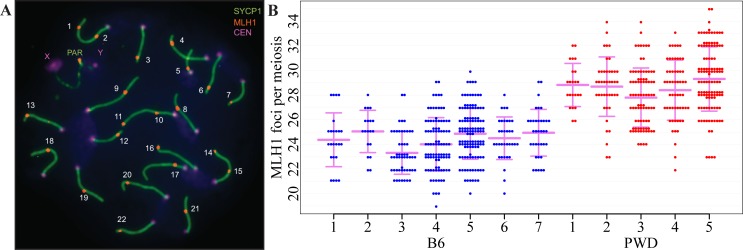
Fig 1
Fig 1. Variation in recombination rate of B6 and PWD male mice.
(A) Pachytene spread of a B6 male meiosis shows central elements of synaptonemal complexes of 19 autosomes immunostained for SYCP1 (green), 22 MLH1 foci (red) and foci of centromeric proteins (violet). The number of MLH1 foci per nucleus was used as an equivalent of number of crossovers. The pseudoautosomal region (PAR) of Chr X and Chr Y carries an additional CO mark. (B) Variation of the number of MLH1 foci per pachytene nucleus of PWD and B6 males. The PAR-associated MLH1 foci were not counted. Each dot represents the MLH1 count of one pachytene spermatocyte. Vertical bars designate SD of individual males, horizontal bars represent the mean number of MLH1 foci per analyzed animal. Average MLH1 counts significantly differ between both strains.
Fig 2
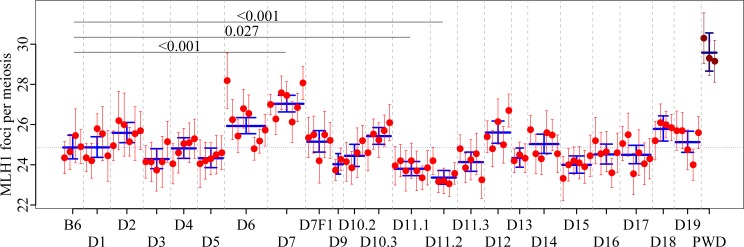
Fig 2. Meiotic recombination rate in consomic strains carrying PWD autosomes on B6 background.
Each dot with error bars represents the mean number ± SEM of MLH1 foci per pachytene nucleus of one analyzed male. D1—D19 refers to B6.PWD-Chr# consomic strains carrying Chr 1PWD—Chr 19PWD on B6 genetic background. The long blue bar with error bar represents the mean number of MLH1 foci and 95% CI per analyzed strain. The significance of the difference between B6 wildtype and a consomic strain is marked only when p<0.05.
Fig 3
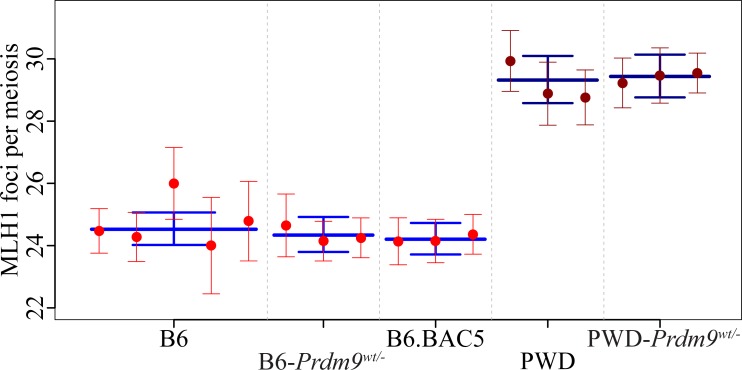
Fig 3. Meiotic recombination rate in males heterozygous for null mutation or carrying extra copies of Prdm9.
The mean number of MLH1 foci depends on the genetic background of B6 and PWD males but does not reflect differences in the Prdm9 copy number. See Fig 2 for legend.
Fig 4
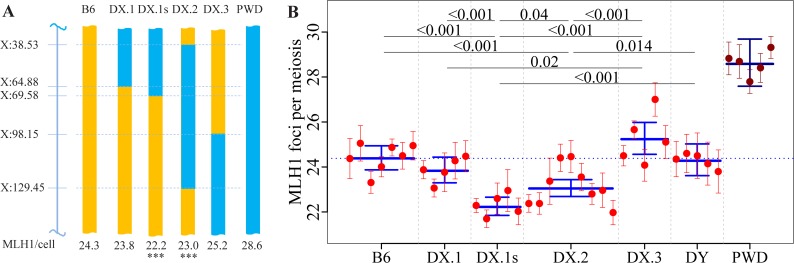
Fig 4. Fine mapping of meiotic recombination 1, Meir1, on Chr XPWD using subconsomic strains.
(A) The 4.7 Mb interval of the proximal part of Chr X shared by B6.PWD-Chr X.1s and B6.PWD-Chr X.2, but absent in B6.PWD-Chr X.1 and B6.PWD-Chr X.3, harbors a transgressive modifier of meiotic recombination rate Meir1. The Y axis shows the distance from the centromere in megabases (GRCm38). Chromosome intervals carrying the B6 DNA sequence are depicted in orange, the PWD sequence in blue. (B) The B6.PWD-Chr X.# subconsomics are abbreviated DX.# in column scatters. The significance of differences between strains (excluding PWD) is marked only when p<0.05. See Fig 2 for legend.
Fig 5
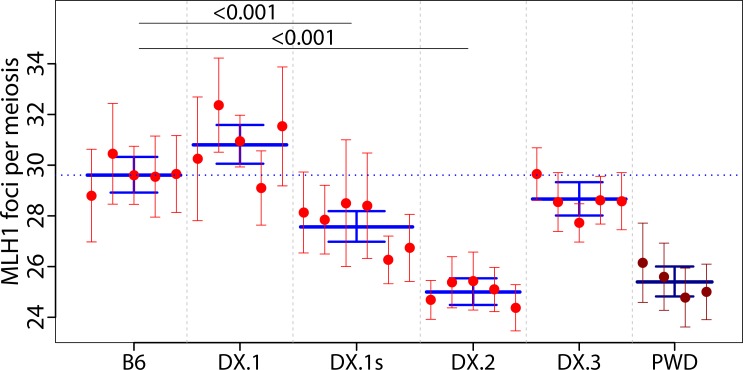
Fig 5. Mean MLH1 counts in female meiosis of Chr X subconsomic strains.
The PWD genomic sequence present in B6.PWD-Chr X.2 carries the strongest female-specific modifier of meiotic recombination rate. For strain abbreviations see Fig 4. For detailed analysis of differences between individual subconsomics, see S7 Table. See Fig 2 for legend.
Fig 6
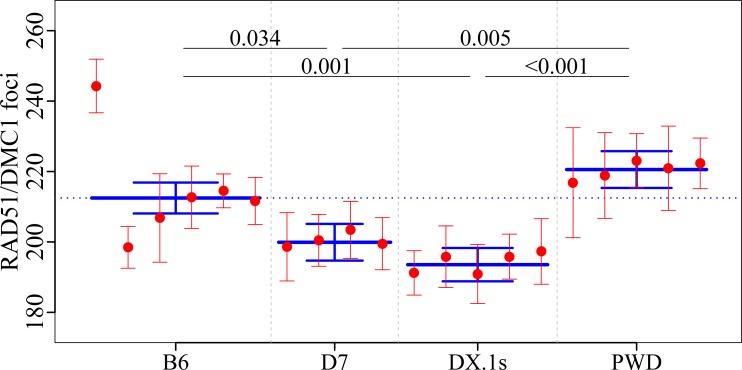
Fig 6. Mean RAD51/DMC1 counts in males with distinct meiotic recombination rates.
The average frequency of DSBs in B6.PWD-Chr 7 and B6.PWD-Chr X.1 is lower than in both parental strains. For detailed analysis of differences between individual subconsomics, see S9 and S10 Tables.

References

    1. Baker CL, Walker M, Kajita S, Petkov PM, Paigen K (2014) PRDM9 binding organizes hotspot nucleosomes and limits Holliday junction migration. Genome Res 24: 724–732. 10.1101/gr.170167.113 - DOI - PMC - PubMed
    1. Moens PB, Kolas NK, Tarsounas M, Marcon E, Cohen PE, et al. (2002) The time course and chromosomal localization of recombination-related proteins at meiosis in the mouse are compatible with models that can resolve the early DNA-DNA interactions without reciprocal recombination. J Cell Sci 115: 1611–1622. - PubMed
    1. Baier B, Hunt P, Broman KW, Hassold T (2014) Variation in genome-wide levels of meiotic recombination is established at the onset of prophase in mammalian males. PLoS Genet 10: e1004125 10.1371/journal.pgen.1004125 - DOI - PMC - PubMed
    1. Bellani MA, Boateng KA, McLeod D, Camerini-Otero RD (2010) The expression profile of the major mouse SPO11 isoforms indicates that SPO11beta introduces double strand breaks and suggests that SPO11alpha has an additional role in prophase in both spermatocytes and oocytes. Mol Cell Biol 30: 4391–4403. 10.1128/MCB.00002-10 - DOI - PMC - PubMed
    1. Boateng KA, Bellani MA, Gregoretti IV, Pratto F, Camerini-Otero RD (2013) Homologous pairing preceding SPO11-mediated double-strand breaks in mice. Dev Cell 24: 196–205. 10.1016/j.devcel.2012.12.002 - DOI - PMC - PubMed

Publication types

Substances