


Serum Uric Acid and Its Association with Longitudinal Cognitive Change Among Urban Adults
- PMID: 27104899
- PMCID: PMC4902772
- DOI: 10.3233/JAD-160028
Serum Uric Acid and Its Association with Longitudinal Cognitive Change Among Urban Adults
Abstract
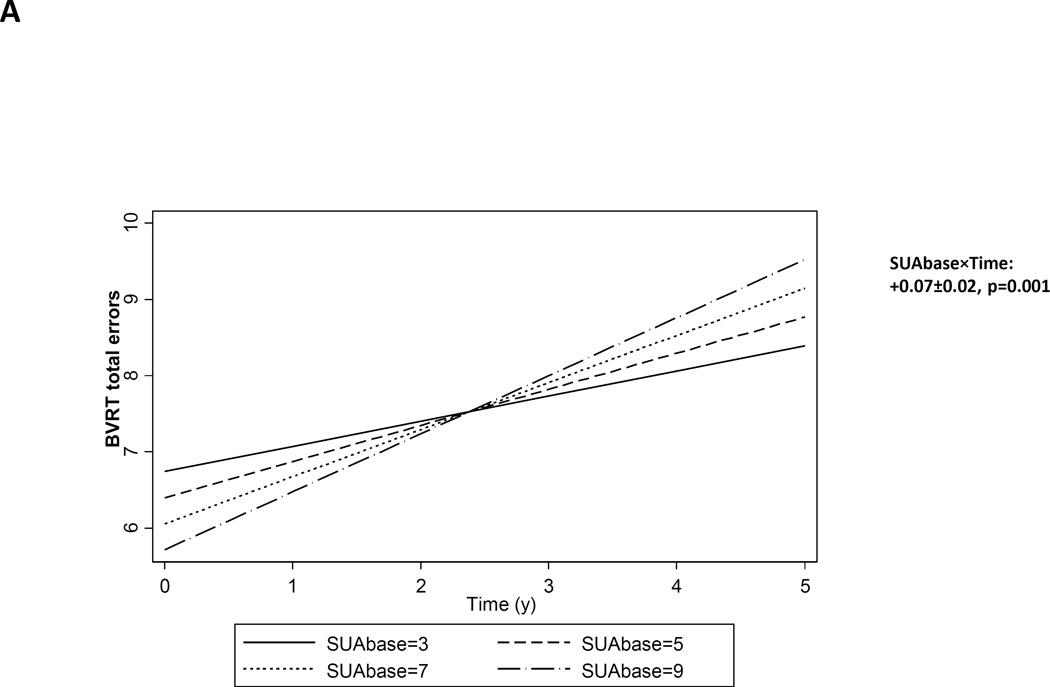
Uric acid, a waste metabolite among humans, was linked to various cognitive outcomes. We describe sex and age-group specific associations of baseline serum uric acid (SUAbase) and significant change in SUA (ΔSUA: 1 versus 0 = decrease versus no change; 2 versus 0 = increase versus no change) with longitudinal annual rate of cognitive change among a large sample of urban adults. Data from the Healthy Aging in Neighborhoods of Diversity across the Life Span study, 2004-2009 (visit 1) and 2009-2013 (visit 2) were used. Of 3,720 adults selected at baseline (age range: 30-64 y), complete data were available for N = 1,487-1,602 with a mean repeat of 1.5-1.7 visits/participant. Cognitive test domains spanned attention, processing speed, learning/memory, executive function, visuo-spatial/visuo-construction ability, language/verbal, and global cognitive function. SUA was measured at both visits. Multiple mixed-effects regression analyses were conducted. In the total population, a higher SUAbase was associated with a faster annual rate of decline on a measure of visual memory/visuo-construction ability (the Benton Visual Retention Test) by γ= 0.07 with a standard error of 0.02, p < 0.001. Among older men, a significant increase in SUA was associated with slower decline on a test of attention/processing speed, namely Trailmaking test, Part A, measured in seconds to completion (γ= -6.91 ± 1.73, p < 0.001). In sum, a higher SUAbase was associated with faster cognitive decline over-time in a visual memory/visuo-construction ability test. ΔSUA had particular beneficial effects of an increasing ΔSUA on the domain of attention/processing speed among older men. More longitudinal studies are needed to examine cognitive domain-specific effects of over-time change in SUA within sex and age groups.
Keywords: Aging; cognition; serum uric acid; sex differences.
Figures


References
-
- Johnson RJ, Kang DH, Feig D, Kivlighn S, Kanellis J, Watanabe S, Tuttle KR, Rodriguez-Iturbe B, Herrera-Acosta J, Mazzali M. Is there a pathogenetic role for uric acid in hypertension and cardiovascular and renal disease? Hypertension. 2003;41:1183–1190. - PubMed
-
- Mene P, Punzo G. Uric acid: bystander or culprit in hypertension and progressive renal disease? J Hypertens. 2008;26:2085–2092. - PubMed
-
- Guasch-Ferre M, Bullo M, Babio N, Martinez-Gonzalez MA, Estruch R, Covas MI, Warnberg J, Aros F, Lapetra J, Serra-Majem L, Basora J, Salas-Salvado J. Mediterranean diet and risk of hyperuricemia in elderly participants at high cardiovascular risk. J Gerontol A Biol Sci Med Sci. 2013;68:1263–1270. - PubMed
Publication types
MeSH terms
Substances
Grants and funding
LinkOut - more resources
Full Text Sources
Other Literature Sources
Medical
