


Genome instability in Alzheimer disease
- PMID: 27105872
- PMCID: PMC5195918
- DOI: 10.1016/j.mad.2016.04.005
Genome instability in Alzheimer disease
Abstract
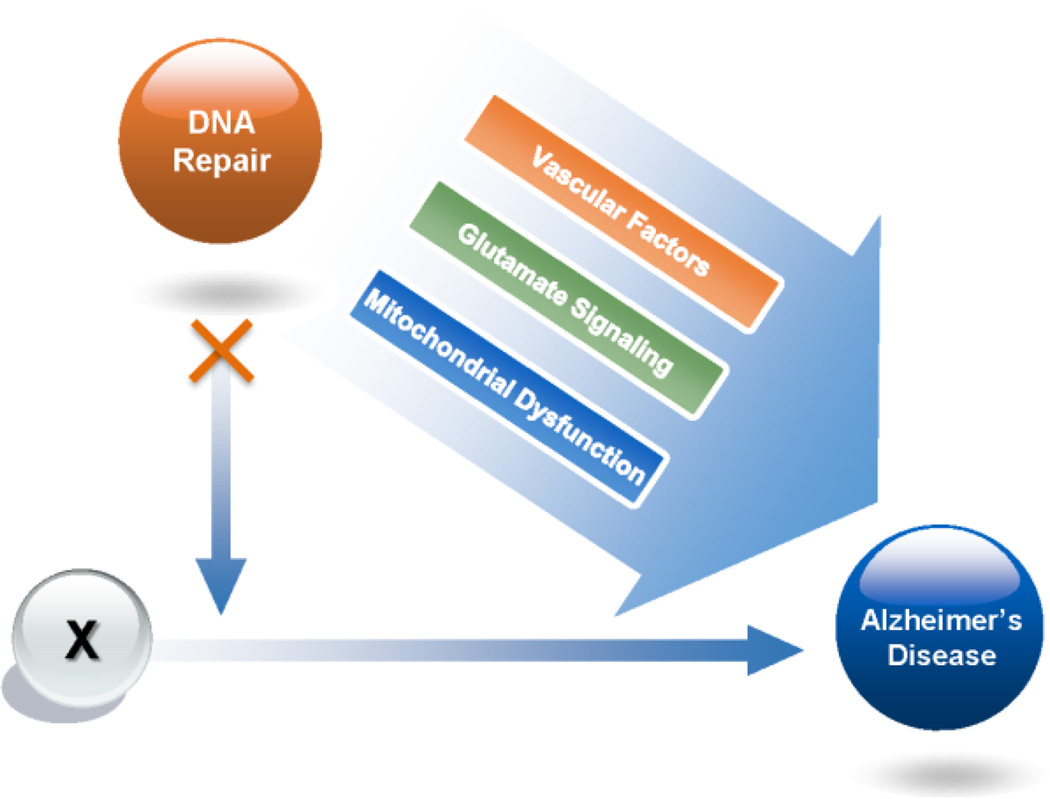
Alzheimer's disease (AD) is a progressive neurodegenerative disorder and the most common form of dementia. Autosomal dominant, familial AD (fAD) is very rare and caused by mutations in amyloid precursor protein (APP), presenilin-1 (PSEN-1), and presenilin-2 (PSEN-2) genes. The pathogenesis of sporadic AD (sAD) is more complex and variants of several genes are associated with an increased lifetime risk of AD. Nuclear and mitochondrial DNA integrity is pivotal during neuronal development, maintenance and function. DNA damage and alterations in cellular DNA repair capacity have been implicated in the aging process and in age-associated neurodegenerative diseases, including AD. These findings are supported by research using animal models of AD and in DNA repair deficient animal models. In recent years, novel mechanisms linking DNA damage to neuronal dysfunction have been identified and have led to the development of noninvasive treatment strategies. Further investigations into the molecular mechanisms connecting DNA damage to AD pathology may help to develop novel treatment strategies for this debilitating disease. Here we provide an overview of the role of genome instability and DNA repair deficiency in AD pathology and discuss research strategies that include genome instability as a component.
Keywords: Alzheimer’s disease; DNA damage; DNA repair.
Published by Elsevier B.V.
Figures

References
-
- Adamec E, Vonsattel JP, Nixon RA. DNA strand breaks in Alzheimer’s disease. Brain research. 1999;849:67–77. - PubMed
-
- Alzheimer’s A. 2015 Alzheimer’s disease facts and figures. Alzheimer’s & dementia : the journal of the Alzheimer’s Association. 2015;11:332–384. - PubMed
-
- Avvakumov N, Nourani A, Cote J. Histone chaperones: modulators of chromatin marks. Molecular cell. 2011;41:502–514. - PubMed
-
- Biton S, Barzilai A, Shiloh Y. The neurological phenotype of ataxia-telangiectasia: solving a persistent puzzle. DNA repair. 2008;7:1028–1038. - PubMed
-
- Borgesius NZ, de Waard MC, van der Pluijm I, Omrani A, Zondag GC, van der Horst GT, Melton DW, Hoeijmakers JH, Jaarsma D, Elgersma Y. Accelerated age-related cognitive decline and neurodegeneration, caused by deficient DNA repair. The Journal of neuroscience : the official journal of the Society for Neuroscience. 2011;31:12543–12553. - PMC - PubMed
Publication types
MeSH terms
Substances
Grants and funding
LinkOut - more resources
Full Text Sources
Other Literature Sources
Medical
