


Immunobiology and immunosurveillance in patients with intraductal papillary mucinous neoplasms (IPMNs), premalignant precursors of pancreatic adenocarcinomas
- PMID: 27106024
- PMCID: PMC11028509
- DOI: 10.1007/s00262-016-1838-1
Immunobiology and immunosurveillance in patients with intraductal papillary mucinous neoplasms (IPMNs), premalignant precursors of pancreatic adenocarcinomas
Abstract
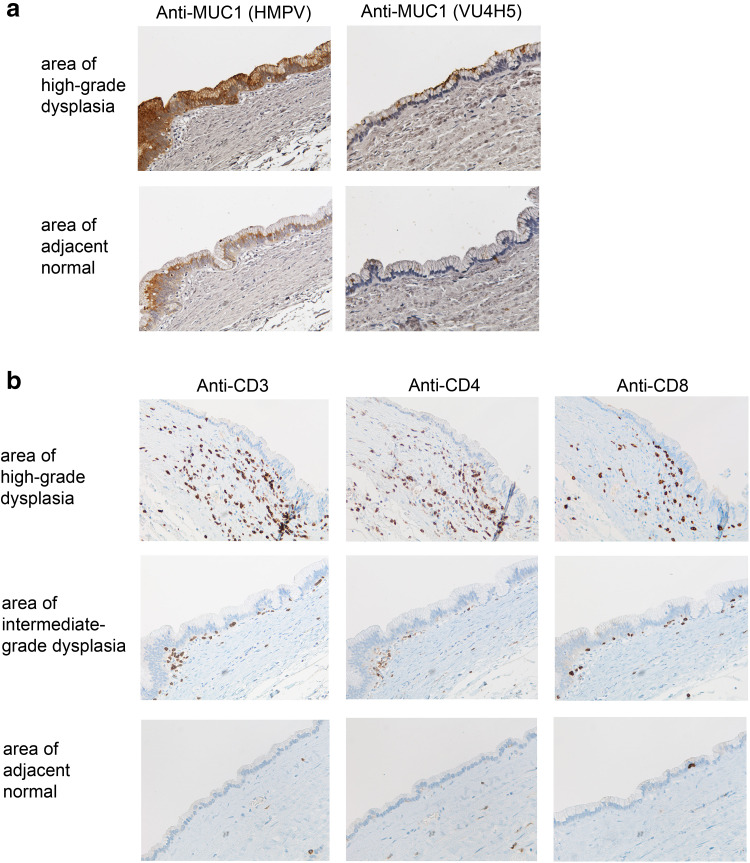
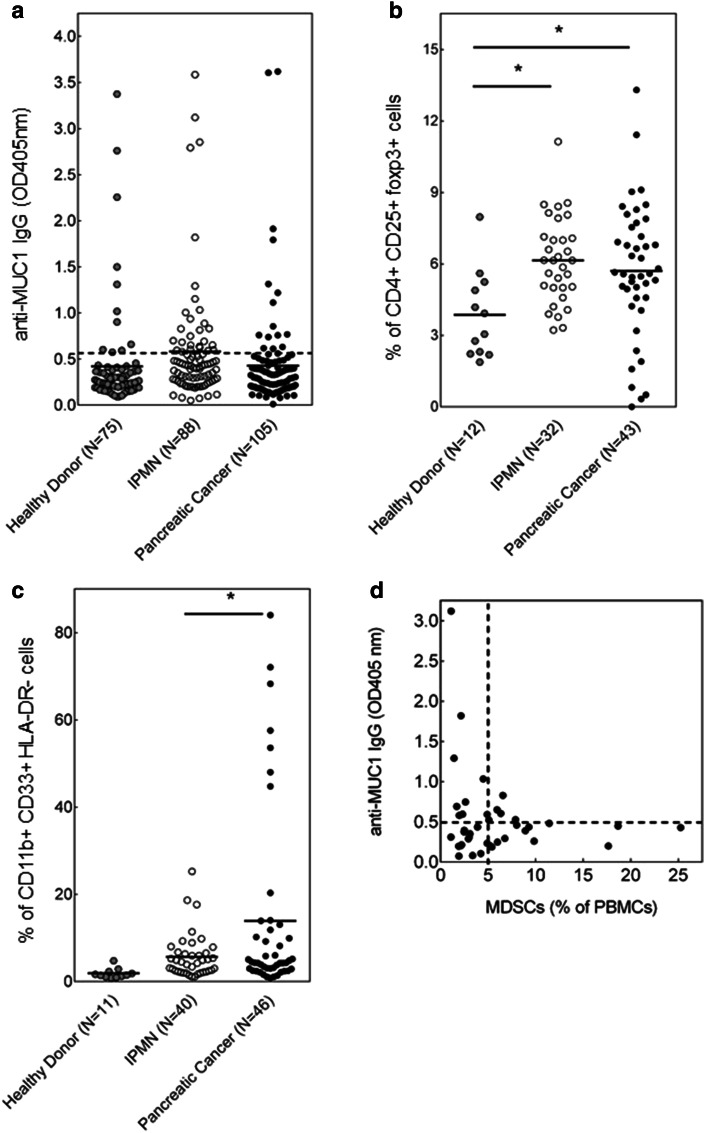
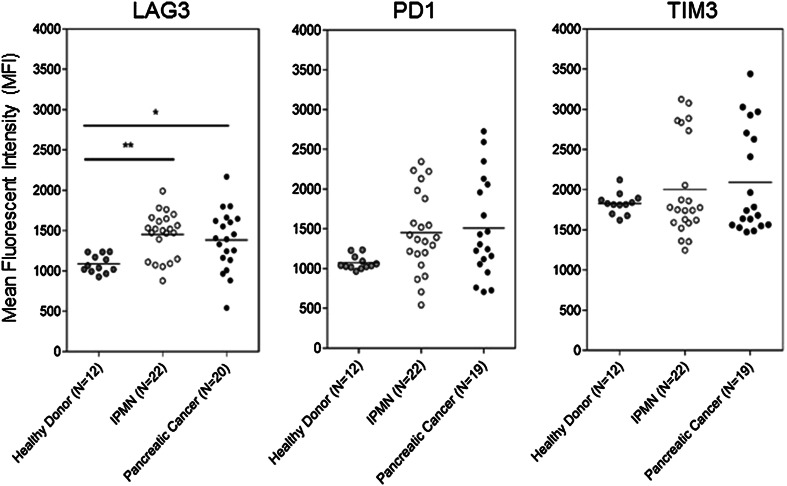
Premalignant lesions for many cancers have been identified, and efforts are currently directed toward identification of antigens expressed on these lesions that would provide suitable targets for vaccines for cancer prevention. Intraductal papillary mucinous neoplasms (IPMNs) are premalignant pancreatic cysts of which a subset has the potential to progress to cancer. Currently, there are no validated predictive markers for progression to malignancy. We hypothesized that the presence or absence of immune surveillance of these lesions would be one such factor. Here we show that the tumor antigen MUC1, which is abnormally expressed on pancreatic cancer and is a target for cancer immunosurveillance, is also abnormally expressed on premalignant IPMN. We show that some IPMN patients make MUC1-specific IgG. Moreover, we show evidence of CD4 and CD8 T cell infiltration into IPMN areas of high dysplasia suggesting an ongoing immune response within the lesions. We also found, however, increased levels of circulating myeloid-derived suppressor cells (MDSCs) and regulatory T cells (Tregs) in some IPMN patients as well as evidence of T cell exhaustion. Further studies correlating immunosurveillance or immunosuppression with IPMN progression to malignancy will help define the immune response as a biomarker of risk, leading potentially to a vaccine to boost spontaneous immunity and prevent progression to cancer.
Keywords: CITIM 2015; Cancer vaccines; IPMN; Immunosurveillance; MUC1; Pancreatic cancer.
Conflict of interest statement
None of the authors has conflict of interest to declare.
Figures
References
-
- Brahmer JR, Tykodi SS, Chow LQ, Hwu WJ, Topalian SL, Hwu P, Drake CG, Camacho LH, Kauh J, Odunsi K, Pitot HC, Hamid O, Bhatia S, Martins R, Eaton K, Chen S, Salay TM, Alaparthy S, Grosso JF, Korman AJ, Parker SM, Agrawal S, Goldberg SM, Pardoll DM, Gupta A, Wigginton JM. Safety and activity of anti-PD-L1 antibody in patients with advanced cancer. N Engl J Med. 2012;366(26):2455–2465. doi: 10.1056/NEJMoa1200694. - DOI - PMC - PubMed
-
- Topalian SL, Hodi FS, Brahmer JR, Gettinger SN, Smith DC, McDermott DF, Powderly JD, Carvajal RD, Sosman JA, Atkins MB, Leming PD, Spigel DR, Antonia SJ, Horn L, Drake CG, Pardoll DM, Chen L, Sharfman WH, Anders RA, Taube JM, McMiller TL, Xu H, Korman AJ, Jure-Kunkel M, Agrawal S, McDonald D, Kollia GD, Gupta A, Wigginton JM, Sznol M. Safety, activity, and immune correlates of anti-PD-1 antibody in cancer. N Engl J Med. 2012;366(26):2443–2454. doi: 10.1056/NEJMoa1200690. - DOI - PMC - PubMed
-
- Ledford H. Immunotherapy’s cancer remit widens. Nature. 2013;497(7451):544. - PubMed
Publication types
MeSH terms
Substances
Grants and funding
LinkOut - more resources
Full Text Sources
Other Literature Sources
Medical
Research Materials
Miscellaneous
